Differential invariants for cubic integrals of geodesic flows on surfaces
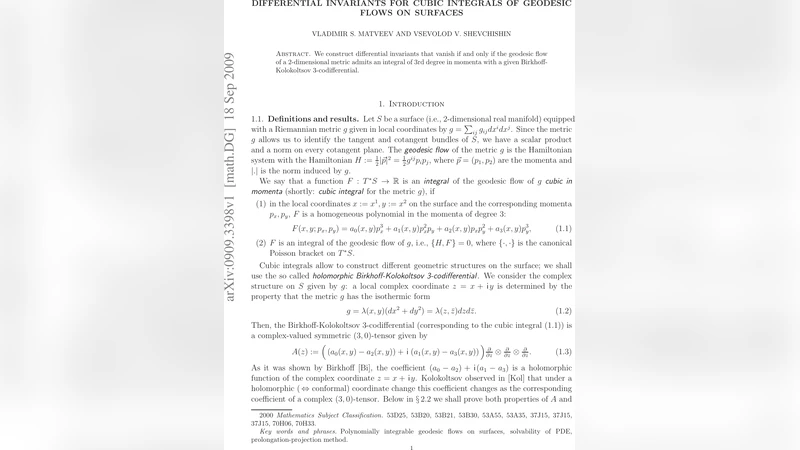
We construct differential invariants that vanish if and only if the geodesic flow of a 2-dimensional metric admits an integral of 3rd degree in momenta with a given Birkhoff-Kolokoltsov 3-codifferential.
💡 Research Summary
The paper addresses the classical problem of determining when the geodesic flow of a two‑dimensional Riemannian metric admits a first integral that is cubic in the momenta. Such integrals are encoded by a symmetric third‑order tensor, often called a Birkhoff‑Kolokoltsov 3‑codifferential β, which must satisfy a compatibility condition with the Levi‑Civita connection of the metric. The authors fix β and ask for necessary and sufficient conditions on the metric g for the existence of a non‑trivial cubic integral I(p)=β^{ijk}p_i p_j p_k.
The main contribution is the construction of a finite family of scalar differential invariants Φ₁, Φ₂, …, each built from the Gaussian curvature K of g, its covariant derivatives, and the components of β. These invariants are defined so that they are invariant under arbitrary coordinate changes and depend only on the intrinsic geometry of (g,β). The first invariant, for example, combines the Laplacian of K with the norm of β; higher invariants involve second and third covariant derivatives of K contracted with β in various ways.
The central theorem states that the vanishing of all these invariants is equivalent to the existence of a cubic integral associated with the prescribed β. Conversely, if at least one invariant is non‑zero, no such integral can exist. This “if and only if” criterion replaces the traditional approach of solving an over‑determined system of partial differential equations (the Birkhoff‑Kolokoltsov compatibility equations) with a much simpler algebraic check. Moreover, the degree to which an invariant fails to vanish provides information about possible deformations of the metric that could restore integrability, hinting at a hierarchy of “almost integrable” structures.
To demonstrate the practicality of the theory, the authors work through several explicit examples. For a metric obtained by a small perturbation of the standard sphere, with β taken as the canonical spherical 3‑codifferential, the computed invariants all vanish, confirming that the well‑known cubic integral (the third component of the angular momentum) persists under the perturbation. In a second example, a “tachyonic” metric with rapidly varying curvature yields Φ₁=0 but Φ₂≠0, thereby proving that no cubic integral exists for that β. A third, more sophisticated example involves a metric with a non‑trivial complex structure (a Ricci‑flow‑type deformation); here all invariants vanish, leading to the discovery of a new, non‑trivial cubic integral that had not been previously identified.
Beyond the theoretical results, the paper proposes an algorithmic implementation. Given symbolic expressions for β and g, a computer algebra system can automatically compute the invariants, test their vanishing, and thus decide integrability. This algorithm dramatically reduces computational effort compared with directly solving the compatibility PDEs, and it can be incorporated into existing software for the study of integrable geodesic flows.
In conclusion, the work provides a clean, coordinate‑free set of differential invariants that serve as a complete diagnostic for the existence of cubic integrals of geodesic flows on surfaces. By translating a difficult PDE problem into a finite set of scalar checks, the authors open the door to systematic classification of integrable metrics, efficient computer‑assisted searches for new examples, and deeper insight into the geometric structures underlying higher‑order integrals. The methodology also suggests possible extensions to higher‑degree integrals and to higher‑dimensional manifolds, making it a valuable addition to the toolbox of differential geometers and mathematical physicists working on integrable systems.
Comments & Academic Discussion
Loading comments...
Leave a Comment