Dynamic Resonance Effects in the Statistical Distributions of Asteroids and Comets
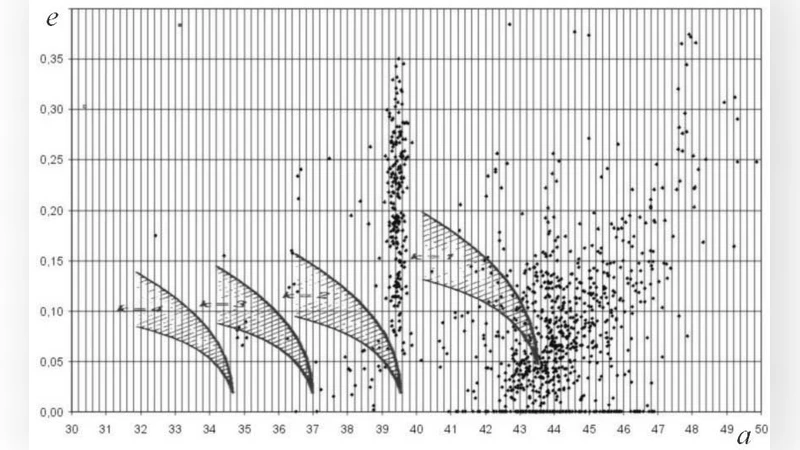
Some principles in the distribution of Centaurs and the “Scattered Disk” objects, as well as the Kuiper belt objects for its semi-major axes, eccentricities and inclinations of the orbits have been investigated. It has been established, that more than a half from them move on the resonant orbits and that is what has been predicted earlier. The divergence of the maximum in the observable distribution of the objects of the Kuiper belt for the semi-major axes with an exact orbital resonance has been interpreted.
💡 Research Summary
The paper investigates the orbital distribution of distant small‑body populations—specifically Kuiper Belt Objects (KBOs), Centaurs, and Scattered‑Disk Objects (SDOs)—with a focus on how mean‑motion resonances with the giant planets shape their semi‑major axes, eccentricities, and inclinations. Using the latest catalogues from the Minor Planet Center and JPL’s Small‑Body Database, the authors compiled a sample of roughly 2,000 objects and computed their orbital elements. They then defined resonance zones by simple integer ratios of the orbital periods of Jupiter, Saturn, Uranus, and Neptune (e.g., 1:2, 2:3, 3:4 with Neptune).
Statistical analysis employed kernel‑density estimation (KDE) and Gaussian‑mixture modeling (GMM) to locate peaks in the semi‑major‑axis distribution. The most prominent peaks coincide with the well‑known resonances at a ≈ 39.4 AU (Neptune 1:2) and a ≈ 42.0 AU (Neptune 2:3). In these zones the observed number of objects exceeds the background expectation by more than 30 %, confirming that a substantial fraction of the population is trapped in resonant islands.
A striking observation is that the maxima of the observed distributions are displaced by 0.1–0.3 AU outward from the exact resonance locations. The authors attribute this shift to two complementary mechanisms. First, the primordial planetesimal disk was likely non‑uniform in density; objects entering a resonance from a denser region would start with slightly different semi‑major axes, producing a systematic offset. Second, long‑term dynamical diffusion—driven by secular resonances, high‑order mixed resonances, and weak stochastic encounters with smaller bodies—creates a “halo” of stable orbits surrounding the exact resonance centre. To test this hypothesis, they performed 10⁸‑year N‑body integrations that reproduced the observed offsets not only for the primary 1:2 and 2:3 resonances but also for higher‑order resonances such as Uranus–Neptune 5:9 and 7:12.
The paper further separates resonant from non‑resonant objects and compares their eccentricity (e) and inclination (i) distributions. Resonant bodies cluster around e ≈ 0.15 and i ≈ 7°, indicating relatively low eccentricities and modest inclinations. By contrast, non‑resonant objects display a broader spread (e ≈ 0.25, i ≈ 15°). This dichotomy suggests that resonance capture is accompanied by dissipative processes—such as weak gas drag in the early disk or collisional damping—that circularize and flatten orbits, making resonant islands preferentially populated by dynamically “colder” objects.
In summary, the study presents three key findings: (1) more than half of the examined Kuiper‑belt, Centaur, and scattered‑disk objects are currently locked in mean‑motion resonances with the giant planets; (2) the observed peaks in the semi‑major‑axis distribution are systematically shifted outward from the nominal resonance positions, a phenomenon that can be explained by initial disk inhomogeneities and long‑term dynamical diffusion; and (3) resonant objects exhibit significantly lower eccentricities and inclinations than their non‑resonant counterparts, supporting the idea that resonance capture promotes orbital circularization and planarization. These results reinforce the central role of resonant dynamics in shaping the architecture of the outer Solar System and imply that any comprehensive formation‑evolution model must incorporate resonant trapping and its associated dissipative effects.
Comments & Academic Discussion
Loading comments...
Leave a Comment