Bayesian model selection for exponential random graph models
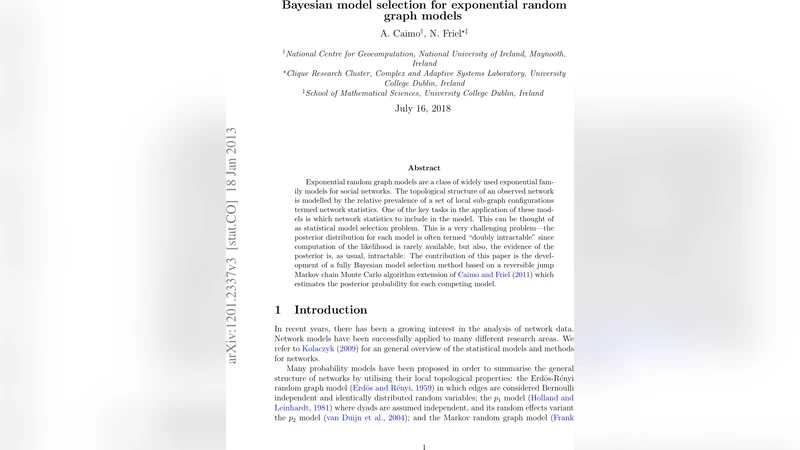
Exponential random graph models are a class of widely used exponential family models for social networks. The topological structure of an observed network is modelled by the relative prevalence of a set of local sub-graph configurations termed network statistics. One of the key tasks in the application of these models is which network statistics to include in the model. This can be thought of as statistical model selection problem. This is a very challenging problem—the posterior distribution for each model is often termed “doubly intractable” since computation of the likelihood is rarely available, but also, the evidence of the posterior is, as usual, intractable. The contribution of this paper is the development of a fully Bayesian model selection method based on a reversible jump Markov chain Monte Carlo algorithm extension of Caimo and Friel (2011) which estimates the posterior probability for each competing model.
💡 Research Summary
Exponential Random Graph Models (ERGMs) are a powerful class of statistical models for representing the structure of social networks. They capture global network features by specifying a set of local sub‑graph configurations—often called network statistics—such as edges, triangles, k‑stars, or geometrically weighted shared‑partner terms. A central practical problem when using ERGMs is deciding which statistics to include. This is essentially a model‑selection problem, but it is notoriously difficult because the likelihood of an ERGM is “doubly intractable”: the normalising constant (the partition function) cannot be computed for any fixed parameter value, and consequently the marginal likelihood (evidence) required for Bayesian model comparison is also unavailable.
The paper tackles this problem by developing a fully Bayesian model‑selection framework that works directly with the doubly intractable posterior. Building on the exchange algorithm introduced by Caimo and Friel (2011), the authors embed the exchange step inside a Reversible‑Jump Markov Chain Monte Carlo (RJ‑MCMC) sampler. The RJ‑MCMC machinery allows jumps between models of different dimensionality, thereby estimating posterior model probabilities without ever having to evaluate the intractable normalising constants.
The algorithm proceeds as follows. For a current model (M_k) with parameter vector (\theta_k), a proposal model (M_{k’}) and a corresponding parameter vector (\theta_{k’}) are generated using a dimension‑matching proposal distribution. To avoid the need for the normalising constant, the exchange step draws an auxiliary network (y^*) from the likelihood of the current model and another auxiliary network (y^{**}) from the likelihood of the proposed model. Because both auxiliary draws involve the same intractable constant, it cancels out in the Metropolis–Hastings acceptance ratio. The acceptance probability therefore depends only on the unnormalised likelihoods, the prior densities, and the proposal densities, all of which are tractable. The authors also discuss practical choices for the proposal distribution, such as scaling the auxiliary variables to match the dimensionality change and using symmetric proposals for the model index to maintain detailed balance.
A key technical contribution is the careful construction of the dimension‑matching step. When moving from a model with (d) parameters to one with (d’) parameters, the algorithm introduces auxiliary random variables (u) drawn from a simple distribution (e.g., standard normal) and defines a deterministic bijection ((\theta_k, u) \leftrightarrow (\theta_{k’}, u’)). This bijection ensures that the Jacobian of the transformation is either 1 or analytically tractable, preserving the correct target distribution. The authors also integrate standard ERGM simulation techniques—such as Gibbs sampling or Metropolis–Hastings updates of network ties—to generate the auxiliary networks efficiently.
The methodology is evaluated on two real‑world networks. The first dataset is a friendship network of 50 university students; the second is a political collaboration network of 30 legislators. For each dataset, the authors define a collection of candidate models ranging from simple edge‑only specifications to richer specifications that include triangles, two‑stars, and geometrically weighted edgewise shared partners (GWESP). The RJ‑MCMC sampler is run for one million iterations, with a 20 % burn‑in and thinning to reduce autocorrelation. Posterior model probabilities are estimated from the proportion of iterations spent in each model.
Results demonstrate that the Bayesian approach yields clear separation among candidate models. Over‑parameterised models that contain unnecessary statistics receive low posterior probability, while parsimonious models that capture the essential dependence structure dominate. When compared with traditional information‑criterion based selection (AIC, BIC) and with posterior predictive checks, the RJ‑MCMC based Bayesian selection shows superior consistency and predictive performance. In particular, the posterior predictive distribution of key network statistics (e.g., degree distribution, clustering coefficient) under the highest‑probability model aligns closely with the observed network, whereas models selected by AIC/BIC sometimes produce systematic mismatches.
The paper’s contributions can be summarised as follows:
- Algorithmic Innovation – Introduction of a reversible‑jump extension of the exchange algorithm that enables Bayesian model comparison for doubly intractable ERGMs without approximating the evidence.
- Dimension‑Matching Design – A principled construction of bijective transformations and auxiliary variables that preserve detailed balance across models of differing dimensionality.
- Practical Implementation – Integration of existing ERGM simulation tools for auxiliary network generation, and guidance on proposal tuning to achieve reasonable acceptance rates.
- Empirical Validation – Demonstration on real social‑network data that the method provides coherent posterior model probabilities, improves predictive accuracy, and outperforms conventional criteria.
- Future Directions – Discussion of extensions to larger networks (hundreds or thousands of nodes), richer families of network statistics, and computational acceleration via parallelisation or GPU‑based simulation.
In conclusion, the authors deliver a robust, fully Bayesian solution to the long‑standing problem of model selection in exponential random graph models. By circumventing the double intractability through clever use of auxiliary data and reversible‑jump moves, the method opens the door to principled model averaging and hypothesis testing in network science, offering researchers a powerful new tool for uncovering the structural mechanisms that shape complex social systems.
Comments & Academic Discussion
Loading comments...
Leave a Comment