Index theory for locally compact noncommutative geometries
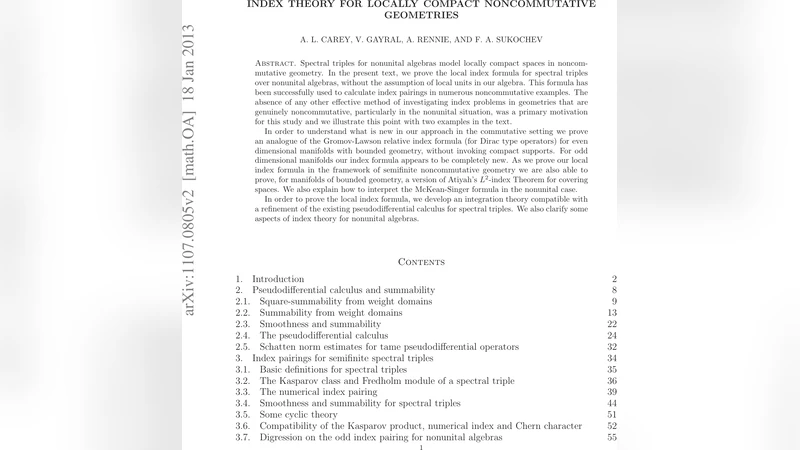
Spectral triples for nonunital algebras model locally compact spaces in noncommutative geometry. In the present text, we prove the local index formula for spectral triples over nonunital algebras, without the assumption of local units in our algebra. This formula has been successfully used to calculate index pairings in numerous noncommutative examples. The absence of any other effective method of investigating index problems in geometries that are genuinely noncommutative, particularly in the nonunital situation, was a primary motivation for this study and we illustrate this point with two examples in the text. In order to understand what is new in our approach in the commutative setting we prove an analogue of the Gromov-Lawson relative index formula (for Dirac type operators) for even dimensional manifolds with bounded geometry, without invoking compact supports. For odd dimensional manifolds our index formula appears to be completely new. As we prove our local index formula in the framework of semifinite noncommutative geometry we are also able to prove, for manifolds of bounded geometry, a version of Atiyah’s L^2-index Theorem for covering spaces. We also explain how to interpret the McKean-Singer formula in the nonunital case. In order to prove the local index formula, we develop an integration theory compatible with a refinement of the existing pseudodifferential calculus for spectral triples. We also clarify some aspects of index theory for nonunital algebras.
💡 Research Summary
The paper develops a comprehensive index theory for spectral triples over non‑unital C*-algebras, thereby extending the Connes‑Moscovici local index formula to genuinely non‑compact, non‑commutative geometries without the need for local units. The authors begin by constructing a refined integration theory based on weighted L¹ and L² spaces associated with the unbounded Dirac‑type operator D. This theory allows one to treat elements a of the algebra A as “integrable” whenever the product a(1 + D²)^{-½} is τ‑compact for a semifinite trace τ on a von Neumann algebra 𝔐 containing the representation of A. By avoiding any compact‑support or local‑unit assumptions, the integration framework works uniformly for both unital and non‑unital cases.
Next, the paper extends the pseudodifferential calculus of Connes and Moscovici to the non‑unital setting. The authors introduce a class of “tame” pseudodifferential operators and establish Schatten‑norm estimates that guarantee trace‑class properties for expressions of the form (1 + D²)^{-s/2}a when s>0 is sufficiently large. These estimates are crucial for defining the residue cocycles that appear later.
Section 3 reformulates the K‑homology class of a spectral triple (A, H, D) in terms of a semifinite Kasparov module. Even when D is not Fredholm, the compactness of a(1 + D²)^{-½} ensures that (A, H, D) determines a well‑defined Kasparov product with K‑theory classes of A. The authors spell out the necessary smoothness and summability conditions, showing that they are precisely those required for the integration theory of Section 2.
The core of the work is in Section 4, where a family of co‑chains—resolvent, double, and auxiliary chains—is constructed. By a “double” construction the authors remove the need for D to be invertible, and they prove that the resulting residue cocycle lies in the same (b,B)‑cohomology class as the Chern character of the Kasparov module. The main theorem (Theorem 4.33) then states that for any unitary u∈M_n(A) the index pairing is given by a residue formula: \
Comments & Academic Discussion
Loading comments...
Leave a Comment