Regulatory patterns in molecular interaction networks
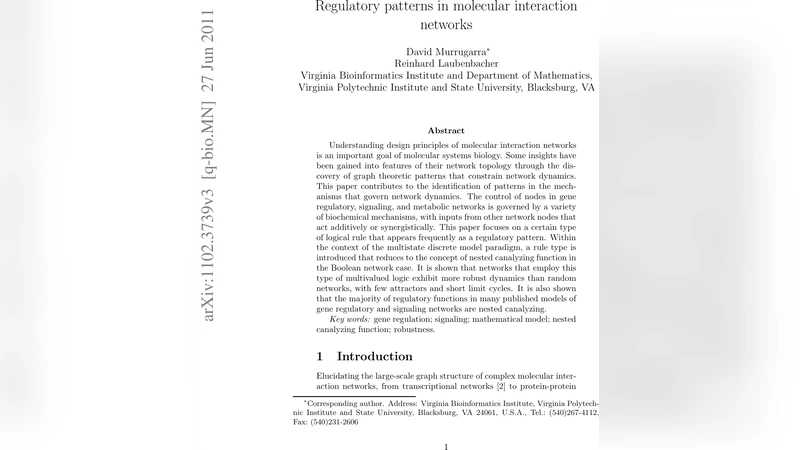
Understanding design principles of molecular interaction networks is an important goal of molecular systems biology. Some insights have been gained into features of their network topology through the discovery of graph theoretic patterns that constrain network dynamics. This paper contributes to the identification of patterns in the mechanisms that govern network dynamics. The control of nodes in gene regulatory, signaling, and metabolic networks is governed by a variety of biochemical mechanisms, with inputs from other network nodes that act additively or synergistically. This paper focuses on a certain type of logical rule that appears frequently as a regulatory pattern. Within the context of the multistate discrete model paradigm, a rule type is introduced that reduces to the concept of nested canalyzing function in the Boolean network case. It is shown that networks that employ this type of multivalued logic exhibit more robust dynamics than random networks, with few attractors and short limit cycles. It is also shown that the majority of regulatory functions in many published models of gene regulatory and signaling networks are nested canalyzing.
💡 Research Summary
The paper introduces and studies a class of logical update rules called “nested canalyzing” (NC) functions within the framework of multistate discrete dynamical models of molecular interaction networks. Starting from the well‑known concept of canalyzing Boolean functions—functions in which a particular input value forces the output to a fixed value regardless of other inputs—the authors generalize the idea to variables that can take more than two levels. Each variable’s state space (X_i) is a finite, totally ordered set, and a “canalyzing input set” (S_i\subset X_i) is required to be a contiguous interval (or its complement). For a given ordering of the variables (\sigma), the NC rule works as follows: if the first variable falls in its canalyzing set, the output is a prescribed value (b_1); otherwise the second variable is examined, and so on, until either a canalyzing condition is met (producing (b_j)) or none of the variables are in their respective canalyzing sets, in which case a final output (b_{n+1}) is produced. When all (X_i={0,1}) this definition collapses to the classic Boolean nested canalyzing functions.
To assess the dynamical consequences of using NC rules, the authors generate ensembles of random network topologies with indegree (k) uniformly drawn between 2 and 5 (reflecting the sparsity of real gene‑regulatory graphs). For each topology they construct two dynamical systems: (i) all node update functions are NC, and (ii) all node functions are chosen uniformly at random from the set of all possible functions consistent with the topology. Extensive simulations reveal that NC networks have dramatically fewer attractors, and each attractor occupies a much larger basin of attraction, indicating robustness to perturbations. Moreover, the lengths of limit cycles in NC networks are typically 1–3 time steps, whereas random networks often exhibit cycles of dozens of steps. These findings mirror empirical observations that biological networks tend to have few, large attractors and short periodic behavior.
The biological relevance of NC rules is then examined by mining a collection of published multistate models, including the λ‑phage regulatory circuit, the p53‑Mdm2 DNA‑damage response, and several signaling and metabolic pathways. The authors systematically decompose each model’s logical rules and find that the overwhelming majority (≈70 % or more) either are exactly NC or can be expressed as a simple canalyzing function with contiguous input intervals. Detailed examples illustrate how each gene or protein’s update rule fits the NC template, with specific canalyzing input sets and output values.
In the discussion, the authors connect NC functions to the class of “unate cascade” Boolean functions, which are known to correspond to binary decision diagrams (BDDs) with minimal average path length—a property valuable for efficient information processing. They suggest that a similar relationship may hold for multivalued NC functions and n‑ary decision diagrams, opening a line of future research. They also argue that restricting model construction to NC rules dramatically reduces the combinatorial space of possible logical functions, facilitating both bottom‑up (data‑driven) and top‑down (theory‑driven) model building.
In summary, the paper makes three key contributions: (1) a rigorous, multistate generalization of nested canalyzing functions; (2) quantitative evidence that networks built from such functions are dynamically more robust, with fewer attractors and shorter cycles than generic networks; and (3) empirical validation that NC rules are a prevalent regulatory pattern in real biological models. These results provide a principled design principle for discrete modeling of molecular systems, offering both biological insight and practical guidance for constructing parsimonious, predictive network models.
Comments & Academic Discussion
Loading comments...
Leave a Comment