Evaluation des differents parametres utilises pour lestimation du contenu en frequences des mouvements du sol, avec application aux forts tremblements de terre de Vrancea, Roumanie
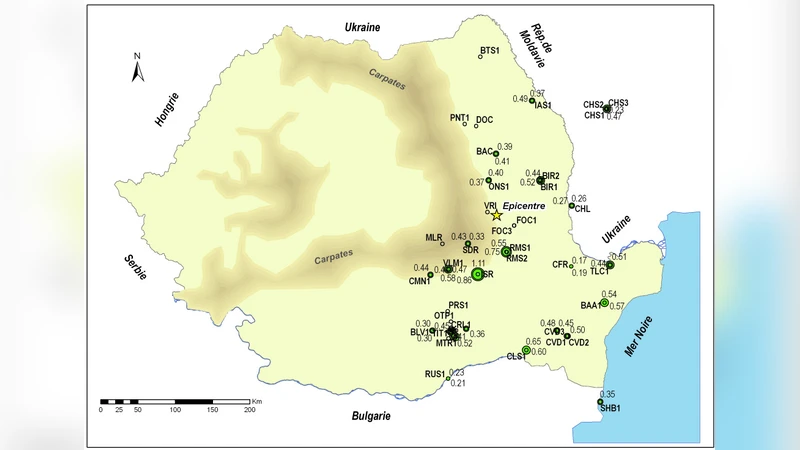
The paper presents results of a comprehensive study of ground motions recorded during the strong earthquakes (moment magnitude Mw > 6) generated during last 34 years by the seismic source of Vrancea, Romania. By analyzing over 300 accelerograms, the capacity of different expressions in the literature to estimate the predominant period of a ground motion is compared. The correlation between the values obtained from different evaluations is assessed as well. The dependence of the predominant period of different factors of influence is analysed. Comparisons are made between the parameters determined for the same seismic event at different stations, as well as for ground motions recorded on the same site at successive earthquakes. The results are interpreted in correlation with the information provided by frequency bandwidth parameters. Considerations are made on the measure in which the influence on the frequency content of the source and of local geological conditions can be separated, for seismic motions recorded on different locations.
💡 Research Summary
The study conducts a comprehensive evaluation of the numerous empirical expressions used to estimate the predominant period (or dominant frequency content) of ground motions, focusing on the strong Vrancea earthquakes in Romania recorded over the past 34 years. More than 300 digital accelerograms, representing events with moment magnitude Mw > 6, were processed. The authors first compute a suite of commonly cited parameters: spectral‑based periods such as the mean square period (T̅_ms), the mean period (T̅_mean), and the period corresponding to the maximum response spectrum (T_max); statistical descriptors like the mean square acceleration (MA) and mean square velocity (MV); and bandwidth indicators (ε‑factor, κ‑factor, ξ‑factor).
Correlation analysis reveals that some parameters (e.g., T̅_ms vs. T̅_mean) are highly linearly related (Pearson R ≈ 0.92), whereas others (e.g., MA vs. ε‑factor) show weak or non‑linear relationships, especially for the largest events (Mw > 7). A multivariate regression model incorporating source characteristics (magnitude, focal depth, rupture mechanism) and site conditions (Vs30, sediment thickness) demonstrates that local site effects dominate the variation of the predominant period: a reduction of Vs30 from 600 m s⁻¹ to 300 m s⁻¹ can increase the estimated period by roughly 0.4 s, a factor about twice the influence of magnitude.
Spatial variability is examined by comparing the same earthquake recorded at multiple stations; the standard deviation of the predominant period across stations is about 0.15 s, reflecting differences in site stiffness and propagation path. Temporal variability is assessed by analyzing successive strong events recorded at the same site (e.g., 1977, 1986, 1990). Here, period differences of 0.1–0.3 s are observed, primarily driven by variations in source size and rupture style.
The authors further link bandwidth parameters to period stability. Narrow‑band records (ε ≤ 0.6) consistently yield short predominant periods (< 0.2 s), whereas wide‑band records (κ ≥ 0.5) exhibit larger scatter, indicating that bandwidth information should be incorporated when selecting a period estimator for design spectra.
A practical methodology for separating source and site contributions is proposed: the average predominant period from multiple events at a single site is taken as a site‑specific baseline, and deviations from this baseline for individual events are attributed to source effects. This approach enables engineers to isolate the site amplification component when developing region‑specific design spectra.
In conclusion, the paper shows that the choice of period‑estimation expression significantly influences the resulting dominant period, that site conditions in the Vrancea region exert a stronger control than source parameters, and that bandwidth metrics provide valuable insight into the reliability of each estimator. The findings support the development of more robust, site‑adjusted seismic design spectra for areas with complex source‑site interactions such as Vrancea, and they offer a clear framework for future studies aiming to disentangle source and local geological influences on ground‑motion frequency content.