Wave breaking in the Ostrovsky--Hunter equation
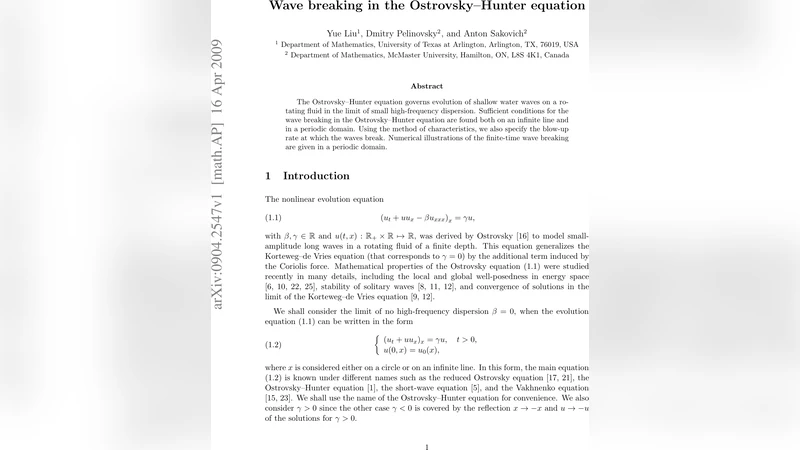
The Ostrovsky–Hunter equation governs evolution of shallow water waves on a rotating fluid in the limit of small high-frequency dispersion. Sufficient conditions for the wave breaking in the Ostrovsky–Hunter equation are found both on an infinite line and in a periodic domain. Using the method of characteristics, we also specify the blow-up rate at which the waves break. Numerical illustrations of the finite-time wave breaking are given in a periodic domain.
💡 Research Summary
The paper investigates finite‑time wave breaking (gradient blow‑up) for the Ostrovsky–Hunter (OH) equation, which models shallow‑water waves on a rotating fluid in the limit where high‑frequency dispersion is negligible. The OH equation reads
u_t + u u_x = γ ∂_x^{-1} u, γ>0,
where the nonlocal term γ ∂_x^{-1} u originates from the Coriolis effect. The authors address two settings: the whole real line ℝ and a periodic domain of length L. Their main contributions are (i) rigorous sufficient conditions guaranteeing that the spatial derivative u_x becomes unbounded in finite time, (ii) an explicit description of the blow‑up rate using the method of characteristics, and (iii) numerical simulations that illustrate the theoretical predictions in the periodic case.
Infinite‑line analysis.
Assume the initial data u₀∈H¹(ℝ) and let x₀ be a point where u₀ attains its minimum with a negative slope, i.e. u₀′(x₀)<0. The characteristic curve ξ(t;x₀) satisfies dξ/dt = u(t,ξ), ξ(0)=x₀. Along this curve the solution obeys the ordinary differential equation du/dt = γ ∂_x^{-1} u. Differentiating the OH equation with respect to x and evaluating on the characteristic yields a Riccati‑type evolution for the gradient:
d/dt u_x(t,ξ) = – u_x²(t,ξ) – γ u(t,ξ) u_x(t,ξ).
The quadratic negative term forces u_x to decrease rapidly. By integrating this inequality and introducing the energy functional E(t)=∫ℝ u_x² dx, the authors derive
E′(t) ≤ –C E³(t) (C>0),
which implies a finite blow‑up time bound
T* ≤ (C E(0)²)⁻¹.
Consequently, if the initial slope satisfies
u₀′(x₀) < –γ ‖u₀‖_{L∞},
the solution must develop a vertical slope in finite time.
Periodic domain analysis.
On a periodic interval
Comments & Academic Discussion
Loading comments...
Leave a Comment