The Triangle Closure is a Polyhedron
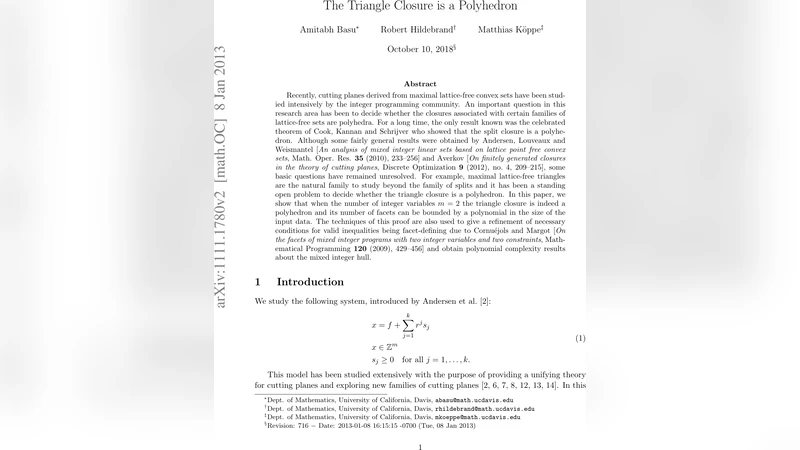
Recently, cutting planes derived from maximal lattice-free convex sets have been studied intensively by the integer programming community. An important question in this research area has been to decide whether the closures associated with certain families of lattice-free sets are polyhedra. For a long time, the only result known was the celebrated theorem of Cook, Kannan and Schrijver who showed that the split closure is a polyhedron. Although some fairly general results were obtained by Andersen, Louveaux and Weismantel [ An analysis of mixed integer linear sets based on lattice point free convex sets, Math. Oper. Res. 35 (2010), 233–256] and Averkov [On finitely generated closures in the theory of cutting planes, Discrete Optimization 9 (2012), no. 4, 209–215], some basic questions have remained unresolved. For example, maximal lattice-free triangles are the natural family to study beyond the family of splits and it has been a standing open problem to decide whether the triangle closure is a polyhedron. In this paper, we show that when the number of integer variables $m=2$ the triangle closure is indeed a polyhedron and its number of facets can be bounded by a polynomial in the size of the input data. The techniques of this proof are also used to give a refinement of necessary conditions for valid inequalities being facet-defining due to Cornu'ejols and Margot [On the facets of mixed integer programs with two integer variables and two constraints, Mathematical Programming 120 (2009), 429–456] and obtain polynomial complexity results about the mixed integer hull.
💡 Research Summary
The paper addresses a long‑standing open problem in mixed‑integer linear programming: whether the closure obtained from all cutting planes derived from maximal lattice‑free triangles—known as the triangle closure—is a polyhedron. The authors focus on the case where the number of integer variables m equals two and assume that all data (the right‑hand side vector f and the coefficient vectors r₁,…,r_k) are rational.
The starting point is the standard mixed‑integer model introduced by Andersen, Hildebrand, and Köppe:
x = f + Σ_{j=1}^k r_j s_j, x ∈ ℤ^m, s_j ≥ 0.
Since the integer variables x are uniquely determined by the non‑negative continuous variables s, the feasible set can be represented in the s‑space as R_f = { s ≥ 0 | f + Σ r_j s_j ∈ ℤ^m }.
For any matrix B ∈ ℝ^{n×m} such that the polyhedron M(B) = { x ∈ ℝ^m | B(x−f) ≤ e } is lattice‑free (i.e., its interior contains no integer point), the Minkowski functional ψ_B(r) = max_{i} b_i·r yields a valid inequality ψ_B(r₁)s₁ + … + ψ_B(r_k)s_k ≥ 1 for the mixed‑integer set. The coefficient vector γ(B) = (ψ_B(r₁),…,ψ_B(r_k)) therefore defines a cutting plane.
When m = 2, every lattice‑free set in ℝ² is either a split (a strip of width one bounded by two parallel integer hyperplanes) or a triangle. The split closure, the intersection of all split‑derived inequalities, is known to be a polyhedron by the Cook‑Kannan‑Schrijver theorem. The triangle closure T is defined analogously as the intersection of all inequalities derived from lattice‑free triangles. Because split inequalities can be obtained as limits of triangle inequalities, T can be expressed uniformly using all lattice‑free sets (including splits) as
T = { s ≥ 0 | γ·s ≥ 1 for every γ that arises from a lattice‑free set }.
The authors introduce the set Δ = { γ(B) | M(B) is lattice‑free } and its closed convex hull plus the non‑negative orthant, Δ₀ = cl(conv(Δ)) + ℝ_+^k. They prove that T can be equivalently described by the extreme points of Δ₀:
T = { s ≥ 0 | a·s ≥ 1 for all extreme points a of Δ₀ }.
Since the recession cone of Δ₀ is ℝ_+^k, every extreme point is minimal (i.e., not dominated by another point of Δ₀).
The central technical contribution is to show that the set of extreme points of Δ₀ is finite and its cardinality is bounded by a polynomial in the binary encoding size of the input data. This is achieved through a careful geometric analysis of maximal lattice‑free triangles. The authors rely on the classical classification of such triangles into three types (Type 1, Type 2, Type 3) based on the arrangement of integer points on their edges. For each type they characterize the possible γ‑vectors, showing that any γ not belonging to a certain finite “core” set Ξ is either dominated by another γ or can be expressed as a strict convex combination of two other γ‑vectors from Δ. Consequently, the number of nondominated γ‑vectors—and thus the number of extreme points of Δ₀—is polynomially bounded.
With this finiteness result, Theorem 1.3 follows: the triangle closure T is a polyhedron with a polynomial number of facets.
The paper then leverages the same machinery to study the mixed‑integer hull conv(R_f). By showing that the hull can be described by the same finite family of inequalities, the authors prove that the number of facets of the hull is also polynomially bounded (Theorem 1.4) and that all facets can be enumerated in polynomial time (Theorem 1.5).
Beyond these main results, the authors refine necessary conditions for a maximal lattice‑free convex set to generate a facet‑defining inequality, improving upon earlier work by Cornuéjols and Margot. Their approach avoids the reduction algorithm previously used and offers a more geometric proof technique, which may be extensible to higher dimensions (m ≥ 3).
In summary, the paper resolves the open question of the polyhedrality of the triangle closure for two integer variables, establishes polynomial bounds on the complexity of both the triangle closure and the mixed‑integer hull, and provides algorithmic implications for facet enumeration. The techniques introduced—particularly the analysis of extreme points of Δ₀ and the classification of lattice‑free triangles—represent a significant advance in the theory of cutting planes derived from lattice‑free convex sets.
Comments & Academic Discussion
Loading comments...
Leave a Comment