Three-dimensional evolution of erupted flux ropes from the Sun (2-20 Rs) to 1 AU
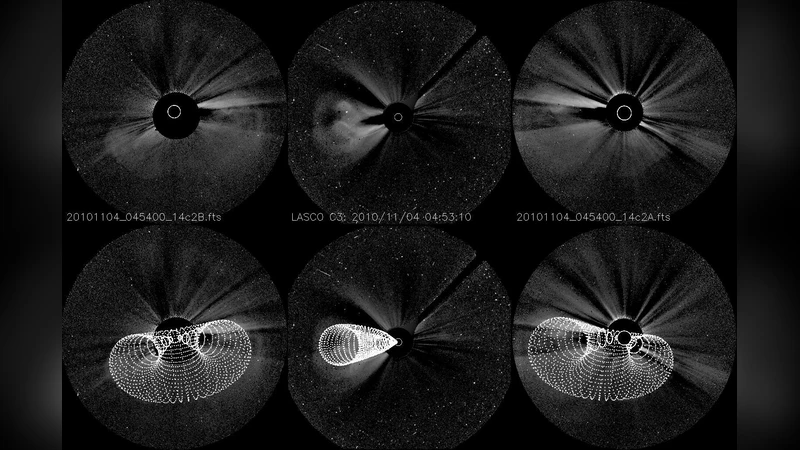
Studying the evolution of magnetic clouds entrained in coronal mass ejections using in-situ data is a difficult task since only a limited number of observational points is available at large heliocentric distances. Remote sensing observations can, however, provide important information for events close to the Sun. In this work we estimate the flux rope orientation first in the close vicinity of the Sun (2-20 Rs) using forward modeling of STEREO/SECCHI and SOHO/LASCO coronagraph images of coronal mass ejections and then in-situ using Grad-Shafranov reconstruction of the magnetic cloud. Thus, we are able to measure changes in the orientation of the erupted flux ropes as they propagate from the Sun to 1 AU. We present both techniques and use them to study 15 magnetic clouds observed during the minimum following Solar Cycle 23 and the rise of Solar Cycle 24. This is the first multievent study to compare the three-dimensional parameters of CMEs from imaging and in-situ reconstructions. The results of our analysis confirm earlier studies showing that the flux ropes tend to deflect towards the solar equatorial plane. We also find evidence of rotation on their travel from the Sun to 1 AU. In contrast to past studies, our method allows one to deduce the evolution of the three-dimensional orientation of individual flux ropes rather than on a statistical basis.
💡 Research Summary
The paper presents a comprehensive investigation of how the three‑dimensional orientation of magnetic flux ropes evolves from the low‑corona (2–20 solar radii) out to 1 AU. The authors combine two complementary techniques: forward modeling of coronagraph images from the STEREO‑SECCHI and SOHO‑LASCO instruments, and Grad‑Shafranov (GS) reconstruction of magnetic clouds measured in situ by near‑Earth spacecraft. In the forward‑modeling step, a Graduated Cylindrical Shell (GCS) geometry is fitted simultaneously to multi‑viewpoint white‑light images, yielding the CME’s height, radius, tilt, latitude and longitude with an estimated uncertainty of about ±5°. This provides the initial flux‑rope axis direction close to the Sun. At 1 AU, the GS method assumes a two‑dimensional magnetostatic equilibrium and reconstructs the cross‑sectional magnetic field distribution, from which the final axis orientation and shape are derived; typical angular errors are ±7°.
Fifteen events occurring between 2008 and 2011—spanning the solar minimum after Cycle 23 and the rise of Cycle 24—are selected. These events are relatively slow (300–600 km s⁻¹) and have both suitable coronagraph data and high‑resolution magnetic‑field/plasma measurements from ACE or Wind. For each event the authors compare the initial axis orientation obtained from imaging with the final orientation from the GS reconstruction, quantifying both deflection (change in latitude) and rotation (change in tilt).
The analysis reveals two systematic behaviors. First, most flux ropes experience a latitudinal deflection toward the solar equatorial plane, with an average shift of ~12°. High‑latitude eruptions (>30°) show the largest deflections, up to 20°, suggesting that large‑scale heliospheric structures such as the heliospheric current sheet and ambient solar‑wind pressure gradients exert a torque that pulls the ropes equator‑ward. Second, a noticeable rotation occurs during propagation, ranging from 0° to about 30°. The rotation is most pronounced for ropes that start with a large initial tilt (>45°), indicating that interaction with asymmetric solar‑wind streams, high‑speed streams, or internal current‑distribution asymmetries can twist the rope as it travels.
By directly linking the three‑dimensional parameters derived from remote sensing with those obtained from in‑situ reconstruction for individual events, the study moves beyond previous statistical approaches. It demonstrates that the combined forward‑modeling/GS methodology can track the full evolution of a single flux rope, offering a potential tool for space‑weather forecasting: early estimates of CME deflection and rotation could improve predictions of impact geometry and geomagnetic storm intensity at Earth. The authors conclude by recommending further work that incorporates high‑resolution MHD simulations, expands the event sample, and investigates the special dynamics of polar‑origin CMEs.
Comments & Academic Discussion
Loading comments...
Leave a Comment