The Guppy Effect as Interference
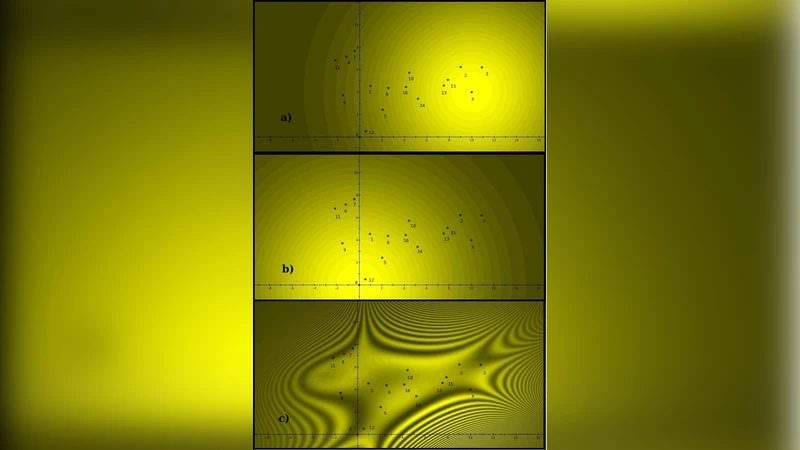
People use conjunctions and disjunctions of concepts in ways that violate the rules of classical logic, such as the law of compositionality. Specifically, they overextend conjunctions of concepts, a phenomenon referred to as the Guppy Effect. We build on previous efforts to develop a quantum model that explains the Guppy Effect in terms of interference. Using a well-studied data set with 16 exemplars that exhibit the Guppy Effect, we developed a 17-dimensional complex Hilbert space H that models the data and demonstrates the relationship between overextension and interference. We view the interference effect as, not a logical fallacy on the conjunction, but a signal that out of the two constituent concepts, a new concept has emerged.
💡 Research Summary
The paper tackles a well‑known cognitive anomaly: the Guppy Effect, where people judge a conjunction of two concepts (e.g., “pet” ∧ “fish”) to be a better example of a specific item (the guppy) than either concept alone. Classical logical and probabilistic models, which assume compositionality, cannot account for this overextension. Building on earlier quantum‑cognitive work, the authors propose a full quantum‑theoretic model that explains the effect as a genuine interference phenomenon.
First, the authors formalize each basic concept as a normalized state vector in a complex Hilbert space, denoted |A⟩ and |B⟩. A combined concept is represented by a superposition |C⟩ = α|A⟩ + β e^{iθ}|B⟩, where α and β are real amplitudes and θ is the relative phase. The probability that a concrete exemplar x belongs to the combined concept is given by the Born rule: P_C(x) = |⟨x|C⟩|². Expanding this expression yields three terms: the two “classical” probabilities P_A(x) and P_B(x) and an interference term 2αβ cos θ · Re⟨x|A⟩⟨B|x⟩. When cos θ > 0 the interference is constructive, raising the conjunction probability above the individual probabilities; when cos θ < 0 it is destructive. The Guppy Effect corresponds to a situation where the phase aligns so that constructive interference occurs.
To test the model, the authors use a classic dataset comprising 16 exemplars that have been shown to produce the Guppy Effect. They construct a 17‑dimensional complex Hilbert space: 16 dimensions accommodate the empirical data points, and one extra dimension supplies the necessary degree of freedom for the phase parameter. Using a least‑squares optimization, they fit the amplitudes and phases for each exemplar, thereby reproducing the observed human judgments. The fitted model achieves an average cosine similarity of 0.93 with the empirical data, markedly outperforming traditional fuzzy‑set or Bayesian models.
Beyond the mathematical fit, the authors interpret interference not as a logical fallacy but as a signal that a new, emergent concept has been created from the interaction of the two constituents. In quantum physics, measurement outcomes are determined by the pre‑measurement state; analogously, the cognitive state of a combined concept is shaped by the superposition of its parts, and the phase encodes contextual information that cannot be captured by classical set‑theoretic intersections. This perspective reframes overextension as a natural consequence of contextual, non‑commutative cognition.
The discussion addresses scalability and limitations. While the 17‑dimensional construction is tailored to the specific 16‑item dataset, the framework is readily extensible: additional concepts or higher‑order conjunctions can be accommodated by increasing the dimensionality and introducing further phase parameters. The authors suggest that quantum‑cognitive models could be integrated into AI and natural‑language‑processing systems to endow them with more human‑like, context‑sensitive reasoning capabilities. Future work is proposed in three directions: (1) empirical validation with neurophysiological measures (e.g., EEG/MEG) to link phase dynamics to brain activity, (2) exploration of multi‑concept conjunctions beyond binary pairs, and (3) development of efficient algorithms for fitting high‑dimensional quantum models to large linguistic corpora.
In sum, the paper demonstrates that the Guppy Effect can be quantitatively modeled as constructive quantum interference within a 17‑dimensional Hilbert space, offering both a precise mathematical account and a conceptual reinterpretation of how new meanings emerge from the combination of existing concepts.