Expectation Propogation for approximate inference in dynamic Bayesian networks
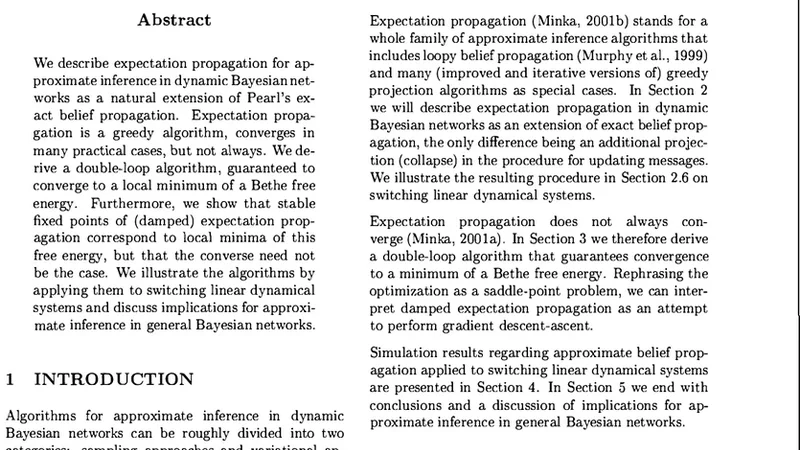
We describe expectation propagation for approximate inference in dynamic Bayesian networks as a natural extension of Pearl s exact belief propagation.Expectation propagation IS a greedy algorithm, converges IN many practical cases, but NOT always.We derive a DOUBLE - loop algorithm, guaranteed TO converge TO a local minimum OF a Bethe free energy.Furthermore, we show that stable fixed points OF (damped) expectation propagation correspond TO local minima OF this free energy, but that the converse need NOT be the CASE .We illustrate the algorithms BY applying them TO switching linear dynamical systems AND discuss implications FOR approximate inference IN general Bayesian networks.
💡 Research Summary
The paper introduces Expectation Propagation (EP) as a principled, message‑passing framework for approximate inference in Dynamic Bayesian Networks (DBNs). While exact belief propagation (BP) works only on tree‑structured graphs, EP extends the idea by approximating each marginal with a tractable exponential‑family distribution (typically Gaussian) and iteratively refining these approximations through a “remove‑insert‑normalize” cycle. The authors first formulate forward and backward EP messages that travel along the temporal axis of a DBN, showing that the update equations have the same algebraic form as BP but are constrained to stay within the chosen family of approximations.
A key practical issue is that EP, like loopy BP, is not guaranteed to converge. In many empirical settings it does, yet for certain transition dynamics or extreme parameter regimes the algorithm can diverge or oscillate. To address this, the authors develop a double‑loop algorithm. The inner loop performs standard EP updates, while the outer loop optimizes a Bethe free‑energy functional under consistency constraints enforced by Lagrange multipliers. This outer loop guarantees a monotonic decrease of the free energy, thereby providing a convergence proof for the overall scheme. The double‑loop method can be viewed as embedding EP within a broader variational optimization problem, turning the heuristic EP updates into a principled descent on a well‑defined objective.
The paper further investigates the relationship between damped EP and the Bethe free energy. Damping blends the newly computed message with the previous one, reducing step size and mitigating oscillations. The authors prove that any stable fixed point of damped EP corresponds to a local minimum of the Bethe free energy. The converse, however, does not hold in general because the Bethe free‑energy landscape is non‑convex; some minima are not reachable by EP dynamics. This result clarifies why EP often works well in practice (it tends to settle in a basin of attraction that is also a free‑energy minimum) while also explaining its occasional failures.
Experimental validation is carried out on Switching Linear Dynamical Systems (SLDS), a class of models that combine continuous Gaussian states with discrete switching modes. Exact inference in SLDS is intractable, making it an ideal testbed for approximate methods. The authors compare three configurations: (1) plain EP, (2) damped EP, and (3) the proposed double‑loop algorithm. Plain EP converges quickly on many sequences but exhibits instability on others, leading to poor posterior estimates. Damped EP improves stability at the cost of slower convergence. The double‑loop algorithm consistently converges and yields posterior approximations comparable to or better than the other methods, while preserving computational efficiency.
Overall, the paper makes four major contributions. First, it provides a clear derivation of EP message updates for DBNs, bridging the gap between exact belief propagation and practical approximate inference. Second, it introduces a provably convergent double‑loop scheme that embeds EP within a variational free‑energy minimization, guaranteeing convergence to a local Bethe optimum. Third, it establishes a rigorous connection between damped EP fixed points and Bethe free‑energy minima, elucidating the theoretical underpinnings of EP’s empirical success and its limitations. Fourth, it demonstrates the practical relevance of the approach on a challenging real‑world model (SLDS), showing that the method scales to non‑trivial dynamic systems.
In conclusion, the work positions Expectation Propagation as a powerful, flexible tool for inference in temporal probabilistic models, while providing the necessary algorithmic safeguards (double‑loop optimization, damping) to ensure reliable performance. The insights about the free‑energy landscape open avenues for future research, such as designing adaptive damping schedules, extending the framework to non‑Gaussian exponential families, or integrating the double‑loop scheme with modern stochastic variational inference techniques for large‑scale DBNs.