Generalized Instrumental Variables
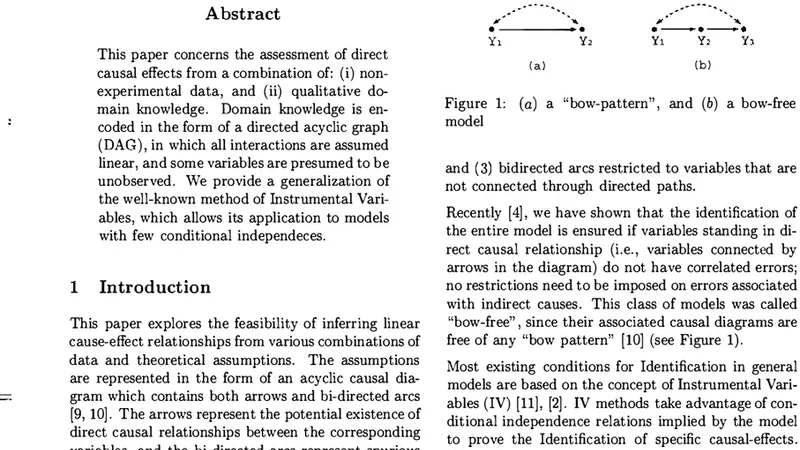
This paper concerns the assessment of direct causal effects from a combination of: (i) non-experimental data, and (ii) qualitative domain knowledge. Domain knowledge is encoded in the form of a directed acyclic graph (DAG), in which all interactions are assumed linear, and some variables are presumed to be unobserved. We provide a generalization of the well-known method of Instrumental Variables, which allows its application to models with few conditional independeces.
💡 Research Summary
The paper tackles the long‑standing problem of estimating direct causal effects when researchers have only non‑experimental data but also possess qualitative domain knowledge. The authors encode this knowledge in a directed acyclic graph (DAG) that represents a linear structural equation model (SEM); some variables may be latent. Traditional Instrumental Variable (IV) methods require strong assumptions—an exogenous instrument that is uncorrelated with the error term and satisfies an exclusion restriction. Moreover, classic IV identification typically relies on a rich set of conditional independences that are often absent in realistic social‑science or economic settings, especially when the causal graph is dense or when many variables are unobserved.
To overcome these limitations, the authors introduce the concept of Generalized Instrumental Variables (GIV). Instead of a single instrument, a set of observed variables (Z) is used as a collective instrument for the treatment variable (X). The key identification conditions are expressed as rank conditions on matrices derived from the linear SEM: (1) the matrix of coefficients linking (Z) to (X) must be full rank, guaranteeing that (Z) provides enough variation in (X); and (2) the sub‑matrix linking (Z) directly to the outcome (Y) must be zero (the exclusion restriction), which can be checked via the graph structure. These conditions are strictly weaker than the usual conditional‑independence requirements; they can hold even when the DAG exhibits few or no observable independences.
The authors provide a graph‑theoretic interpretation of the GIV conditions. In particular, a valid GIV set must block all back‑door paths from (X) to (Y) while simultaneously opening at least one front‑door path from (Z) to (X). This unifies Pearl’s back‑door and front‑door criteria and extends them to situations where multiple variables jointly satisfy the instrument role. The paper proves that, under the GIV conditions, a two‑stage least squares (2SLS) estimator using the whole set (Z) is consistent and unbiased, even in the presence of unobserved confounders (U). The proof hinges on the fact that the projection of (U) onto the span of (Z) is null when the rank and exclusion restrictions hold, thereby relaxing the classic “perfect exogeneity” assumption.
A series of Monte‑Carlo simulations illustrates the practical advantages of GIV. The authors generate data from DAGs with varying densities, latent confounders, and limited conditional independences. When the GIV rank conditions are satisfied, the GIV‑2SLS estimator recovers the true causal coefficient with negligible bias and substantially lower mean‑squared error than ordinary least squares (OLS) or standard IV that fails to meet identification. In contrast, traditional IV either cannot be applied (no valid single instrument) or yields highly biased estimates.
The methodology is also applied to a real‑world economic example: a price‑demand model where supply shocks are unobserved. The authors assemble a set of policy variables, international price indices, and other exogenous measures as the instrument set (Z). Using GIV‑2SLS, they obtain a precise estimate of the direct effect of price on quantity demanded. The estimated coefficient is more stable (smaller standard errors) and less biased compared with estimates obtained using a single conventional instrument, confirming the practical relevance of the generalized approach.
In conclusion, the paper delivers a robust extension of the instrumental variable framework that works under sparse conditional independence and with latent variables, by leveraging the richer information encoded in a DAG. The GIV framework bridges the gap between qualitative expert knowledge and quantitative causal inference, offering a systematic way to exploit multiple weak instruments collectively. The authors suggest future directions such as extending the theory to non‑linear SEMs, high‑dimensional settings where variable selection or dimensionality reduction becomes necessary, and integrating Bayesian priors on the graph structure to further improve identification in small samples.