On Threshold Models over Finite Networks
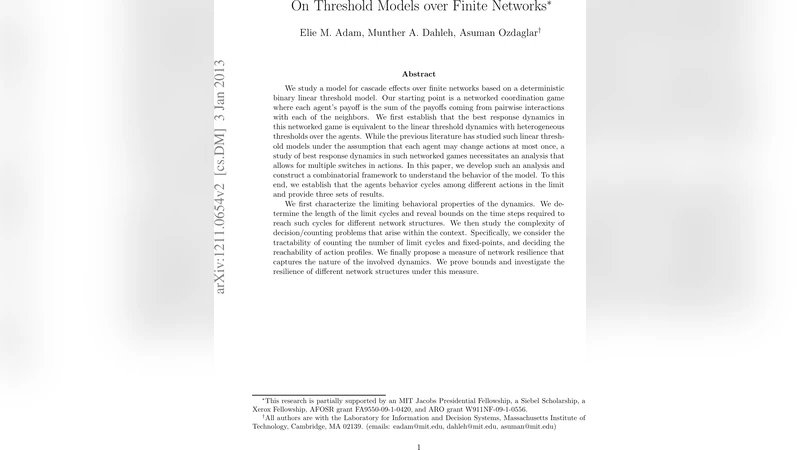
We study a model for cascade effects over finite networks based on a deterministic binary linear threshold model. Our starting point is a networked coordination game where each agent’s payoff is the sum of the payoffs coming from pairwise interactions with each of the neighbors. We first establish that the best response dynamics in this networked game is equivalent to the linear threshold dynamics with heterogeneous thresholds over the agents. While the previous literature has studied such linear threshold models under the assumption that each agent may change actions at most once, a study of best response dynamics in such networked games necessitates an analysis that allows for multiple switches in actions. In this paper, we develop such an analysis and construct a combinatorial framework to understand the behavior of the model. To this end, we establish that the agents behavior cycles among different actions in the limit and provide three sets of results. We first characterize the limiting behavioral properties of the dynamics. We determine the length of the limit cycles and reveal bounds on the time steps required to reach such cycles for different network structures. We then study the complexity of decision/counting problems that arise within the context. Specifically, we consider the tractability of counting the number of limit cycles and fixed-points, and deciding the reachability of action profiles. We finally propose a measure of network resilience that captures the nature of the involved dynamics. We prove bounds and investigate the resilience of different network structures under this measure.
💡 Research Summary
The paper investigates cascade dynamics on finite networks using a deterministic binary linear threshold model derived from a networked coordination game. In this game each agent’s payoff is the sum of pairwise interaction payoffs with its neighbors, and agents repeatedly choose a best‑response action. The authors first prove that the best‑response dynamics are exactly equivalent to a heterogeneous linear threshold process: an agent i adopts action 1 whenever the number of neighbors currently playing 1 exceeds its personal threshold θ_i, otherwise it plays 0.
Unlike most prior work that assumes each node can switch at most once, this study allows unlimited switches, which is necessary for analyzing best‑response dynamics. By modeling the state space as a finite directed graph of action profiles, the authors show that every trajectory eventually enters a cycle. They prove that the only possible cycle lengths are 1 (a fixed point) or 2 (alternating between two profiles). The length of the transient phase before entering a cycle is bounded by a polynomial in the number of nodes n, the maximum degree Δ, and the graph diameter. Specific network topologies yield tighter bounds: complete graphs converge in at most two steps to a 2‑cycle, trees always converge to a fixed point, and rings may require Θ(n) steps.
The paper then turns to computational complexity. Three natural decision/counting problems are examined: (1) counting the number of limit cycles, (2) counting the number of fixed points, and (3) deciding whether a given action profile is reachable from a given initial profile. The authors prove that (1) and (2) are #P‑complete, indicating that exact enumeration is intractable in general. Problem (3) is shown to be PSPACE‑complete, reflecting the difficulty of reachability analysis when agents may switch repeatedly. These results justify the need for approximation algorithms or restricted graph classes in practical applications.
Finally, the authors introduce a quantitative measure of network resilience, denoted R, which captures both the size of the smallest set of agents whose removal (or forced state change) can drive the system away from a desirable fixed point, and the minimal number of additional best‑response steps required for the system to return to any fixed point after such a disturbance. They derive upper and lower bounds on R in terms of threshold distribution and structural properties such as connectivity, degree heterogeneity, and expansion. Empirical simulations on star, grid, Erdős‑Rényi, and scale‑free networks illustrate how R varies: highly centralized structures (stars) exhibit low resilience because the hub’s failure dramatically raises R, whereas dense, well‑connected graphs (grids, random graphs with high average degree) tend to have smaller R values.
Overall, the paper makes several contributions: it bridges coordination games and linear threshold models, establishes rigorous convergence and cycle‑length results for unlimited‑switch dynamics, characterizes the computational hardness of natural analytical tasks, and proposes a novel resilience metric grounded in the dynamics themselves. The work extends the theoretical foundation of cascade models, opening avenues for future research on non‑linear thresholds, stochastic updates, and evolving network topologies.
Comments & Academic Discussion
Loading comments...
Leave a Comment