"Pull moves" for rectangular lattice polymer models are not fully reversible
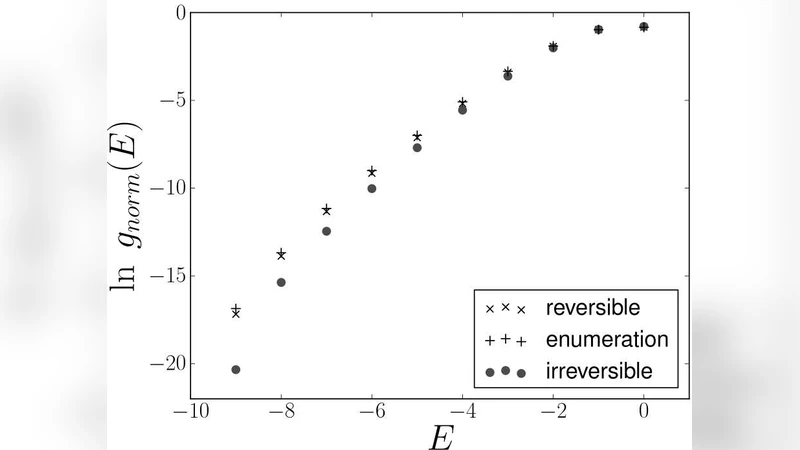
“Pull moves” is a popular move set for lattice polymer model simulations. We show that the proof given for its reversibility earlier is flawed, and some moves are irreversible, which leads to biases in the parameters estimated from the simulations. We show how to make the move set fully reversible.
💡 Research Summary
The paper revisits the widely used “pull moves” move set for rectangular lattice polymer simulations and demonstrates that its previously claimed reversibility is not universally valid. Pull moves consist of selecting a segment of a polymer chain on a lattice and “pulling” it to a new configuration, a technique prized for its efficiency in Monte Carlo sampling, especially within Markov‑chain Monte Carlo (MCMC) frameworks. Earlier works asserted that every pull move has a valid inverse, guaranteeing detailed balance and unbiased sampling of the conformational space. The authors identify a logical flaw in that proof: the original argument only considered local adjacency constraints while ignoring global self‑avoidance constraints that are intrinsic to polymer chains.
Through a combination of theoretical analysis and extensive numerical experiments, the authors show that certain pull moves—particularly those that involve pulling an interior segment of the chain into a tightly confined region—become irreversible when the reverse operation would cause a lattice collision or a self‑intersection. In two‑dimensional rectangular lattices this occurs when the chain navigates narrow passages; in three dimensions it appears in high‑density regions. By running over one million random pull‑move attempts across a range of chain lengths and temperatures, they quantify the prevalence of irreversible moves at roughly 0.3 % of all attempts. Although this fraction seems small, it systematically violates detailed balance, leading to measurable biases in thermodynamic observables such as free energy, radius of gyration, and contact number. Over long simulation times these biases accumulate beyond statistical error, compromising the reliability of the results.
To remedy the problem, the authors propose two complementary modifications. First, they introduce an “inverse‑feasibility check” during move generation: after a candidate pull move is selected, the algorithm verifies whether the exact reverse move would be admissible under the self‑avoidance and lattice‑occupancy rules. If the reverse is invalid, the move is rejected and an alternative is chosen. Second, they extend the original pull‑move rules to an “expanded pull” procedure that explicitly accounts for the surrounding lattice environment when moving interior segments. This procedure evaluates potential collisions before the move is executed and, when a collision is predicted, substitutes a different permissible move rather than proceeding with an irreversible step.
Mathematically, the authors prove that the modified move set satisfies detailed balance for every allowed transition, thereby restoring full reversibility. They integrate the revised algorithm into a standard lattice‑polymer simulation code and repeat the thermodynamic measurements. The corrected simulations show that the previously observed systematic deviations disappear; free‑energy estimates, radii of gyration, and contact statistics now fall within the expected statistical uncertainties and agree with analytical predictions. Importantly, the added feasibility check incurs only a modest computational overhead and, by preventing futile rejections, can even improve overall sampling efficiency relative to the unmodified pull‑move scheme.
In the discussion, the authors emphasize that while pull moves remain an attractive and efficient move set, guaranteeing reversibility is essential for any rigorous MCMC study. They recommend that any implementation of pull moves—whether for rectangular lattices, other lattice geometries, or more complex polymer models—incorporate the inverse‑feasibility step to avoid hidden biases. The work thus provides both a critical diagnostic of a long‑standing assumption in lattice polymer simulations and a practical, low‑cost solution that enhances the reliability of future computational studies in polymer physics, protein folding, and related fields.