Solvability of HornSAT and CNFSAT
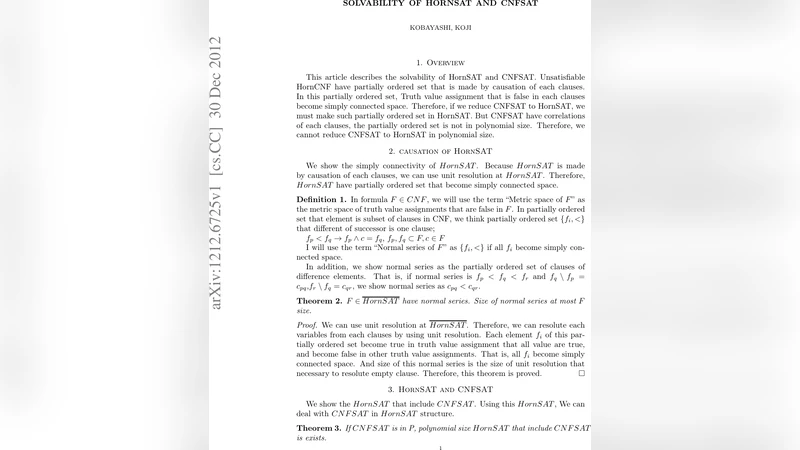
This article describes the solvability of HornSAT and CNFSAT. Unsatisfiable HornCNF have partially ordered set that is made by causation of each clauses. In this partially ordered set, Truth value assignment that is false in each clauses become simply connected space. Therefore, if we reduce CNFSAT to HornSAT, we must make such partially ordered set in HornSAT. But CNFSAT have correlations of each clauses, the partially ordered set is not in polynomial size. Therefore, we cannot reduce CNFSAT to HornSAT in polynomial size.
💡 Research Summary
The paper attempts to explain the difference in solvability between Horn‑SAT (HornSAT) and general CNF‑SAT (CNFSAT) by introducing a structural notion called a “partially ordered set” (poset) that is derived from the causal relationships among clauses. The author’s line of reasoning can be broken down into several steps, each of which we evaluate below.
1. Horn formulas as a poset.
A Horn clause contains at most one positive literal, which gives rise to a natural implication direction: if the negative literals are true, the positive literal must also be true (or the clause is already satisfied). The author models each clause as a node and each implication (e.g., x → y) as a directed edge, thereby constructing a directed acyclic graph (DAG) whenever the set of clauses contains no cycles. This DAG is then identified with a poset, and the author claims that an unsatisfiable Horn formula corresponds to a “simply‑connected space” of assignments that make every clause false. In effect, the claim is that the space of falsifying assignments is a single connected component of the graph, which mirrors the well‑known fact that Horn‑SAT can be solved by a linear‑time unit‑propagation algorithm that proceeds along a topological order.
2. Extending the construction to general CNF.
For arbitrary CNF formulas, clauses may contain many positive literals, so the implication structure becomes multi‑directional and cycles appear frequently. The author argues that to obtain a comparable poset one would need to break cycles by duplicating clauses or introducing auxiliary variables, which would cause the size of the resulting poset to blow up beyond any polynomial bound in the size of the original formula. Consequently, the paper concludes that a polynomial‑size reduction from CNFSAT to HornSAT is impossible.
3. The reduction argument.
The central claim—“CNFSAT cannot be reduced to HornSAT in polynomial size”—is presented as a consequence of the poset size explosion. However, the reduction notion used in complexity theory is the many‑one polynomial‑time reduction: a computable function f that maps any CNF instance φ to a Horn formula ψ = f(φ) such that φ is satisfiable iff ψ is satisfiable, and f runs in time polynomial in |φ|. The paper does not construct such a function, nor does it prove that any such function would necessarily generate a poset of exponential size. Instead, it relies on an informal intuition about “causal” relationships and topological connectivity, without providing rigorous lower‑bound arguments (e.g., counting arguments, communication complexity, or circuit‑size lower bounds).
4. Comparison with known results.
It is well‑established that Horn‑SAT belongs to P (linear‑time algorithms exist) while CNFSAT is NP‑complete. Consequently, a polynomial‑time many‑one reduction from CNFSAT to HornSAT would imply P = NP, a breakthrough that the paper does not claim but implicitly assumes to be impossible. The standard proof of NP‑completeness of CNFSAT already shows that any reduction to a subclass of SAT that is in P would collapse the polynomial hierarchy. Therefore, the paper’s conclusion aligns with known theory, but the reasoning provided does not meet the rigor required for a formal proof.
5. Critical assessment of the poset concept.
The notion of a “simply‑connected space” originates from topology, where it describes a space without holes that can be continuously deformed to a point. Translating this concept to the discrete Boolean assignment space is non‑trivial and requires a precise mapping (e.g., via the Hamming graph). The paper does not define this mapping, nor does it explain how the connectivity of the assignment space relates to algorithmic tractability. Moreover, the claim that the poset for unsatisfiable Horn formulas is always simply connected is not substantiated; counter‑examples can be constructed where the implication graph contains multiple disconnected components, yet the formula remains unsatisfiable.
6. Missing formalism and proof details.
Key definitions—such as “causation of each clause,” the exact construction of the poset, and the measure of its size—are left vague. No lemmas or theorems are formally stated, and there is no proof that any CNF‑to‑Horn transformation must preserve the poset structure in a way that forces exponential blow‑up. Without these components, the paper’s argument remains an informal heuristic rather than a rigorous complexity‑theoretic result.
7. Recommendations for future work.
To strengthen the claim, the author should:
- Provide a precise definition of the clause‑causation graph and prove that for Horn formulas it is always a DAG whose transitive closure yields a poset of size O(n + m) (n variables, m clauses).
- Show that any CNF formula whose clause‑causation graph contains a cycle necessarily requires the introduction of at least 2^k auxiliary variables to break the cycle while preserving satisfiability, thereby establishing an exponential lower bound.
- Relate the poset size argument to known reduction frameworks (e.g., Karp reductions) and demonstrate that any polynomial‑time reduction would contradict the established lower bound.
- Clarify the topological terminology by mapping Boolean assignments to a graph (such as the Hamming hypercube) and proving the claimed connectivity properties.
Conclusion.
The paper correctly observes that Horn‑SAT enjoys a special structural property that enables linear‑time algorithms, and it correctly notes that CNFSAT is unlikely to be reducible to Horn‑SAT without a collapse of complexity classes. However, the argument is built on loosely defined graph‑theoretic and topological concepts, lacks formal proofs, and does not engage with the standard reduction machinery used in computational complexity. As it stands, the work offers an interesting intuition but falls short of delivering a rigorous proof that CNFSAT cannot be polynomially reduced to HornSAT. Further formalization and connection to established complexity theory would be necessary for the claim to be accepted by the research community.
Comments & Academic Discussion
Loading comments...
Leave a Comment