Exploring mutexes, the Oracle RDBMS retrial spinlocks
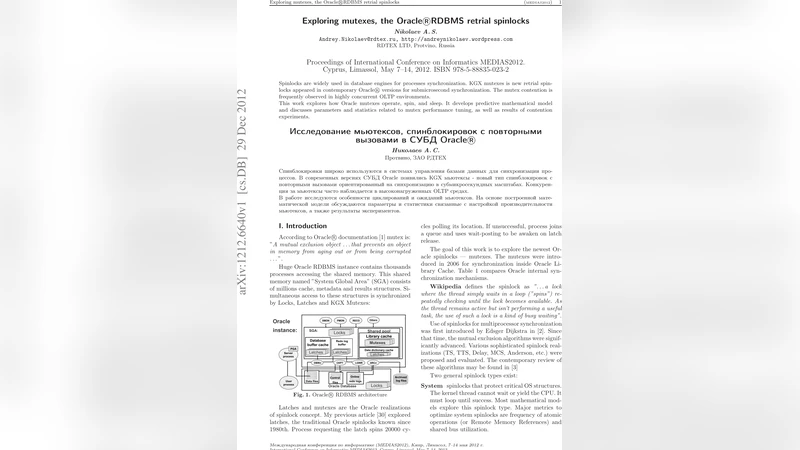
Spinlocks are widely used in database engines for processes synchronization. KGX mutexes is new retrial spinlocks appeared in contemporary Oracle versions for submicrosecond synchronization. The mutex contention is frequently observed in highly concurrent OLTP environments. This work explores how Oracle mutexes operate, spin, and sleep. It develops predictive mathematical model and discusses parameters and statistics related to mutex performance tuning, as well as results of contention experiments.
💡 Research Summary
The paper provides a comprehensive examination of the KGX mutex, a retrial spinlock introduced in recent Oracle Database releases to address sub‑microsecond synchronization requirements in highly concurrent OLTP environments. It begins by outlining the limitations of traditional Oracle synchronization primitives such as lightweight spinlocks and semaphores, which either waste CPU cycles during prolonged spinning or cause excessive latency when forced to sleep. The KGX mutex combines a short spin‑retry loop with an automatic fallback to a sleep‑based wait, thereby aiming to keep CPU usage low while still providing fast lock acquisition when contention is modest.
The internal structure of a KGX mutex consists of three components: an owner field that holds the session identifier of the current lock holder, a waiters counter that tracks the number of sessions waiting for the lock, and a spin‑retry loop that attempts to acquire the lock using an atomic compare‑and‑swap (CAS) operation. The number of spin attempts is governed by the parameter _mutex_spin_count; after this count is exhausted, the session is placed on an internal wait queue and enters a sleep state. While sleeping, the session generates the “mutex sleep” wait event, and while spinning it generates the “mutex spin” event. Oracle’s scheduler periodically wakes sleeping sessions, and the database collects a set of statistics—GETS (total lock requests), MISSES (failed spin attempts), SPINS (actual spin cycles), and SLEEPS (sleep events)—that become the primary data for performance analysis.
A key contribution of the work is a mathematical model that relates lock request arrival rate (λ), spin time (τ_spin), and sleep time (τ_sleep) to the probability of successful lock acquisition (P_success). Under a Poisson arrival assumption, the model approximates P_success ≈ 1 – λ·τ_spin and derives τ_sleep = (1/μ)·ln