Domain ontology and multi-criteria analysis for enterprise modeling
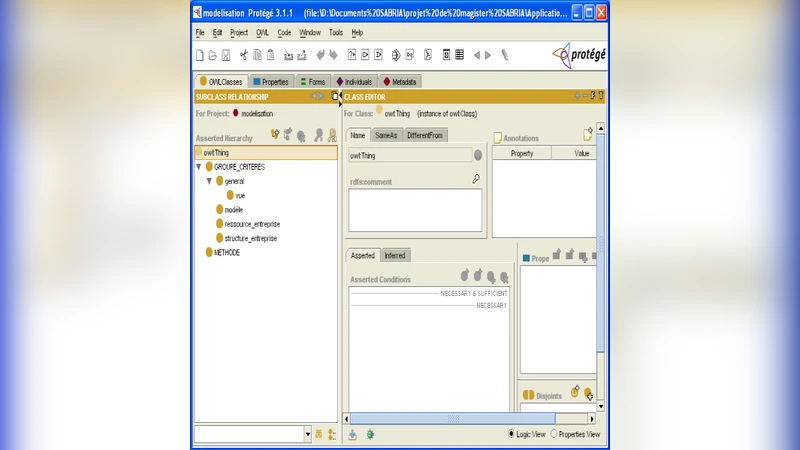
Knowing that an enterprise is a complex reality, it is necessary to develop a modeling framework allowing the description of system structure and dynamics that alter the structure. The concept of enterprise modeling addresses this need and many techniques have emerged. Our goal is to provide leaders of Algerian enterprise an overview of modeling techniques. Thus these managers may elect, in collaboration with the University, the modeling technique best suited to their requirements. TWe believe that this could be a step towards an effective reorganization of the enterprise leading. TThis article proposes a domain ontology and multi-criteria analysis in the frame of modeling enterprise. Our approach is based on two stages using the Prot'eg'e tool for the technique representation and the PROMETHEE method for their evaluation. The result is a ranking between the different techniques, which allows selecting the most appropriate methodology according to the criteria for a given Tenterprise.
💡 Research Summary
The paper addresses the challenge of selecting an appropriate enterprise modeling technique for Algerian companies by integrating a domain ontology with a multi‑criteria decision‑making (MCDM) approach. Recognizing that enterprises are complex systems whose structure and dynamics must be captured simultaneously, the authors first construct a comprehensive ontology of existing modeling methods. They survey the literature and practice to identify the most widely used techniques—CIMOSA, IDEF, ARIS, BPMN, EPC, among others—and extract their core concepts (processes, resources, goals, rules, etc.). These concepts are formalized in OWL using the Protégé editor, resulting in a reusable, extensible knowledge base that explicitly encodes classes, properties, relationships, and constraints. The ontology not only clarifies similarities and differences among techniques but also provides a visual map that can be consulted by decision‑makers and researchers alike.
In the second phase, the authors apply the PROMETHEE (Preference Ranking Organization METHod for Enrichment of Evaluations) method to rank the techniques according to five evaluation criteria: (1) technical suitability (fit with the organization’s processes), (2) implementation cost (software licences, training, etc.), (3) user‑friendliness (learning curve, interface intuitiveness), (4) scalability (ability to accommodate future changes), and (5) localization potential (alignment with Algerian legal, cultural, and infrastructural specifics). To determine the relative importance of each criterion, they conduct a structured survey and semi‑structured interviews with fifteen stakeholders, including senior managers from Algerian firms and academic experts. The resulting weights are applied in a PROMETHEE‑II analysis, which computes positive (P⁺) and negative (P⁻) outranking flows for each technique and derives a net flow (Q = P⁺ – P⁻) that serves as the final ranking metric.
The empirical results reveal distinct preferences depending on organizational context. For small‑ and medium‑sized enterprises that prioritize low cost and high localization, BPMN emerges as the top‑ranked method. In contrast, large, complex organizations that value comprehensive process integration and scalability favor CIMOSA. When user‑friendliness is the dominant concern, ARIS attains a higher position. These findings demonstrate that no single technique universally dominates; instead, the optimal choice is contingent on the specific weight configuration reflecting a firm’s strategic priorities.
The contribution of the study is threefold. First, it provides a rigorously defined domain ontology that can serve as a reference model for the enterprise modeling community, reducing ambiguity in technique comparison. Second, it showcases the practical utility of PROMETHEE as an MCDM tool capable of handling both qualitative and quantitative criteria, thereby offering Algerian managers a transparent, data‑driven decision framework. Third, by focusing on the Algerian context, the research supplies actionable guidance tailored to local constraints, which is often missing in generic modeling literature.
Nevertheless, the authors acknowledge several limitations. The criterion weights are derived from a relatively small, region‑specific sample, which may limit the generalizability of the rankings to other countries or industries. The ontology construction requires expert knowledge and an upfront investment in tooling and maintenance; without a systematic update mechanism, the knowledge base could become outdated as new modeling approaches emerge. Future work is proposed to develop automated ontology evolution processes, expand the empirical validation to a broader set of nations and sectors, and explore alternative MCDM methods (e.g., TOPSIS, AHP) for comparative robustness.
In summary, the paper demonstrates how a combined ontology‑and‑PROMETHEE approach can systematically evaluate and rank enterprise modeling techniques, providing Algerian decision‑makers with a clear, evidence‑based pathway to select the methodology that best aligns with their organizational goals, resource constraints, and local environment.
Comments & Academic Discussion
Loading comments...
Leave a Comment