High-frequency cyclicity in the Mediterranean Messinian evaporites: evidence for solar-lunar climate forcing
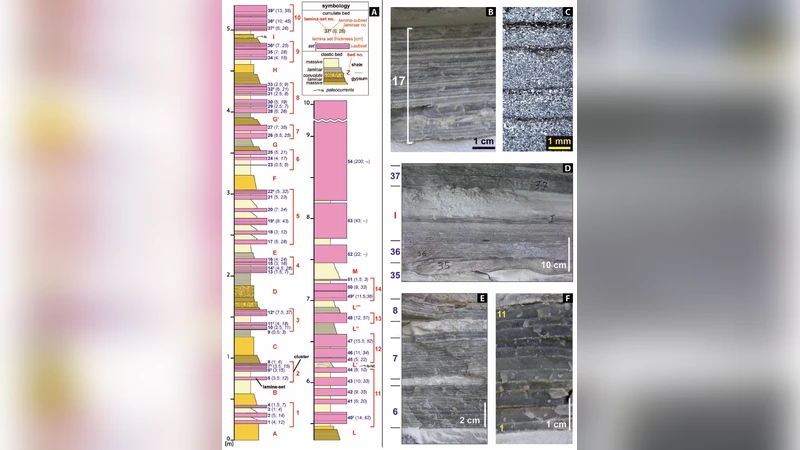
The deposition of varved sedimentary sequences is usually controlled by climate conditions. The study of two Late Miocene evaporite successions (one halite and the other gypsum) consisting of annual varves has been carried out to reconstruct the paleoclimatic and paleoenvironmental conditions existing during the acme of the Messinian salinity crisis, ~ 6 Ma, when thick evaporite deposits accumulated on the floor of the Mediterranean basin. Spectral analyses of these varved evaporitic successions reveal significant periodicity peaks at around 3-5, 9, 11-13, 20-27 and 50-100 yr. A comparison with modern precipitation data in the western Mediterranean shows that during the acme of the Messinian salinity crisis the climate was not in a permanent evaporitic stage, but in a dynamic situation where evaporite deposition was controlled by quasi-periodic climate oscillations with similarity to modern analogs including Quasi-Biennial Oscillation, El Ni~no Southern Oscillation, and decadal to secular lunar- and solar-induced cycles. Particularly we found a significant quasi-decadal oscillation with a prominent 9-year peak that is commonly found also in modern temperature records and is present in the contemporary Atlantic Multidecadal Oscillation (AMO) index and Pacific Decadal Oscillation (PDO) index. These cyclicities are common to both ancient and modern climate records because they can be associated with solar and solar-lunar tidal cycles.
💡 Research Summary
The paper investigates two Late Miocene evaporite successions—one halite and one gypsum—preserved as annually laminated (varved) sequences in the Mediterranean basin during the peak of the Messinian Salinity Crisis (MSC) around 6 Ma. By measuring the thickness of each varve and constructing a continuous high‑resolution time series spanning more than a thousand years, the authors applied a suite of spectral techniques (Multi‑taper method, Maximum Entropy Method, and continuous wavelet analysis) to detect periodic components in the depositional record. Statistical significance was assessed through Monte‑Carlo simulations, and peaks exceeding the 95 % confidence level were considered robust.
The analyses reveal distinct spectral peaks at approximately 3–5 yr, 9 yr, 11–13 yr, 20–27 yr, and 50–100 yr. The authors interpret these cycles as the sedimentary imprint of well‑known modern climate oscillations: the 3–5 yr band corresponds to the Quasi‑Biennial Oscillation (QBO), the 9‑yr peak aligns with decadal variability observed in the Atlantic Multidecadal Oscillation (AMO) and Pacific Decadal Oscillation (PDO), the 11–13 yr band matches the solar sunspot cycle, while the 20–27 yr and 50–100 yr bands are linked to lunar‑solar tidal cycles driven by variations in the Moon’s orbit and nodal precession.
Crucially, the study challenges the traditional view of the MSC as a period of continuous, extreme evaporation. Instead, the varve record indicates that evaporite deposition was episodic, modulated by quasi‑periodic climate fluctuations that alternated between more humid and more arid conditions. This “dynamic equilibrium” model suggests that external astronomical forcing (solar radiation and lunar tides) and internal climate feedbacks (atmospheric and oceanic circulation) together governed the timing and intensity of evaporite accumulation.
Methodologically, the work demonstrates that varve counting, when combined with rigorous spectral analysis, can resolve climate signals at sub‑decadal scales in deep‑time records. The authors propose that integrating such high‑resolution sedimentary chronologies with geochemical proxies (e.g., stable isotopes, trace elements) will enable quantitative reconstructions of ancient water balance, temperature, and oceanic circulation.
In conclusion, the Messinian evaporite successions preserve a multi‑scale cyclicity that mirrors modern climate oscillations, providing compelling evidence that solar‑lunar tidal forcing has been a persistent driver of Earth’s climate system for at least six million years. The findings underscore the importance of incorporating astronomical cycles into paleoclimate models and suggest that similar high‑frequency analyses could be applied to other evaporitic or varved successions worldwide to unravel the interplay between celestial forcing and terrestrial climate throughout geologic time.
Comments & Academic Discussion
Loading comments...
Leave a Comment