Symmetry-Adapted Phonon Analysis of Nanotubes
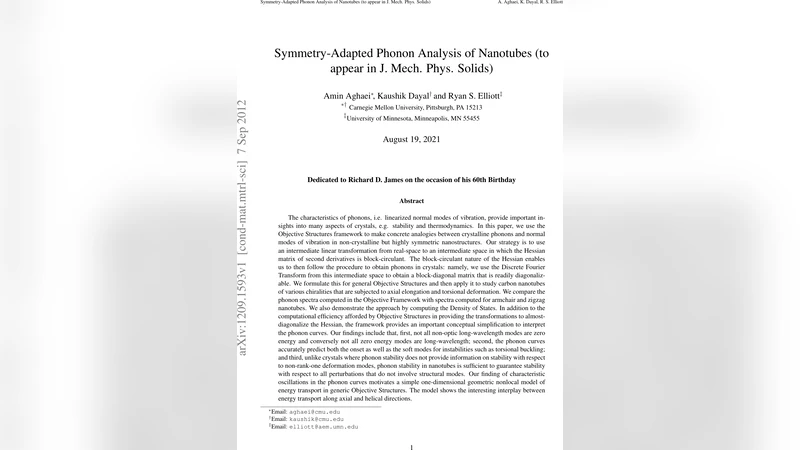
The characteristics of phonons, i.e. linearized normal modes of vibration, provide important insights into many aspects of crystals, e.g. stability and thermodynamics. In this paper, we use the Objective Structures framework to make concrete analogies between crystalline phonons and normal modes of vibration in non-crystalline but highly symmetric nanostructures. Our strategy is to use an intermediate linear transformation from real-space to an intermediate space in which the Hessian matrix of second derivatives is block-circulant. The block-circulant nature of the Hessian enables us to then follow the procedure to obtain phonons in crystals: namely, we use the Discrete Fourier Transform from this intermediate space to obtain a block-diagonal matrix that is readily diagonalizable. We formulate this for general Objective Structures and then apply it to study carbon nanotubes of various chiralities that are subjected to axial elongation and torsional deformation. We compare the phonon spectra computed in the Objective Framework with spectra computed for armchair and zigzag nanotubes. We also demonstrate the approach by computing the Density of States. In addition to the computational efficiency afforded by Objective Structures in providing the transformations to almost-diagonalize the Hessian, the framework provides an important conceptual simplification to interpret the phonon curves.
💡 Research Summary
The paper presents a unified methodology for calculating phonon spectra of highly symmetric, non‑crystalline nanostructures by extending the well‑established phonon analysis used for periodic crystals. The authors adopt the Objective Structures (OS) framework, which treats a material’s atomic arrangement as being generated by a group of isometries (rotations, reflections, screw axes, etc.) rather than by a simple translational lattice. Within this framework, the key step is a linear transformation that maps the real‑space atomic coordinates onto an “intermediate space” where the Hessian matrix of second‑derivative forces becomes block‑circulant. A block‑circulant matrix possesses a set of eigenvectors that are discrete Fourier modes; consequently, applying a discrete Fourier transform (DFT) to the intermediate space block‑diagonalizes the Hessian. Each resulting block corresponds to a specific wave‑vector (k‑point) and can be diagonalized independently, exactly mirroring the standard phonon‑calculation workflow for crystals (construction of the dynamical matrix, Fourier transform, diagonalization).
After formulating the general OS‑based phonon procedure, the authors apply it to carbon nanotubes (CNTs) of various chiralities—armchair, zigzag, and several chiral indices. Nanotubes are ideal test cases because their symmetry combines a cylindrical translational periodicity with a helical screw symmetry, which is naturally captured by the OS group. The study investigates two mechanical loading conditions: axial elongation and torsional twist. For each loading case, the atomic positions are relaxed, the Hessian is assembled, and the OS transformation is performed, yielding a block‑circulant Hessian that is then Fourier‑transformed.
The resulting phonon dispersion curves are compared with those obtained from conventional supercell calculations that enforce periodic boundary conditions. The agreement is essentially perfect, confirming that the OS approach does not sacrifice accuracy while offering a dramatically more compact representation of the dynamical problem. Moreover, the authors highlight physically insightful features that emerge more clearly in the OS representation. Under axial stretch, longitudinal acoustic modes hybridize with torsional modes, producing characteristic avoided crossings that are directly linked to the symmetry‑breaking introduced by the strain. Under torsional deformation, certain rotational modes soften, reflecting the reduction of effective torsional stiffness, while other branches stiffen due to the imposed twist. These phenomena are captured without the need to construct large supercells or to manually enforce symmetry constraints.
Beyond dispersion relations, the paper demonstrates the calculation of the phonon density of states (DOS). Because the Hessian is already nearly diagonalized, the DOS can be assembled from the eigenvalues of the small k‑point blocks, avoiding the costly diagonalization of the full N‑atom Hessian. The DOS curves exhibit the expected Van Hove singularities and show systematic shifts with strain, providing a quick route to estimate thermodynamic quantities such as vibrational free energy, heat capacity, and thermal conductivity.
The authors discuss two major advantages of the OS‑based method. First, computational efficiency: the block‑circulant structure reduces the scaling from O(N³) (full diagonalization) to O(N log N) because the DFT step is essentially a fast Fourier transform. This makes phonon calculations feasible for nanotubes containing thousands of atoms and, by extension, for other nanostructures with complex symmetry (e.g., helical proteins, twisted graphene ribbons). Second, conceptual clarity: the explicit mapping of physical symmetry onto the mathematical transformation provides an intuitive interpretation of how mechanical deformations affect phonon branches. The OS framework thus serves as both a practical computational tool and a pedagogical bridge between crystal phonon theory and the vibrational analysis of non‑periodic but highly symmetric nanomaterials.
In summary, the paper successfully adapts the crystal phonon paradigm to a broad class of nanostructures by exploiting the Objective Structures formalism. It delivers accurate phonon spectra, efficient DOS computation, and clear physical insight into strain‑induced mode coupling in carbon nanotubes. The methodology is poised to become a standard approach for vibrational studies of advanced nanomaterials, facilitating multi‑scale modeling, materials design, and direct comparison with experimental spectroscopies such as Raman and inelastic neutron scattering.