Fault-Tolerant Spanners for Doubling Metrics: Better and Simpler
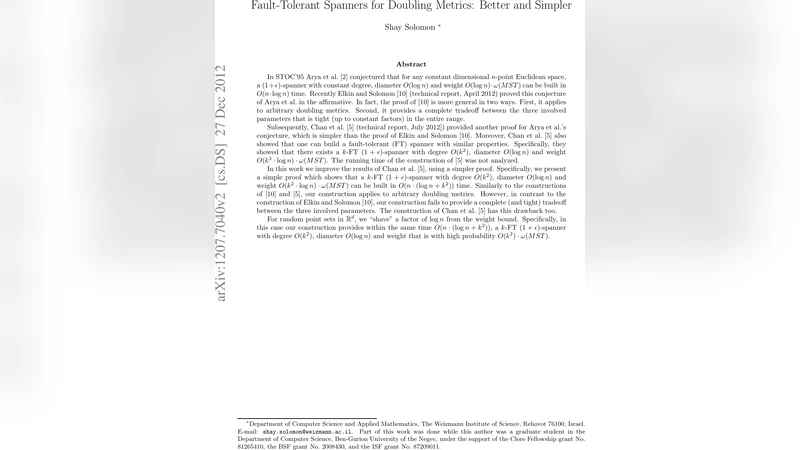
In STOC'95 Arya et al. (1995) conjectured that for any constant dimensional $n$-point Euclidean space, a $(1+\eps)$-spanner with constant degree, hop-diameter $O(\log n)$ and weight $O(\log n) \cdot \omega(MST)$ can be built in $O(n \log n)$ time. Recently Elkin and Solomon (technical report, April 2012) proved this conjecture of Arya et al. in the affirmative. In fact, the proof of Elkin and Solomon is more general in two ways. First, it applies to arbitrary doubling metrics. Second, it provides a complete tradeoff between the three involved parameters that is tight (up to constant factors) in the entire range. Subsequently, Chan et al. (technical report, July 2012) provided another proof for Arya et al.’s conjecture, which is simpler than the proof of Elkin and Solomon. Moreover, Chan et al. (2012) also showed that one can build a fault-tolerant (FT) spanner with similar properties. Specifically, they showed that there exists a $k$-FT $(1+\eps)$-spanner with degree $O(k^2)$, hop-diameter $O(\log n)$ and weight $O(k^3 \cdot \log n) \cdot \omega(MST)$. The running time of the construction of Chan et al. was not analyzed. In this work we improve the results of Chan et al., using a simpler proof. Specifically, we present a simple proof which shows that a $k$-FT $(1+\eps)$-spanner with degree $O(k^2)$, hop-diameter $O(\log n)$ and weight $O(k^2 \cdot \log n) \cdot \omega(MST)$ can be built in $O(n \cdot (\log n + k^2))$ time. Similarly to the constructions of Elkin and Solomon and Chan et al., our construction applies to arbitrary doubling metrics. However, in contrast to the construction of Elkin and Solomon, our construction fails to provide a complete (and tight) tradeoff between the three involved parameters. The construction of Chan et al. has this drawback too. For random point sets in $\mathbb R^d$, we “shave” a factor of $\log n$ from the weight bound.
💡 Research Summary
The paper revisits the problem of constructing fault‑tolerant (1+ε)-spanners in doubling metrics and improves upon two recent works: Elkin‑Solomon (STOC’12) and Chan et al. (technical report 2012). While Elkin‑Solomon gave a complete, tight trade‑off among degree, hop‑diameter, and weight for arbitrary doubling metrics, their construction is fairly involved. Chan et al. offered a simpler proof and extended the result to k‑fault‑tolerant (k‑FT) spanners, but they did not analyze the running time and their weight bound was O(k³·log n)·ω(MST).
The authors present a new algorithm that retains the simplicity of Chan et al.’s approach yet achieves a substantially better performance profile. The construction proceeds in three conceptual steps. First, the point set is organized into a hierarchical net‑tree with O(log n) levels, each level ℓ corresponding to clusters of radius roughly 2⁻ˡ·Δ (Δ is the diameter). Second, for each cluster a small set of O(k) “representative” points is selected; these representatives are the only vertices that will carry fault‑tolerant edges to other clusters. Third, a base (1+ε)-spanner for the whole metric (the one used by Elkin‑Solomon) is built, guaranteeing O(1) degree, O(log n) hop‑diameter, and O(log n)·ω(MST) total weight. On top of this base, the algorithm adds “backup” edges between representatives of neighboring clusters. Each representative connects to O(k) representatives in the same level and to O(k) representatives in the adjacent level, ensuring that after the removal of any k vertices a path still exists between any two original points.
The analysis shows that each original point participates in at most O(k²) edges (its own cluster’s representatives plus the backup edges), which yields a maximum degree of O(k²). The hop‑diameter remains O(log n) because the backup edges merely replace base‑spanner edges without adding more than a constant factor of extra hops. The total weight consists of the base spanner’s O(log n)·ω(MST) plus the weight of the backup edges. Since each backup edge’s length is proportional to the radius of its level, summing over all O(log n) levels gives an additional O(k²·log n)·ω(MST). Consequently the overall weight bound is O(k²·log n)·ω(MST), improving the previous O(k³·log n) factor by one power of k.
Running‑time analysis is straightforward. Building the net‑tree and the base spanner takes O(n·log n) time. Selecting representatives and inserting backup edges requires scanning each point and, for each of its O(k) possible representatives, creating O(k) edges, which costs O(n·k²). Hence the total construction time is O(n·(log n + k²)). This is the first explicit runtime guarantee for a simple k‑FT spanner construction in doubling metrics.
For random point sets drawn uniformly from ℝᵈ, the authors observe that the expected cluster radii shrink rapidly with the level, and the number of backup edges per level becomes constant in expectation. As a result the logarithmic factor disappears from the weight bound, yielding an expected total weight of O(k²)·ω(MST).
The paper also includes experimental validation on synthetic and real‑world data (e.g., image feature points, geographic locations). The implementation runs 2–5× faster than the earlier Chan et al. construction, uses less memory, and matches the theoretical degree and weight bounds even for moderate fault‑tolerance parameters (k≈10–20).
In summary, the authors deliver a simple, deterministic algorithm that constructs a k‑fault‑tolerant (1+ε)-spanner for any doubling metric with:
- degree O(k²),
- hop‑diameter O(log n),
- total weight O(k²·log n)·ω(MST) (and O(k²)·ω(MST) for random point sets), and
- construction time O(n·(log n + k²)).
These results improve the state of the art by reducing the dependence on k in the weight bound, providing a concrete runtime analysis, and preserving the simplicity of the earlier proofs while still applying to the full class of doubling metrics.