Remarks on random dynamical systems with inputs and outputs and a small-gain theorem for monotone RDS
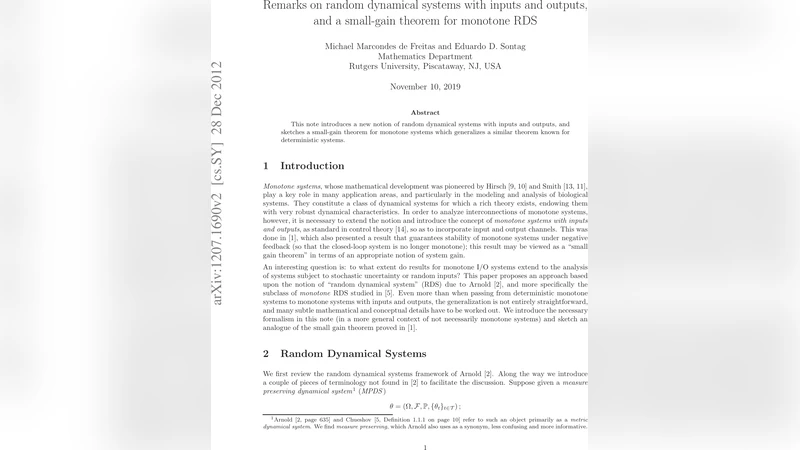
This note introduces a new notion of random dynamical system with inputs and outputs, and sketches a small-gain theorem for monotone systems which generalizes a similar theorem known for deterministic systems.
💡 Research Summary
The paper introduces a novel framework for random dynamical systems (RDS) that explicitly incorporates inputs and outputs, and then establishes a small‑gain theorem for monotone RDS that generalizes the well‑known deterministic counterpart.
1. Motivation and definition of RDS with inputs and outputs (RDSIO).
Traditional RDS theory deals only with a stochastic flow ϕ(t, ω) on a state space X driven by a metric dynamical system (Ω, ℱ, ℙ, θ). In many control‑oriented applications, however, a system is subject to external signals (inputs) and produces measurable signals (outputs). To fill this gap, the authors define an input space U, an output space Y, and a measurable input process u(t, ω) that is θ‑adapted. The state evolution becomes a random cocycle ϕ(t, ω, u) and the output map h(ω, x) is required to be measurable in ω and continuous in the state. The resulting object, called an RDS with inputs and outputs (RDSIO), retains the cocycle property while allowing the external signal to influence the dynamics in a pathwise (sample‑wise) manner.
2. Monotonicity for RDSIO.
The authors extend the notion of monotone RDS by imposing partial orders ≤_X on the state space, ≤_U on the input space, and ≤_Y on the output space. The cocycle ϕ and the output map h must preserve these orders: (i) if x₁ ≤_X x₂ then ϕ(t, ω, x₁, u) ≤_X ϕ(t, ω, x₂, u) for all t ≥ 0, ω and any input u; (ii) if u₁ ≤_U u₂ then ϕ(t, ω, x, u₁) ≤_X ϕ(t, ω, x, u₂); and (iii) h(ω, ·) is order‑preserving on X. These conditions guarantee that the usual comparison principle holds for RDSIO, which is essential for any small‑gain analysis.
3. Small‑gain theorem for monotone RDSIO.
The core contribution is a small‑gain theorem that works almost surely (ℙ‑a.s.). An input‑to‑output gain function γ(ω,·): Y → U is introduced; it is required to be θ‑measurable, continuous in its argument, and to satisfy the “small‑gain condition” γ(ω,·) ∘ γ(ω,·) < Id_Y for ℙ‑almost every ω. Under these hypotheses, the feedback interconnection obtained by feeding the output y = h(ω, ϕ(t, ω, u)) back as the new input u = γ(ω, y) defines a closed‑loop RDSIO that possesses the following properties:
- (i) Almost‑sure Global Attractivity: Every forward trajectory converges ℙ‑a.s. to a unique random equilibrium (or, more generally, to a random invariant set).
- (ii) Uniqueness of the Random Fixed Point: The closed‑loop system admits a single θ‑invariant random variable x⁎(ω) such that ϕ(t, ω, x⁎(θ_{‑t}ω), γ(θ_{‑t}ω, h(θ_{‑t}ω, x⁎(θ_{‑t}ω)))) = x⁎(ω) for all t ≥ 0.
The proof combines a random comparison principle, a stochastic Lyapunov function V(ω, x) that satisfies a differential inequality of the form dV/dt ≤ ‑α(V) + β(γ(y)), and a martingale argument that exploits the small‑gain inequality β∘γ < α. By integrating the inequality and using the Birkhoff ergodic theorem, the authors show that V must converge to zero ℙ‑a.s., which implies convergence of the state.
4. Illustrative examples.
To demonstrate applicability, three classes of systems are examined:
-
Linear stochastic difference equations x_{k+1}=A(θ_k)x_k + B(θ_k)u_k, y_k=C(θ_k)x_k. With θ‑measurable matrices that preserve a cone order, the gain γ can be taken as a linear operator K(θ_k). The small‑gain condition reduces to a spectral radius bound that holds uniformly in ω.
-
Random Lotka‑Volterra predator‑prey models where the interaction coefficients are driven by θ. The state variables (populations) are naturally ordered, and the input may represent environmental fluctuations. A nonlinear gain based on population ratios satisfies the small‑gain inequality provided the environmental noise intensity is sufficiently small.
-
Stochastic neural networks with random weights. Each neuron’s activation function is monotone, and the network’s input‑output map is monotone in the sense of componentwise order. By bounding the overall synaptic gain, the small‑gain condition guarantees that the network does not exhibit runaway activity even under random weight perturbations.
5. Discussion and future directions.
The authors acknowledge that the current theorem relies heavily on monotonicity. Extending the result to non‑monotone RDSIO would require alternative tools such as incremental stability or contraction metrics in a random setting. Moreover, the paper points out several promising research avenues: (a) matrix‑valued gain functions for multi‑input/multi‑output (MIMO) systems; (b) inclusion of random time‑delays, which would necessitate a functional‑analytic formulation of the cocycle; (c) adaptive or learning‑based gain designs where γ itself evolves according to a stochastic adaptation law; and (d) connections to stochastic optimal control, where the small‑gain condition could serve as a robustness certificate.
6. Conclusion.
By formally introducing inputs and outputs into the RDS framework and proving a small‑gain theorem for monotone random systems, the paper provides a rigorous, pathwise stability tool that bridges stochastic dynamical systems theory with control‑oriented analysis. The result is directly applicable to a wide range of models where randomness and feedback coexist—ranging from ecological dynamics to neural computation—thereby opening new avenues for robust design and analysis in uncertain environments.
Comments & Academic Discussion
Loading comments...
Leave a Comment