Linear Operator Inequality and Null Controllability with Vanishing Energy for unbounded control systems
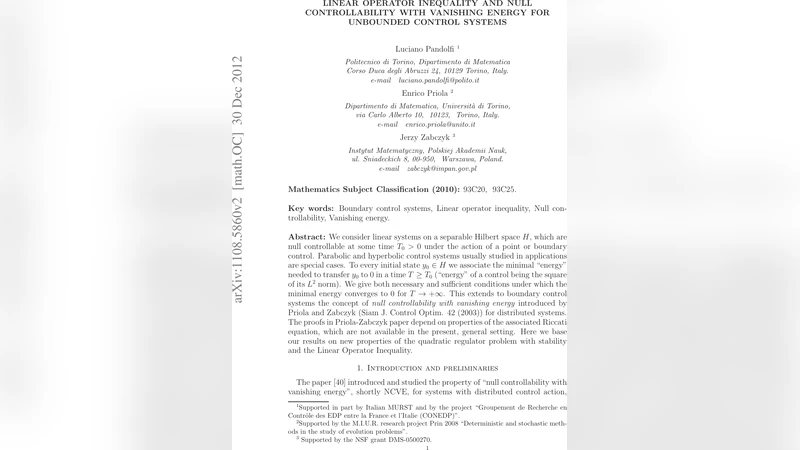
We consider linear systems on a separable Hilbert space $H$, which are null controllable at some time $T_0>0$ under the action of a point or boundary control. Parabolic and hyperbolic control systems usually studied in applications are special cases. To every initial state $ y_0 \in H$ we associate the minimal “energy” needed to transfer $ y_0 $ to $ 0 $ in a time $ T \ge T_0$ (“energy” of a control being the square of its $ L^2 $ norm). We give both necessary and sufficient conditions under which the minimal energy converges to $ 0 $ for $ T\to+\infty $. This extends to boundary control systems the concept of null controllability with vanishing energy introduced by Priola and Zabczyk (Siam J. Control Optim. 42 (2003)) for distributed systems. The proofs in Priola-Zabczyk paper depend on properties of the associated Riccati equation, which are not available in the present, general setting. Here we base our results on new properties of the quadratic regulator problem with stability and the Linear Operator Inequality.
💡 Research Summary
The paper studies linear control systems on a separable Hilbert space (H) of the form
\
Comments & Academic Discussion
Loading comments...
Leave a Comment