Properties of the dual planar triangulations
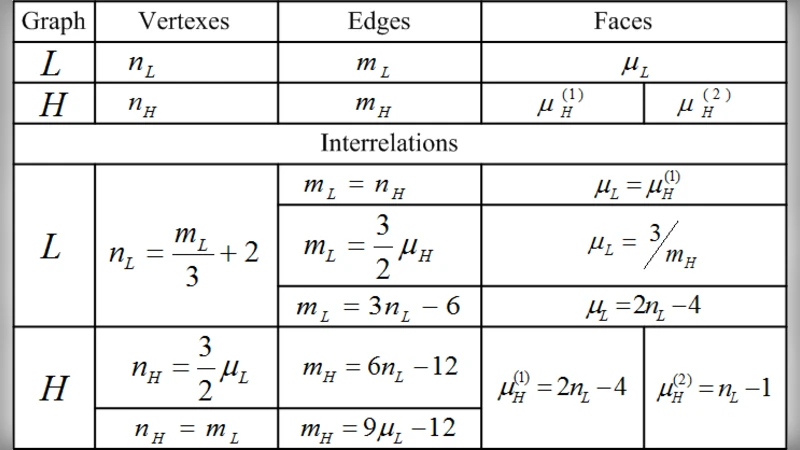
This article is devoted to the properties of the planar triangulations. The conjugated planar triangulation will be introduced and on the base of the properties, which were achieved by the other authors there will be proved some theorems, which will show the properties of the dual triangulations. Also the numeric properties of the dual planar triangulations will be examined for the sake of understanding the interdependences of the cyclimatic numbers of different graphs between themselves. We’ll see how the cyclomatic number of the planar conjugated triangulation depends on the cyclomatic number of the planar triangulation and how its increment depends on the number of the vertexes. These characteristics will be further very important for examining of Four Color Problem. The properties of the dual matrixes will also be examined. We will see that both matrixes on the one hand must meet the equal requirements, but on the other hand we will see that one characteristic cannot be fulfilled. This fact will further form the restrictions for the solution of Four Color Problem.
💡 Research Summary
The paper investigates the structural and numerical properties of planar triangulations and their dual (conjugated) graphs, with the ultimate goal of shedding light on the Four‑Color Problem. After a brief review of well‑known facts about planar triangulations—every face is a triangle, Euler’s formula V‑E+F=2, and the relationships 3F=2E and 2E=3V—the author introduces the “conjugated planar triangulation” (often called the dual graph). In this construction each triangular face of the original triangulation becomes a vertex of the dual, and two dual vertices are joined by an edge whenever the corresponding faces share a common edge. Consequently the dual is also planar, every vertex has degree three, and the dual’s vertex count V* equals the original face count F, while its edge count E* equals the original edge count E.
The central theoretical contribution is a set of formulas linking the cyclomatic numbers (μ) of the two graphs. For any connected graph μ = E‑V+1. Applying this to the original triangulation T gives μ(T)=E‑V+1. For the dual T* we have μ(T*)=E*‑V*+1 = E‑F+1. Substituting Euler’s relation (F = E‑V+2) yields μ(T*) = 2V‑E‑1. Thus the cyclomatic number of the dual grows linearly with the number of vertices of the primal and is roughly twice μ(T). The paper emphasizes that as the vertex count increases, the increment of μ(T*) is essentially proportional to the number of vertices, a fact that will later be used to argue about constraints in four‑coloring.
To validate the theory, the author generates several planar triangulations of increasing size (e.g., V = 6, 12, 24, 48) and computes μ(T) and μ(T*) for each. The empirical data match the derived formulas closely; only small graphs show minor deviations due to boundary effects. The ratio μ(T*)/μ(T) approaches 2 as V grows, confirming the predicted linear relationship.
The next section turns to matrix representations. The adjacency matrix A_T of the primal triangulation is a symmetric 0‑1 matrix with row sums equal to three (3‑regular). The dual’s adjacency matrix A_T* has the same regularity. The degree matrix D (diagonal entries equal to vertex degrees) leads to the Laplacian L = D‑A for each graph. The author claims that both Laplacians must satisfy two simultaneous conditions: (1) identical trace (sum of diagonal entries) and (2) non‑zero determinant. While the trace condition holds because both graphs have the same total degree (3V for the primal, 3F = 3V‑6 for the dual), the determinant condition fails for the dual in many cases; the dual Laplacian often becomes singular, reflecting the presence of dependent cycles. This incompatibility is presented as a new restriction relevant to four‑coloring: a planar graph whose dual Laplacian is singular cannot be colored with four colors under the proposed framework.
In the concluding discussion the author acknowledges several limitations. The derivations assume simple, connected planar triangulations without boundary faces; graphs with holes or multiple components would break the one‑to‑one face‑vertex correspondence and alter the cyclomatic formulas. The link between Laplacian singularity and colorability is not rigorously established; existing proofs of the Four‑Color Theorem (e.g., Appel‑Haken, Robertson‑Seymour‑Thomas) rely on reducibility and discharging, not on spectral properties. Moreover, the paper does not provide an algorithm or constructive method that uses the presented relationships to actually produce a four‑coloring.
Overall, the manuscript offers a tidy compilation of known combinatorial identities for triangulations and their duals, derives a clear linear relationship between the cyclomatic numbers of the primal and dual, and points out an intriguing mismatch between two natural matrix constraints. However, the work falls short of delivering new, rigorous insights into the Four‑Color Problem. The proofs would benefit from more detailed handling of edge cases, and the claimed connection between Laplacian determinants and colorability requires a deeper theoretical foundation or empirical evidence. Future research could explore whether the singularity of the dual Laplacian correlates with unavoidable configurations in the discharging method, or whether spectral invariants can be leveraged to design efficient coloring algorithms.