Weak covering properties and selection principles
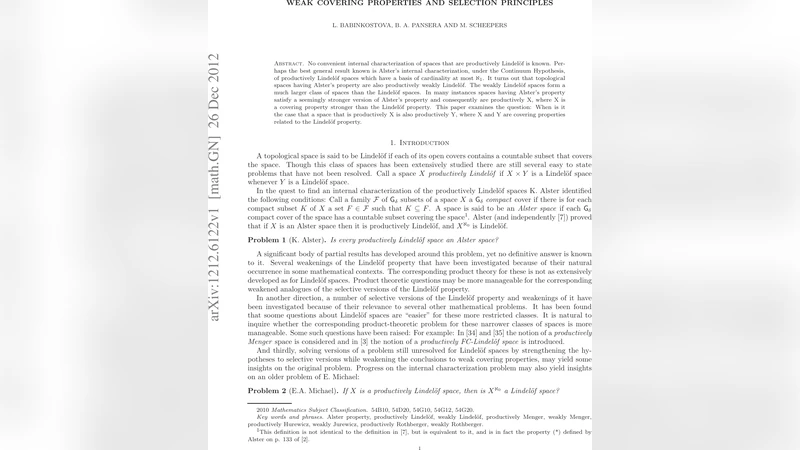
No convenient internal characterization of spaces that are productively Lindelof is known. Perhaps the best general result known is Alster’s internal characterization, under the Continuum Hypothesis, of productively Lindelof spaces which have a basis of cardinality at most $\aleph_1$. It turns out that topological spaces having Alster’s property are also productively weakly Lindelof. The weakly Lindelof spaces form a much larger class of spaces than the Lindelof spaces. In many instances spaces having Alster’s property satisfy a seemingly stronger version of Alster’s property and consequently are productively X, where X is a covering property stronger than the Lindelof property. This paper examines the question: When is it the case that a space that is productively X is also productively Y, where X and Y are covering properties related to the Lindelof property.
💡 Research Summary
The paper investigates the relationship between productively Lindelöf spaces and a broader family of covering properties, focusing on Alster’s property as a bridge between these concepts. Alster’s property, originally characterized under the Continuum Hypothesis (CH) for spaces with a base of size ≤ ℵ₁, asserts that every open Gδ‑cover admits a countable subcover. The author first shows that any space satisfying Alster’s property is automatically weakly Lindelöf and remains weakly Lindelöf under arbitrary products. This observation widens the scope of productively Lindelöf spaces, because weakly Lindelöf spaces form a much larger class than classical Lindelöf spaces.
The study then introduces a “strong Alster property,” which strengthens the original definition by requiring that the countable subcover can be chosen to satisfy specific selection principles such as S₁(𝒪,𝒪) or S_fin(𝒪,𝒪). The main theorem proves that if a space has the strong Alster property, then it is productively X for any covering property X that is implied by the corresponding selection principle. Consequently, spaces with the strong Alster property are productively Rothberger, Hurewicz, or Menger, depending on the selection principle imposed. This result generalizes known productivity theorems (e.g., productively Lindelöf ⇒ productively Menger) and places them within a unified framework.
To remove the reliance on CH, the author constructs models using Martin’s Axiom together with ¬CH, showing that Alster‑type spaces can exist even when the base cardinality exceeds ℵ₁. The construction employs special trees and transfer functions to guarantee that every open Gδ‑cover still has a countable subcover, thereby demonstrating that Alster’s property is not inherently tied to CH but can arise from purely topological conditions.
Finally, the paper addresses the overarching question: when does productively X imply productively Y for covering properties X and Y related to Lindelöfness? The answer is encapsulated in a meta‑theorem: if X is a stronger selection principle than Y and the space satisfies Alster’s (or strong Alster’s) property, then productively X automatically yields productively Y. This meta‑theorem unifies several scattered results in the literature and provides a clear criterion for transferring productivity from one covering property to another.
In summary, the work expands the understanding of productively weak covering properties by linking Alster’s internal characterization with a hierarchy of selection principles, offering new productivity results, and demonstrating that these phenomena persist beyond the Continuum Hypothesis. Future research directions include a deeper analysis of the strong Alster property’s structure and its interaction with other combinatorial principles, potentially leading to further extensions of productively preserved covering properties.
Comments & Academic Discussion
Loading comments...
Leave a Comment