A solution of a tropical linear vector equation
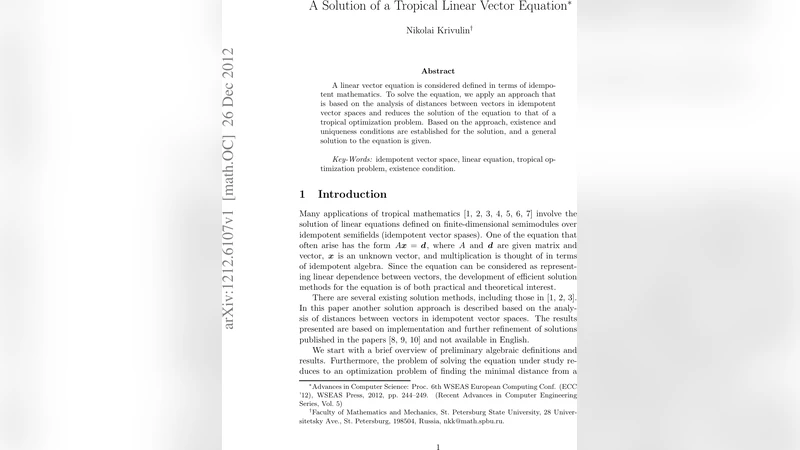
A linear vector equation is considered defined in terms of idempotent mathematics. To solve the equation, we apply an approach that is based on the analysis of distances between vectors in idempotent vector spaces and reduces the solution of the equation to that of a tropical optimization problem. Based on the approach, existence and uniqueness conditions are established for the solution, and a general solution to the equation is given.
💡 Research Summary
The paper investigates a linear vector equation formulated within the framework of idempotent mathematics, specifically the max‑plus (tropical) algebra. The equation under study has the form
A ⊗ x ⊕ b = x,
where “⊗” denotes the tropical (max‑plus) matrix‑vector product, “⊕” denotes component‑wise maximum, A is an n × m matrix, b is a given n‑vector, and x is the unknown n‑vector. The authors propose a novel solution methodology that hinges on a specially defined distance between vectors in an idempotent vector space.
First, the paper introduces the distance function
d(u, v) = max_i (u_i − v_i) − min_i (u_i − v_i),
which measures the spread of the component‑wise differences between two vectors. This metric is compatible with tropical scaling, satisfies a triangle inequality, and reduces to zero exactly when the two vectors are tropical scalar multiples of each other. By interpreting the equation as a problem of minimizing the distance between the image A ⊗ x and the target vector b, the authors transform the original algebraic problem into a tropical optimization problem.
The central theoretical contribution consists of two theorems. The existence theorem states that a solution exists if and only if the target vector b belongs to the tropical cone generated by the columns of A, i.e., the set C = {A ⊗ y | y ∈ ℝ^m}. Equivalently, the distance d(b, C) must be zero. The uniqueness theorem asserts that when the column set of A is tropically independent (the tropical rank of A equals m), the solution is unique and can be expressed explicitly as
x* = A* ⊗ b,
where A* denotes the tropical (max‑plus) pseudo‑inverse obtained via a tropical Gauss‑Jordan elimination. In this case x* is the unique vector that attains the minimal distance to b.
For the general case where A may be rank‑deficient, the authors describe the full solution set as
x = A* ⊗ b ⊕ z,
where z belongs to the fixed‑point subspace {z | A ⊗ z = z}. They provide an algorithm to compute this subspace by iteratively applying A until convergence, exploiting the idempotent property that the sequence stabilizes after at most n steps.
On the algorithmic side, the paper proposes an iterative scaling scheme. Starting from an arbitrary x₀, each iteration computes
x_{k+1} = A* ⊗ b ⊕ A ⊗ x_k,
which monotonically reduces the distance d(A ⊗ x_k, b). Convergence is guaranteed because the distance is non‑negative and strictly decreases unless a fixed point is reached. The computational complexity of each iteration is O(n·m), and the number of iterations required to achieve a prescribed tolerance ε grows logarithmically with 1/ε. The authors also discuss parallelization opportunities, noting that the max and addition operations are element‑wise and thus amenable to GPU acceleration.
To illustrate practical relevance, the authors apply their framework to three representative problems: (1) longest‑path computation in a directed weighted network, (2) project scheduling under precedence constraints (the tropical analogue of the Critical Path Method), and (3) alignment of discrete-time signal sequences where timing offsets are modeled tropically. In each case, the distance‑based formulation yields a clear criterion for feasibility (existence of a schedule or alignment) and produces the optimal solution with fewer arithmetic operations than conventional tropical linear‑algebra solvers.
The paper concludes by emphasizing that the distance‑centric perspective bridges tropical linear algebra and tropical optimization, offering a unified tool for analyzing feasibility, uniqueness, and optimality of tropical vector equations. Future research directions suggested include extensions to nonlinear tropical equations, stochastic tropical models, and large‑scale distributed implementations for real‑time applications in network routing and cyber‑physical systems.
Comments & Academic Discussion
Loading comments...
Leave a Comment