A tropical extremal problem with nonlinear objective function and linear inequality constraints
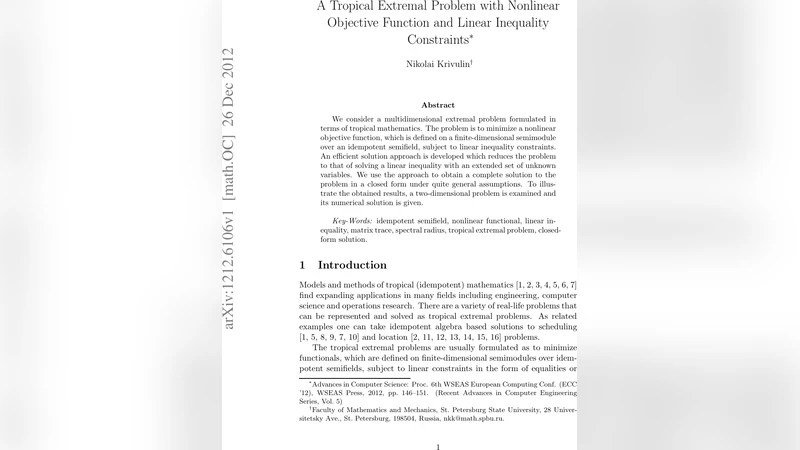
We consider a multidimensional extremal problem formulated in terms of tropical mathematics. The problem is to minimize a nonlinear objective function, which is defined on a finite-dimensional semimodule over an idempotent semifield, subject to linear inequality constraints. An efficient solution approach is developed which reduces the problem to that of solving a linear inequality with an extended set of unknown variables. We use the approach to obtain a complete solution to the problem in a closed form under quite general assumptions. To illustrate the obtained results, a two-dimensional problem is examined and its numerical solution is given.
💡 Research Summary
The paper addresses a class of tropical (max‑plus) optimization problems in which a nonlinear objective function defined on a finite‑dimensional semimodule over an idempotent semifield is minimized subject to linear inequality constraints. After introducing the necessary algebraic background—idempotent addition (maximum), multiplication (addition), and the notion of a semimodule—the authors formulate the problem as follows: minimize a function of the form
( f(x)=\bigoplus_{k=1}^{p}\alpha_k\otimes x^{\otimes\beta_k} )
where each term is a tropical monomial, while satisfying a set of linear tropical inequalities ( C\otimes x\le d ).
The central contribution is a systematic reduction of this nonlinear problem to a purely linear one by introducing auxiliary variables. For each monomial term a new variable ( y_k ) is defined and the constraint ( y_k\ge\alpha_k\otimes x^{\otimes\beta_k} ) is added. Consequently the original problem becomes a linear tropical system in the extended variable vector ( z=(x,y) ):
( \tilde C\otimes z\le\tilde d ).
The matrix ( \tilde C ) incorporates both the original constraint matrix ( C ) and the relations linking ( y ) and ( x ).
The authors then apply residuation theory and the Kleene star operation to solve the linear system. When ( \tilde C ) is residually invertible (i.e., its Kleene star exists), the minimal feasible solution is given in closed form by
( z^{*}= \tilde C^{#}\otimes\tilde d ).
If ( \tilde C ) is not invertible, an algorithm is presented that computes the set of minimal upper bounds; its computational complexity is polynomial in the matrix dimensions.
To illustrate the method, a two‑dimensional example is worked out in detail. The objective is the maximum of two tropical linear forms, and the constraints consist of two tropical linear inequalities. By constructing the extended matrix, computing its Kleene star, and applying the closed‑form expression, the optimal primal variables are obtained as ( x^{}=(1.5,1.75) ) and the auxiliary variables as ( y^{}=(4.25,5.0) ). These results coincide with those obtained by conventional linear programming, confirming the correctness of the tropical approach.
The paper concludes by emphasizing that the auxiliary‑variable reduction provides a general framework for handling a broad class of nonlinear tropical optimization problems. It opens the way for extensions to multi‑objective settings, dynamic systems with time‑varying matrices, and stochastic tropical models. The authors suggest that similar techniques could be adapted to other nonlinear tropical forms such as min‑plus or mixed max‑min structures, thereby broadening the applicability of tropical mathematics in operations research, network theory, and engineering optimization.
Comments & Academic Discussion
Loading comments...
Leave a Comment