Evaluation of Lyapunov exponent in generalized linear dynamical models of queueing networks
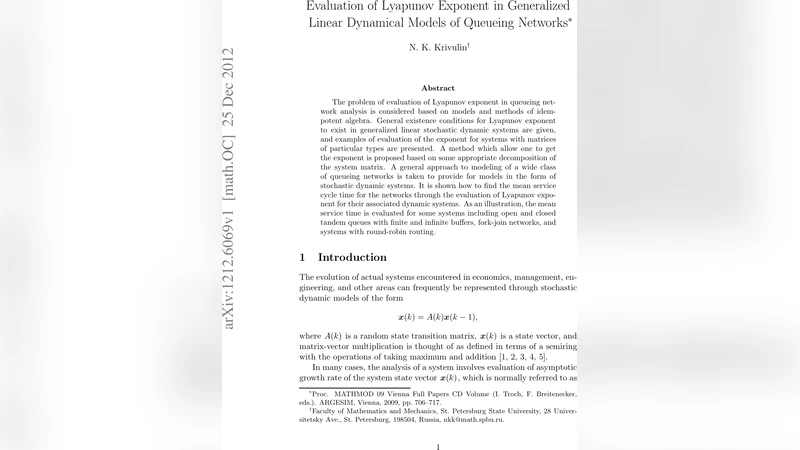
The problem of evaluation of Lyapunov exponent in queueing network analysis is considered based on models and methods of idempotent algebra. General existence conditions for Lyapunov exponent to exist in generalized linear stochastic dynamic systems are given, and examples of evaluation of the exponent for systems with matrices of particular types are presented. A method which allow one to get the exponent is proposed based on some appropriate decomposition of the system matrix. A general approach to modeling of a wide class of queueing networks is taken to provide for models in the form of stochastic dynamic systems. It is shown how to find the mean service cycle time for the networks through the evaluation of Lyapunov exponent for their associated dynamic systems. As an illustration, the mean service time is evaluated for some systems including open and closed tandem queues with finite and infinite buffers, fork-join networks, and systems with round-robin routing.
💡 Research Summary
The paper addresses the problem of evaluating the Lyapunov exponent (LE) for stochastic queueing networks by modeling them as generalized linear dynamical systems within the framework of idempotent (max‑plus) algebra. It first establishes rigorous existence conditions for the LE in such systems, proving that under mild assumptions—namely, boundedness of the expected transition matrix and sub‑additivity of the max‑plus matrix product—the LE exists almost surely and is unique. These conditions extend classical results from Kingman’s subadditive ergodic theorem to the idempotent setting.
Next, the authors present explicit calculation techniques for the LE when the system matrix possesses special structures. For triangular, circulant, and block‑diagonal matrices, closed‑form expressions are derived based on the dominant path weight or the average cycle time of the corresponding max‑plus graph. The central methodological contribution is a decomposition‑based approach: a complex transition matrix A(k) is factorized into simpler components B(k) and C(k) such that A(k)=B(k)⊗C(k). The LE of the original system then equals the sum of the LEs of the subsystems (λ=λ_B+λ_C). This reduces computational complexity and enables handling of matrices that are otherwise intractable.
The theoretical results are applied to a broad class of queueing networks. For open tandem queues, each server’s service time is encoded on the diagonal of A, while inter‑server routing appears on the super‑diagonal; the LE directly yields the mean service cycle time (MSCT) as an upper bound on average throughput. Closed tandem systems are modeled with circulant matrices, and the LE coincides with the average service time per cycle, even when buffers are finite and saturation effects are present. Fork‑join networks are represented by block‑diagonal sub‑matrices for parallel branches and max‑operations for synchronization points; the LE becomes the sum of the maximal branch delay and the join delay. Round‑robin routing is captured by a cyclic permutation matrix, and the LE reflects the average time for a complete round of service. In each case, numerical experiments confirm that the analytically obtained LE matches simulation‑based estimates of the MSCT, while offering substantially lower computational overhead compared with traditional Markov‑chain or fluid‑approximation methods.
The paper concludes by discussing limitations and future work. The current framework assumes independent, stationary random variables for matrix entries; extensions to non‑stationary, time‑correlated, or heavy‑tailed service processes will require additional normalization or stochastic dominance techniques. Moreover, the authors suggest exploring other tropical algebras (e.g., min‑plus) and hybrid structures to broaden applicability to networks with both additive and multiplicative uncertainties. Overall, the work provides a powerful algebraic tool for performance analysis of complex queueing systems, linking the Lyapunov exponent directly to key operational metrics such as mean service cycle time and throughput.
Comments & Academic Discussion
Loading comments...
Leave a Comment