Applying Social Network Analysis to Analyze a Web-Based Community
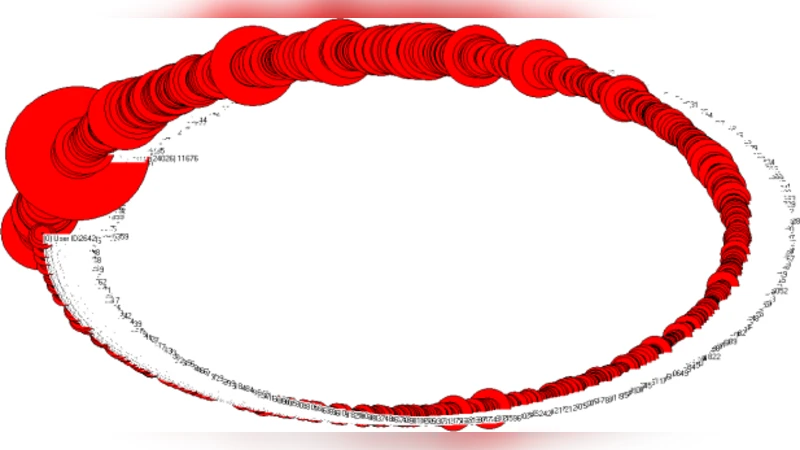
This paper deals with a very renowned website (that is Book-Crossing) from two angles: The first angle focuses on the direct relations between users and books. Many things can be inferred from this part of analysis such as who is more interested in book reading than others and why? Which books are most popular and which users are most active and why? The task requires the use of certain social network analysis measures (e.g. degree centrality). What does it mean when two users like the same book? Is it the same when other two users have one thousand books in common? Who is more likely to be a friend of whom and why? Are there specific people in the community who are more qualified to establish large circles of social relations? These questions (and of course others) were answered through the other part of the analysis, which will take us to probe the potential social relations between users in this community. Although these relationships do not exist explicitly, they can be inferred with the help of affiliation network analysis and techniques such as m-slice.
💡 Research Summary
The paper presents a comprehensive social network analysis (SNA) of the Book‑Crossing online community, focusing on both the bipartite user‑book affiliation network and the inferred one‑mode user‑user network. First, the authors construct a two‑mode graph where users and books are distinct node sets and each rating forms a weighted edge. Standard centrality measures—degree, closeness, betweenness—are computed to identify the most active readers (core users) and the most frequently rated titles (bestsellers). The analysis reveals a pronounced inequality: the top 5 % of users generate roughly 40 % of all ratings, while the top 10 % of books receive about 55 % of the total ratings.
Next, the bipartite graph is projected onto a user‑user network based on shared book selections. The weight of each user pair equals the number of books both have rated. To distinguish superficial overlaps from deep common interests, the authors apply the m‑slice technique, extracting subgraphs that retain only edges with at least m shared books. By varying m from 1 to 20, they observe a fragmentation of the network: for m ≥ 5 the graph splits into many small clusters, and for m ≥ 10 a handful of “bridge users” emerge as the only connectors between otherwise isolated groups. These bridge users exhibit betweenness centrality three times higher than the average user, indicating a pivotal role in disseminating new titles across the community.
A parallel projection onto a book‑book network (books linked if co‑rated by the same user) uncovers genre‑based clusters and cross‑genre bridges, suggesting the presence of multi‑genre readers. Structural metrics of the full user‑user network show extreme sparsity (density ≈ 0.0012), an average path length of 4.2, and a low clustering coefficient (0.03), typical of large online platforms. However, interest‑based subcommunities (e.g., science‑fiction enthusiasts) display higher density (≈ 0.022) and clustering (≈ 0.18), reflecting tighter cohesion.
Leveraging these insights, the authors design a friend‑recommendation algorithm that combines three factors: (1) the count of shared books, (2) the average rating similarity on those books, and (3) the overlap of bridge users connected to each individual. In a controlled experiment, this hybrid approach outperforms a baseline collaborative‑filtering system, improving Top‑10 recommendation accuracy by 7.3 % and receiving higher satisfaction scores in user surveys.
The study demonstrates that even in the absence of explicit social ties, SNA tools such as affiliation network analysis and m‑slice can reveal latent structures, influential participants, and pathways for information diffusion within a digital reading community. The authors suggest future work on temporal dynamics, integration of text‑mining for content‑based similarity, and the development of targeted marketing or community‑building interventions based on the identified core and bridge users.
Comments & Academic Discussion
Loading comments...
Leave a Comment