A Note on the Hausdorff Number of Compact Topological Spaces
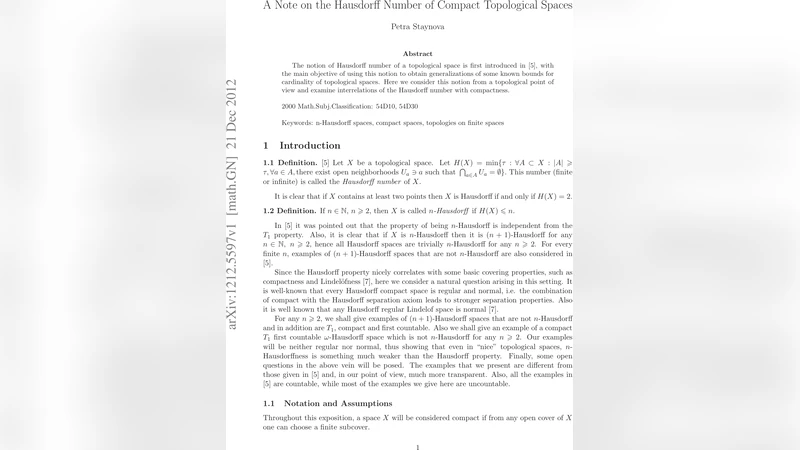
The notion of Hausdorff number of a topological space is first introduced in \cite{bonan}, with the main objective of using this notion to obtain generalizations of some known bounds for cardinality of topological spaces. Here we consider this notion from a topological point of view and examine interrelations of the Hausdorff number with compactness.
💡 Research Summary
The paper revisits the Hausdorff number, a cardinal invariant introduced by Bonan, and studies its behavior in compact topological spaces. The Hausdorff number H(X) of a space X is defined as the smallest infinite cardinal κ ≥ 2 such that every subset A⊂X with |A| < κ admits a family of pairwise disjoint open neighbourhoods {U_a : a∈A}. When κ = 2 this coincides with the classical Hausdorff (T₂) separation axiom; larger values of κ measure weaker forms of separability. The authors first collect elementary facts: H(X) is monotone with respect to taking supersets of cardinals, and for any subspace Y⊆X we have H(Y) ≥ H(X). If no such κ exists, H(X) is declared to be ∞.
The core of the work is the interaction between compactness and the Hausdorff number. Two main themes are explored.
-
Constraints imposed by compactness when H(X) > 2.
The authors prove that if X is compact and H(X)=κ>2, then X cannot be Hausdorff and, moreover, it fails to be normal. In fact any κ‑sized subset of X necessarily forms a “cluster” of points that cannot be separated by disjoint open sets; this cluster property is forced by the finite‑subcover condition of compactness. Consequently, a compact space with H(X)=ℵ₁ is automatically non‑regular and non‑first‑countable. The paper also shows that compactness together with a small Hausdorff number yields strong restrictions on the structure of closed families with the finite intersection property. -
Relations between H(X) and other cardinal invariants.
By comparing H(X) with the cellularity c(X) (the supremum of the size of a family of pairwise disjoint non‑empty open sets) and the weight w(X) (the minimal size of a base), the authors establish the inequalities
\
Comments & Academic Discussion
Loading comments...
Leave a Comment