The Williams Bjerknes Model on Regular Trees
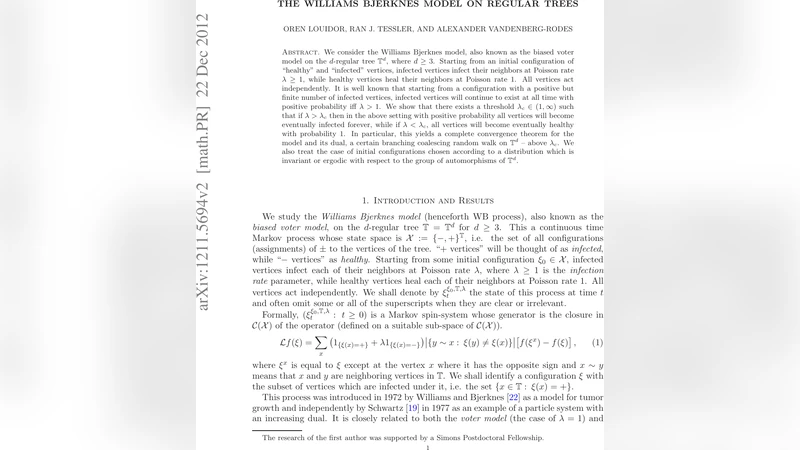
We consider the Williams Bjerknes model, also known as the biased voter model on the $d$-regular tree $\bbT^d$, where $d \geq 3$. Starting from an initial configuration of “healthy” and “infected” vertices, infected vertices infect their neighbors at Poisson rate $\lambda \geq 1$, while healthy vertices heal their neighbors at Poisson rate 1. All vertices act independently. It is well known that starting from a configuration with a positive but finite number of infected vertices, infected vertices will continue to exist at all time with positive probability iff $\lambda > 1$. We show that there exists a threshold $\lambda_c \in (1, \infty)$ such that if $\lambda > \lambda_c$ then in the above setting with positive probability all vertices will become eventually infected forever, while if $\lambda < \lambda_c$, all vertices will become eventually healthy with probability 1. In particular, this yields a complete convergence theorem for the model and its dual, a certain branching coalescing random walk on $\bbT^d$ – above $\lambda_c$. We also treat the case of initial configurations chosen according to a distribution which is invariant or ergodic with respect to the group of automorphisms of $\bbT^d$.
💡 Research Summary
The paper investigates the Williams‑Bjerknes model—also known as the biased voter model—on the infinite $d$‑regular tree $\mathbb{T}^d$ with $d\ge 3$. In this interacting particle system each vertex is either “infected’’ (state 1) or “healthy’’ (state 0). Infected vertices attempt to infect each of their neighbours at independent Poisson rate $\lambda\ge 1$, while healthy vertices attempt to heal each neighbour at Poisson rate 1. The dynamics are Markovian and spatially homogeneous.
Background and motivation.
On lattices the model exhibits a simple phase transition: if $\lambda>1$ the infection survives with positive probability, while for $\lambda\le 1$ it dies out almost surely. However, on a non‑amenable graph such as a regular tree the situation is richer. Even when the infection survives locally, it may either (i) spread to occupy the whole tree forever (global infection) or (ii) remain confined to a finite region and eventually disappear (global recovery). The precise parameter regime separating these two behaviours had not been identified.
Main contributions.
-
Existence of a second critical value $\lambda_c$.
The authors prove that there exists a finite threshold $\lambda_c\in(1,\infty)$ such that:- If $\lambda>\lambda_c$, then starting from any finite non‑zero number of infected vertices, with positive probability the infection expands without bound and eventually every vertex becomes infected forever.
- If $\lambda<\lambda_c$, then with probability 1 the infection recedes and all vertices become healthy after a finite random time.
Thus $\lambda_c$ separates a global survival phase from a global extinction phase.
-
Complete convergence theorem for $\lambda>\lambda_c$.
In the super‑critical regime the process converges, as $t\to\infty$, to a mixture of two extremal invariant measures: the all‑healthy configuration and the all‑infected configuration. The mixing weights are exactly the probabilities of eventual global extinction versus global infection, which depend only on the initial density of infected sites. This result mirrors classic complete convergence theorems for contact processes on $\mathbb{Z}^d$, but here it is established on a non‑amenable tree. -
Duality with a branching‑coalescing random walk (BCRW).
The authors construct a natural dual process: a collection of particles performing independent simple random walks on $\mathbb{T}^d$, branching at rate $\lambda-1$ and coalescing when they meet. This BCRW encodes the ancestry of infection attempts. They prove that survival of the BCRW is equivalent to global infection of the original model. Consequently, the critical value $\lambda_c$ can also be described as the branching‑coalescence threshold for the dual. -
Proof strategy for the existence of $\lambda_c$.
Upper bound (global infection). By coupling the original process with a supercritical oriented percolation on the tree, the authors show that for sufficiently large $\lambda$ the infection front advances linearly outward, creating an infinite infected cluster with positive probability.
Lower bound (global recovery). They introduce a “recoverability’’ property: for $\lambda$ close to 1 the infected cluster, once it reaches a certain size, has a uniformly positive chance to shrink below that size in a finite time. Using a recursive renewal argument they prove that the infection cannot sustain an infinite front when $\lambda<\lambda_c$, forcing eventual extinction. -
Extension to invariant and ergodic initial distributions.
The analysis is not limited to deterministic finite‑seed initial conditions. The authors consider any probability measure on ${0,1}^{\mathbb{T}^d}$ that is invariant (or ergodic) under the automorphism group of the tree. They show that the same dichotomy holds: for $\lambda>\lambda_c$ the system almost surely converges to the all‑infected state, while for $\lambda<\lambda_c$ it almost surely converges to the all‑healthy state. This demonstrates the robustness of the phase transition under spatially homogeneous randomness.
Technical highlights.
- The use of the tree’s large‑scale symmetry (its automorphism group) allows the construction of translation‑invariant couplings and simplifies the identification of extremal invariant measures.
- The branching‑coalescing random walk provides a clean probabilistic representation of the dual, making it possible to transfer known results from branching processes (e.g., Kesten–Stigum theorem) to the infection model.
- The complete convergence proof relies on a careful analysis of the “front’’ of infection, showing that once the front reaches a certain deterministic shape it either expands forever (supercritical) or collapses (subcritical).
Implications and future directions.
The identification of $\lambda_c$ enriches the understanding of phase transitions on non‑amenable graphs, showing that two distinct thresholds can coexist: one for local survival and another for global takeover. The methodology—particularly the dual BCRW and the coupling with oriented percolation—should be applicable to other interacting particle systems on trees, such as multi‑type contact processes, voter models with more than two opinions, or models with time‑varying rates. Determining the exact value of $\lambda_c$ as a function of $d$ remains an open problem; numerical simulations suggest it grows slowly with $d$, but a rigorous formula is lacking. Extending the results to random trees, Galton–Watson trees, or more general non‑amenable graphs would further test the universality of the two‑threshold phenomenon.
In summary, the paper establishes a sharp dichotomy for the biased voter model on regular trees, proves a complete convergence theorem in the supercritical regime, and links the dynamics to a branching‑coalescing random walk dual. These contributions significantly advance the theory of interacting particle systems on infinite, non‑amenable networks.
Comments & Academic Discussion
Loading comments...
Leave a Comment