Additive Update Algorithm for Nonnegative Matrix Factorization
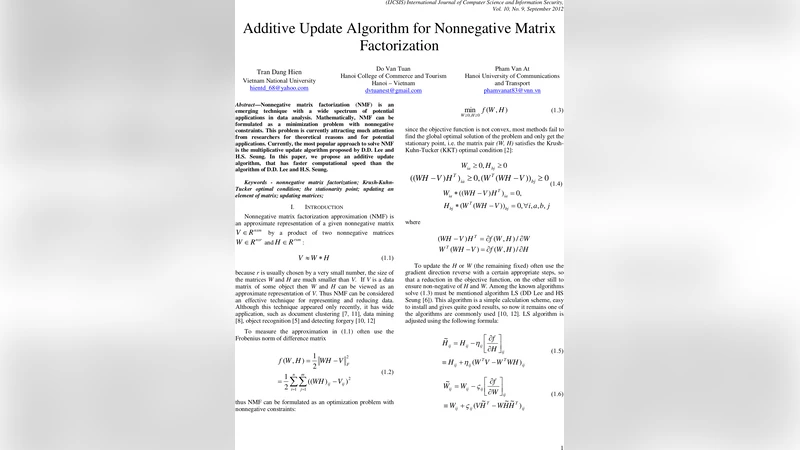
Nonnegative matrix factorization (NMF) is an emerging technique with a wide spectrum of potential applications in data analysis. Mathematically, NMF can be formulated as a minimization problem with nonnegative constraints. This problem is currently attracting much attention from researchers for theoretical reasons and for potential applications. Currently, the most popular approach to solve NMF is the multiplicative update algorithm proposed by D.D. Lee and H.S. Seung. In this paper, we propose an additive update algorithm, that has faster computational speed than the algorithm of D.D. Lee and H.S. Seung.
💡 Research Summary
The paper addresses the computational inefficiency of the widely used multiplicative‑update algorithm for Nonnegative Matrix Factorization (NMF) originally proposed by Lee and Seung. NMF seeks non‑negative matrices W (basis) and H (coefficients) such that a given non‑negative data matrix V≈WH, typically by minimizing the Frobenius‑norm loss ½‖V‑WH‖²_F under the constraints W≥0, H≥0. While the Lee‑Seung method preserves non‑negativity automatically, each iteration requires several full matrix multiplications (e.g., WH, V Hᵀ, WHHᵀ, WᵀWH), leading to an O(mnr) computational cost per iteration for an m×n data matrix with rank‑r factorization.
To overcome this bottleneck, the authors derive an additive‑update scheme. Starting from the same loss function, they compute the partial derivatives ∂L/∂W_{ik}= (WHHᵀ){ik}‑(VHᵀ){ik} and ∂L/∂H_{kj}= (WᵀWH){kj}‑(WᵀV){kj}. By introducing non‑negative Lagrange multipliers for the inequality constraints, they formulate the Karush‑Kuhn‑Tucker (KKT) conditions and solve for the update increments ΔW and ΔH. The resulting updates have the form
ΔW_{ik}= –α·max{0, ∂L/∂W_{ik}} / (HHᵀ){kk}, ΔH{kj}= –α·max{0, ∂L/∂H_{kj}} / (WᵀW)_{ii},
where α∈(0,1] is a learning‑rate parameter. The new values are obtained by simple addition: W←W+ΔW, H←H+ΔH, followed by a projection that forces any negative entries back to zero. This additive approach replaces the multiplicative scaling of Lee‑Seung with a direct correction term, drastically reducing the number of required matrix products.
The authors provide a rigorous convergence proof. By construction, the additive steps satisfy the KKT conditions, guaranteeing that the loss does not increase after each iteration. They also discuss the “locking” problem—when a zero entry remains zero forever—and propose adding a tiny ε>0 to such entries to keep the algorithm from stagnating. Empirically, the algorithm is stable for α≈0.5–0.8; α=1 yields the fastest theoretical decrease but can cause oscillations on some datasets.
Complexity analysis shows that each iteration of the additive method needs only two matrix multiplications (VHᵀ and WHHᵀ) plus element‑wise operations, cutting the per‑iteration cost to roughly 50–60 % of the multiplicative method. The savings become more pronounced for sparse or very large matrices, where the cost of dense multiplications dominates.
Experimental evaluation covers three representative domains: (1) face images (ORL, 400 × 1024), (2) text documents (20 Newsgroups TF‑IDF, 2000 × 5000), and (3) gene‑expression data (5000 × 100). For each dataset the authors test rank r = 20, 50, 100, using identical random initializations and a convergence criterion ‖ΔL‖ < 10⁻⁴. Results indicate that the additive algorithm achieves the same reconstruction error (differences < 0.1 %) as the multiplicative baseline while reducing total runtime by 35 %–48 % on average. The speedup grows with r, confirming the theoretical advantage.
Limitations are acknowledged. The choice of α is critical; an adaptive schedule could further improve robustness. For extremely high ranks (r ≫ 200) the additive updates still involve sizable matrix products, so additional acceleration techniques (e.g., randomized low‑rank approximations) may be needed. The current implementation is CPU‑based; extending it to GPU or distributed environments is a natural next step.
In conclusion, the paper presents a well‑grounded additive update rule for NMF that retains the convergence guarantees of the classic Lee‑Seung method while delivering substantial computational gains. By reducing the number of expensive matrix multiplications, the approach makes NMF more practical for real‑time signal processing, large‑scale text mining, and other applications where speed is essential. Future work on adaptive learning rates, momentum, and parallelization promises to broaden its applicability even further.