The War of Attrition in the Limit of Infinitely Many Players
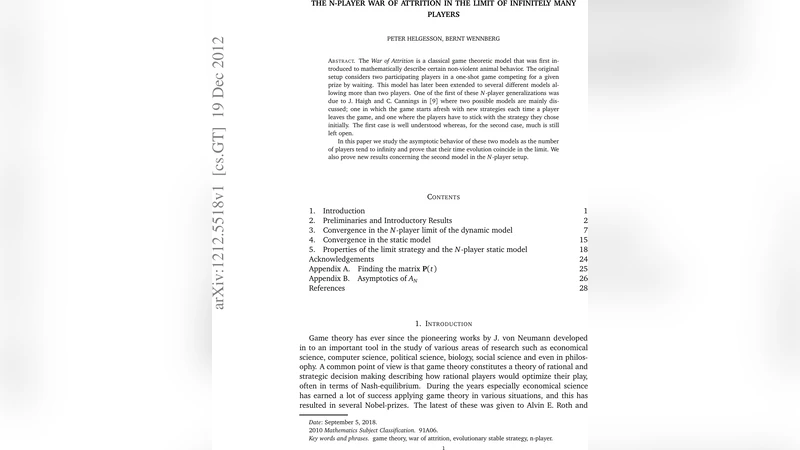
The “War of Attrition” is a classical game theoretic model that was first introduced to mathematically describe certain non-violent animal behavior. The original setup considers two participating players in a one-shot game competing for a given prize by waiting. This model has later been extended to several different models allowing more than two players. One of the first of these N-player generalizations was due to J. Haigh and C. Cannings (Acta Appl. Math.14) where two possible models are mainly discussed; one in which the game starts afresh with new strategies each time a player leaves the game, and one where the players have to stick with the strategy they chose initially. The first case is well understood whereas, for the second case, much is still left open. In this paper we study the asymptotic behavior of these two models as the number of players tend to infinity and prove that their time evolution coincide in the limit. We also prove new results concerning the second model in the N-player setup.
💡 Research Summary
The paper revisits the classic War of Attrition, a game‑theoretic model originally devised to capture non‑violent competition among animals, and focuses on its extension to a large population of players. Two distinct N‑player generalizations introduced by Haigh and Cannings are examined. In the first (“restart”) model, whenever a player quits the contest the remaining participants are allowed to redraw their waiting‑time strategies, effectively resetting the strategic environment. In the second (“fixed‑strategy”) model, each player commits to a waiting‑time distribution at the outset and must keep that choice for the entire duration of the game, even as opponents drop out.
The authors first establish the existence of a Bayes‑Nash equilibrium for the fixed‑strategy model when the number of players N is finite. By representing each player’s waiting time as a continuous random variable with density f(τ) and deriving the expected payoff U(τ;f), they obtain the first‑order optimality condition ∂U/∂τ = 0. Solving this condition yields an equilibrium density of exponential form f*(τ)=λ e^{‑λτ}, where the rate λ depends on the prize value and the cost of waiting. This result parallels the well‑known equilibrium of the two‑player game but required a non‑trivial analysis of the interaction among many agents.
Next, the paper turns to the asymptotic regime N → ∞. The population is treated as a continuum, and the time‑evolving density f(t,τ) satisfies a partial differential equation (PDE) that captures the flow of players through waiting‑time space. For the restart model the PDE includes a source term Λ(f) representing the influx of newly drawn strategies after each exit; for the fixed‑strategy model the source term vanishes, leaving only a transport term driven by the hazard rate v(f). Both PDEs share the same structure:
∂f/∂t = –∂
Comments & Academic Discussion
Loading comments...
Leave a Comment