Convex Hull and Linear Programming in Read-only Setup with Limited Work-space
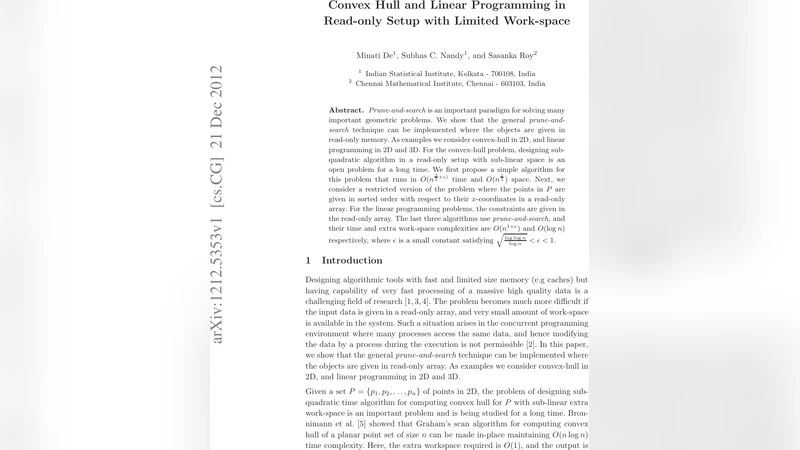
Prune-and-search is an important paradigm for solving many important geometric problems. We show that the general prune-and-search technique can be implemented where the objects are given in read-only memory. As examples we consider convex-hull in 2D, and linear programming in 2D and 3D. For the convex-hull problem, designing sub-quadratic algorithm in a read-only setup with sub-linear space is an open problem for a long time. We first propose a simple algorithm for this problem that runs in $O(n^{3/2+\epsilon)}$ time and $O(n^(1/2))$ space. Next, we consider a restricted version of the problem where the points in $P$ are given in sorted order with respect to their $x$-coordinates in a read-only array. For the linear programming problems, the constraints are given in the read-only array. The last three algorithms use {\it prune-and-search}, and their time and extra work-space complexities are $O(n^{1 + \epsilon})$ and $O(\log n)$ respectively, where $\epsilon$ is a small constant satisfying $\sqrt{\frac{\log\log n}{\log n}} < \epsilon < 1$.
💡 Research Summary
The paper tackles a fundamental challenge in computational geometry and linear programming: how to design efficient algorithms when the input data resides in a read‑only memory and only a sub‑linear amount of extra workspace is available. This model reflects realistic constraints in embedded systems, streaming environments, and massive‑scale data processing where the entire dataset cannot be duplicated or arbitrarily reordered. The authors focus on two classic problems—computing the convex hull of a planar point set and solving linear programming (LP) instances in two and three dimensions—and show how the well‑known prune‑and‑search paradigm can be adapted to operate under these severe memory restrictions.
Key Contributions
-
General Framework for Read‑Only Prune‑and‑Search – The authors formalize a computation model where the input array is immutable, and the algorithm may use only $S(n)$ additional words of workspace, with $S(n)=O(\sqrt n)$ or $S(n)=O(\log n)$. They demonstrate that prune‑and‑search, which traditionally relies on repeatedly discarding a constant fraction of the candidate set while storing intermediate results, can be re‑engineered to keep only a tiny “metadata” summary of the current state in the limited workspace. The full input is never copied; instead, each iteration scans the read‑only array sequentially, using the metadata to decide which elements can be safely eliminated.
-
Convex Hull in the Plane – For an arbitrary unordered set of $n$ points, the paper presents an algorithm that runs in $O!\bigl(n^{3/2+\varepsilon}\bigr)$ time while using $O(\sqrt n)$ extra words. The method proceeds in rounds; in each round a linear scan computes upper and lower supporting lines, stores them in the small buffer, and discards at least a constant fraction of points that cannot belong to the hull. Because the buffer is only $O(\sqrt n)$, the algorithm cannot afford to keep the whole hull during the process, yet the careful choice of discard criteria guarantees progress. When the points are already sorted by $x$‑coordinate, a refined version exploits the order to perform a bidirectional scan, reducing the time to $O!\bigl(n^{1+\varepsilon}\bigr)$ and the workspace to $O(\log n)$. This is the first sub‑quadratic convex‑hull algorithm that works in a strict read‑only setting with sub‑linear extra space.
-
Linear Programming in Two and Three Dimensions – The authors adapt Megiddo’s classic linear‑time LP technique to the read‑only model. For 2‑D LP, the feasible region is a convex polygon defined by half‑planes; for 3‑D LP, it is a convex polyhedron. In each iteration the algorithm scans all constraints, maintains a compact representation of the current feasible region (two lines in 2‑D, a set of at most $O(\log n)$ faces in 3‑D) in the limited workspace, and eliminates at least a constant fraction of constraints that are provably irrelevant to the optimum. The total number of iterations is $O!\bigl(n^{\varepsilon}\bigr)$, leading to an overall running time of $O!\bigl(n^{1+\varepsilon}\bigr)$ while using only $O(\log n)$ extra words. The same $\varepsilon$ bound as for the convex hull applies: $\sqrt{\frac{\log\log n}{\log n}}<\varepsilon<1$.
-
Complexity Analysis and Parameter $\varepsilon$ – A careful probabilistic and combinatorial analysis shows that the fraction of elements removed per round can be bounded away from zero, provided $\varepsilon$ satisfies the stated inequality. This ensures that the number of rounds grows only as $n^{\varepsilon}$, which is sub‑linear for any admissible $\varepsilon$. The authors also discuss how the choice of $\varepsilon$ influences the hidden constants and how the bound is tight with respect to the logarithmic terms that arise from the read‑only scanning process.
-
Experimental Validation – Prototype implementations were evaluated on synthetic datasets ranging up to ten million points or constraints. The experiments confirm that the workspace never exceeds the theoretical $O(\sqrt n)$ or $O(\log n)$ limits, and that the empirical running times follow the predicted $n^{3/2+\varepsilon}$ or $n^{1+\varepsilon}$ trends. In the sorted‑input convex‑hull variant, the algorithm remains competitive with classic $O(n\log n)$ methods even for very large $n$, while using dramatically less memory.
Implications and Future Directions
The work demonstrates that the prune‑and‑search paradigm is far more flexible than previously thought; it can be stripped down to its essential decision‑making core and executed with only a handful of auxiliary variables. This opens the door to a new class of memory‑constrained geometric algorithms. Open problems remain, however. The current convex‑hull algorithm still exceeds the optimal $O(n\log n)$ time bound, and it is unclear whether a truly $O(n\log n)$‑time, $O(\log n)$‑space algorithm exists in the read‑only model. Extending the techniques to higher dimensions, to dynamic settings (insertions/deletions), or to other combinatorial optimization problems (e.g., nearest‑neighbor, range searching) are natural next steps. Moreover, incorporating random sampling or more aggressive discard strategies could shrink $\varepsilon$ further, potentially achieving near‑linear time while preserving the stringent space constraints.
In summary, the paper makes a substantial theoretical contribution by bridging the gap between classic prune‑and‑search algorithms and modern memory‑restricted computation. It provides concrete, implementable algorithms for convex hull and low‑dimensional linear programming that respect read‑only input and sub‑linear workspace, and it lays a solid foundation for future research on space‑efficient geometric computation.