The Model Magnetic Configuration of the Extended Corona in the Solar Wind Formation Region
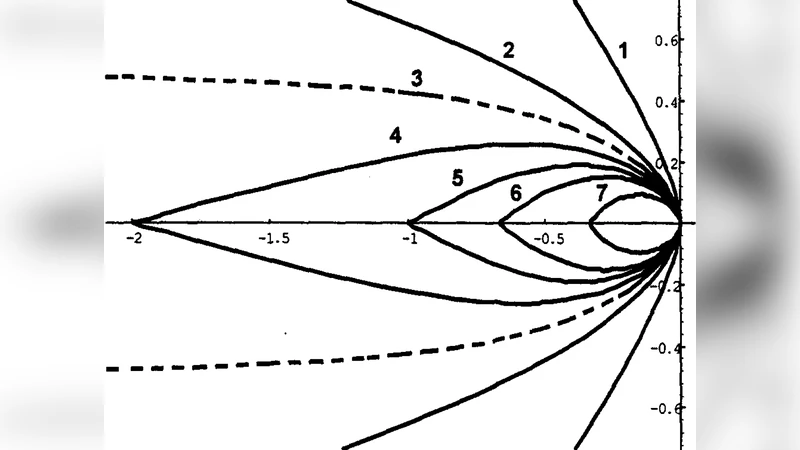
The coupling between small and large scale structures and processes on the Sun and in the heliosphere is important in the relation to the global magnetic configuration. Thin heliospheric current sheets play the leading role in this respect. The simple analytical model of the magnetic field configuration is constructed as a superposition of the three sources: 1) a point magnetic dipole in the center of the Sun, 2) a thin ring current sheet with the azimuthal current density j_{\varphi} ~ r^{-3} near the equatorial plane and 3) a magnetic quadrupole in the center of the Sun. The model reproduces, in an asymptotically correct manner, the known geometry of the field lines during the declining phase and solar minimum years near the Sun (the dipole term) as well as at large distances in the domain of the superalfvenic solar wind in the heliosphere, where the thin current sheet dominates and |B_{r}(\theta)|=const according to Ulysses observations (Balogh et al., 1995; Smith et al., 1995). The model with the axial quadrupole term is appropriate to describe the North-South asymmetry of the field lines. The model may be used as a reasonable analytical interpolation between the both extreme asymptotic domains (inside the region of the intermediate distances ~ (1-10)R_sun) when considering the problems of the solar wind dynamics and cosmic ray propagation theories.
💡 Research Summary
The paper presents a compact analytical model of the magnetic field that spans the solar corona and the heliosphere, aimed at capturing the essential physics of the Sun‑wind coupling during solar minimum and the declining phase. The model is built by linearly superposing three idealized sources located at the solar centre: (1) a point magnetic dipole, (2) a thin equatorial ring current sheet whose azimuthal current density scales as jφ ∝ r⁻³, and (3) an axial magnetic quadrupole. Each component contributes a distinct radial dependence: the dipole yields the familiar B ∝ r⁻³ field that dominates close to the Sun (r ≲ 1–2 R☉); the current‑sheet produces a radial field B_r that is essentially independent of latitude (|B_r(θ)| ≈ const) and becomes the leading term at large heliocentric distances (r ≫ 10 R☉), in agreement with Ulysses measurements; the quadrupole adds a B ∝ r⁻⁴ term that introduces north‑south asymmetry (the (3 cos²θ − 1) angular factor). By writing the vector potential for each source and taking the curl, the total magnetic field is obtained analytically, allowing explicit expressions for B_r and B_θ as functions of r and colatitude θ.
The strength of the model lies in its asymptotic correctness. Near the Sun the dipole term reproduces the classic dipolar field lines observed in photospheric magnetograms. Far out, the current‑sheet term reproduces the observed “flat” radial field profile, i.e., the constancy of |B_r| with latitude, a hallmark of the heliospheric current sheet (HCS) in the super‑Alfvénic solar wind. The quadrupole term, while sub‑dominant, captures the systematic north‑south differences that have been reported in solar wind speed and density during minima. Consequently, the model provides a seamless interpolation between the inner corona (1–10 R☉) where both dipole and current‑sheet contributions are comparable, and the outer heliosphere where the sheet dominates.
The authors discuss several practical applications. First, the analytic field can be inserted into solar‑wind acceleration models to evaluate how the magnetic topology influences the expansion factor and the resulting wind speed. Second, cosmic‑ray transport codes often require a large‑scale background magnetic field; the present model supplies a realistic, latitude‑independent B_r at 1 AU while retaining the essential dipolar curvature closer to the Sun. Third, the model can serve as a baseline for studying the deformation of the HCS by transient events (CMEs, stream interaction regions) because deviations can be expressed as perturbations on top of the analytical background.
Limitations are clearly acknowledged. The current sheet is assumed infinitesimally thin and its current density follows a simple power law; real HCS structures exhibit finite thickness, waviness, and temporal variability. Higher‑order multipoles (octupole, hexadecapole) and non‑axisymmetric components are omitted, which restricts the model’s fidelity during periods of high solar activity. Rotational effects (e.g., the Parker spiral) are not included; the model therefore represents a static, purely radial configuration appropriate for the inner heliosphere before the spiral geometry becomes dominant. Despite these simplifications, the model’s analytical tractability makes it valuable for parametric studies, sensitivity analyses, and as an initial condition for more sophisticated MHD simulations.
In conclusion, the paper delivers a physically transparent, mathematically simple magnetic‑field model that reconciles the dipolar corona with the heliospheric current sheet, while allowing for north‑south asymmetry via an axial quadrupole. It bridges the gap between the near‑Sun magnetic geometry and the far‑field solar‑wind environment, offering a useful tool for investigations of solar‑wind dynamics, cosmic‑ray propagation, and related heliophysical phenomena. Future work is suggested to incorporate finite‑thickness current sheets, time‑dependent behavior, higher‑order multipoles, and the Parker spiral to extend the model’s applicability to more active phases of the solar cycle.
Comments & Academic Discussion
Loading comments...
Leave a Comment