Multilevel Discretized Random Field Models with "Spin" Correlations for the Simulation of Environmental Spatial Data
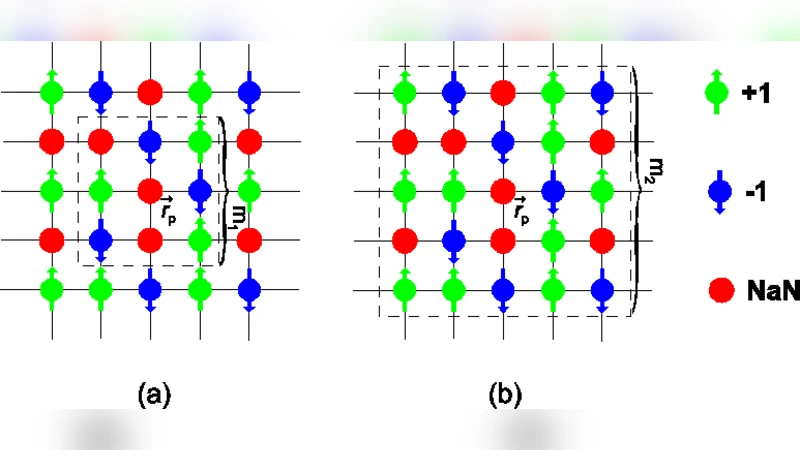
A problem of practical significance is the analysis of large, spatially distributed data sets. The problem is more challenging for variables that follow non-Gaussian distributions. We show that the spatial correlations between variables can be captured by interactions between “spins”. The spins represent multilevel discretizations of the initial field with respect to a number of pre-defined thresholds. The spatial dependence between the “spins” is imposed by means of short-range interactions. We present two approaches, inspired by the Ising and Potts models, that generate conditional simulations from samples with missing data. The simulations of the “spin system” are forced to respect locally the sample values and the system statistics globally. We compare the two approaches in terms of their ability to reproduce the sample statistical properties, to predict data at unsampled locations, as well as in terms of their computational complexity. We discuss the impact of relevant simulation parameters, such as the domain size, the number of discretization levels, and the initial conditions.
💡 Research Summary
The paper tackles the challenging problem of modeling and simulating large spatial datasets that follow non‑Gaussian distributions, a situation common in many environmental applications (e.g., soil moisture, air‑quality indices, satellite‑derived temperatures). Classical geostatistical tools such as ordinary kriging assume Gaussianity and rely on a covariance function to describe spatial dependence. When the underlying field is skewed, heavy‑tailed, or multimodal, a transformation (e.g., Box‑Cox) is usually required, but this introduces bias and often fails to preserve higher‑order moments. To overcome these limitations, the authors borrow concepts from statistical physics—specifically the Ising and Potts spin models—and construct a “multilevel discretized random field” (MDRF) that captures spatial correlations through short‑range spin interactions.
Key methodological steps
-
Multilevel discretization – The continuous field (X(\mathbf{r})) is partitioned into (L) intervals using a set of pre‑defined thresholds ({t_1,\dots,t_{L-1}}). Each interval corresponds to a discrete “spin” level. For the Ising‑based approach each level is represented by an independent binary spin field (S_\ell(\mathbf{r})\in{0,1}); for the Potts‑based approach a single multi‑valued spin field (S(\mathbf{r})\in{1,\dots,L}) is used. This discretization preserves the empirical distribution of the original data because the thresholds can be chosen to match quantiles.
-
Energy (Hamiltonian) formulation – Spatial dependence is introduced by a nearest‑neighbour interaction term. In the Ising case the Hamiltonian is
\
Comments & Academic Discussion
Loading comments...
Leave a Comment