Bibliometric Networks
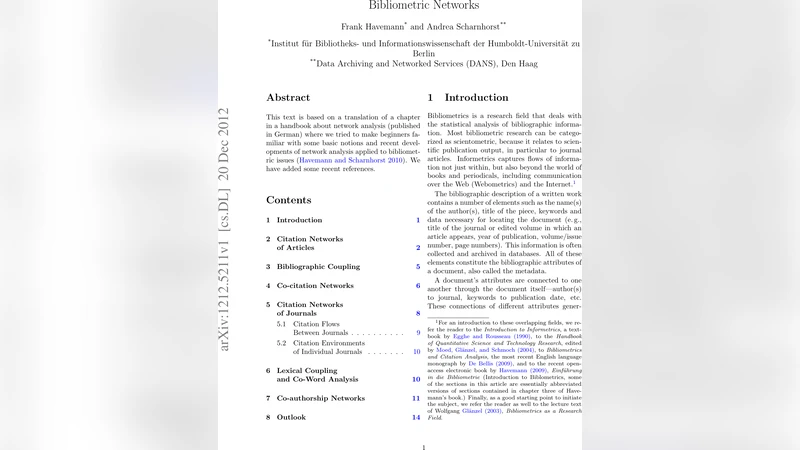
This text is based on a translation of a chapter in a handbook about network analysis (published in German) where we tried to make beginners familiar with some basic notions and recent developments of network analysis applied to bibliometric issues (Havemann and Scharnhorst 2010). We have added some recent references.
💡 Research Summary
The paper “Bibliometric Networks” provides a comprehensive introduction to the application of network analysis techniques within the field of bibliometrics, targeting readers who are new to the topic while also incorporating recent methodological advances. It begins by classifying bibliometric networks into four principal types: citation networks, co‑citation networks, author‑collaboration networks, and keyword (or co‑occurrence) networks. For each type, the authors describe the underlying graph representation, the most appropriate analytical measures, and the typical research questions that can be addressed.
Citation networks are modeled as directed graphs where a directed edge from paper A to paper B indicates that A cites B. The paper discusses classic centrality metrics such as indegree/outdegree, PageRank, HITS, and betweenness, emphasizing how these measures capture not only raw citation counts but also the prestige of the cited sources. The authors illustrate the use of temporal slicing to observe the evolution of citation patterns and to identify seminal works that act as “knowledge hubs” over time.
Co‑citation networks are undirected graphs that connect two papers when they are jointly cited by a third document. This structure reveals thematic similarity and intellectual proximity. The authors explain how modularity‑based community detection (e.g., Louvain, Infomap) and spectral clustering can uncover sub‑fields or research fronts. By applying sliding‑window techniques, one can track the emergence, consolidation, or decline of research topics.
Author‑collaboration networks map co‑authorship relations. Nodes represent scholars, edges indicate joint publications, and edge weights reflect the number of shared papers. The paper highlights measures such as clustering coefficient, core‑periphery structure, and structural equivalence to study the social organization of science. Empirical findings show that a dense core of prolific collaborators often drives the diffusion of new ideas, while peripheral authors tend to join the network through these core members.
Keyword or term co‑occurrence networks capture semantic relationships by linking terms that appear together in the same document. The authors recommend weighting edges with TF‑IDF‑adjusted cosine similarity or Jaccard indices, then applying community detection or topic‑modeling (e.g., LDA) to identify emerging research themes. This approach is particularly useful for detecting rapid shifts in terminology, such as the rise of “big data” or “machine learning” in recent years.
Beyond static analysis, the paper devotes a substantial section to dynamic and multilayer network models. Dynamic networks are constructed by aggregating citations or collaborations within successive time windows, allowing scholars to observe knowledge diffusion rates, citation half‑life, and structural change points. Multilayer networks treat each bibliometric relation (citation, co‑citation, collaboration, keyword) as a separate layer, with inter‑layer edges representing cross‑type interactions. This framework enables the simultaneous study of how, for example, a surge in a particular keyword correlates with changes in collaboration patterns and citation flows.
The methodological toolbox presented includes open‑source visualization platforms (Gephi, Cytoscape, VOSviewer) and programmatic libraries (Python’s NetworkX, R’s igraph). For large‑scale datasets (hundreds of thousands to millions of records), the authors recommend distributed graph processing frameworks such as Apache Spark GraphX and graph databases like Neo4j. They also discuss preprocessing steps—metadata cleaning, disambiguation of author names (using ORCID), and automated labeling of nodes via machine‑learning classifiers (e.g., BERT‑based embeddings).
Two empirical case studies illustrate the concepts. The first examines a ten‑year corpus (2005‑2015) from the Web of Science in a hard‑science domain (e.g., nanotechnology). Results show a highly centralized citation network with a few “hub” papers accounting for a large share of citations, rapid community re‑configuration in co‑citation analysis, and a pronounced international collaboration pattern in the author network. The second case study focuses on a humanities field (e.g., literary studies) over the same period. Here, citation distribution is more dispersed, co‑citation communities evolve slowly, and collaboration remains largely national. Keyword networks in both domains reveal the appearance of new thematic clusters (e.g., “digital humanities” in the humanities case, “graphene” in the nanotech case) that coincide with spikes in both citation activity and co‑authorship.
In the concluding section, the authors acknowledge several limitations. Data quality issues—such as incomplete reference lists, duplicate records, and inconsistent metadata standards—can bias network construction. The lack of standardized extraction algorithms hampers reproducibility across studies. Moreover, purely quantitative network metrics may overlook nuanced, context‑specific interpretations that require qualitative validation (e.g., expert interviews, content analysis). To address these challenges, the paper advocates for interdisciplinary collaboration, the adoption of universal identifiers (DOI, ORCID), and the integration of deep‑learning techniques for automated topic extraction and node labeling.
Overall, “Bibliometric Networks” demonstrates that network analysis offers a powerful lens for visualizing and quantifying the structure, dynamics, and evolution of scientific knowledge. By combining traditional centrality and community‑detection methods with modern dynamic, multilayer, and big‑data approaches, researchers can obtain richer, more timely insights into how ideas spread, how collaborations form, and how research fields transform over time.
Comments & Academic Discussion
Loading comments...
Leave a Comment