NP-Hardness of optimizing the sum of Rational Linear Functions over an Asymptotic-Linear-Program
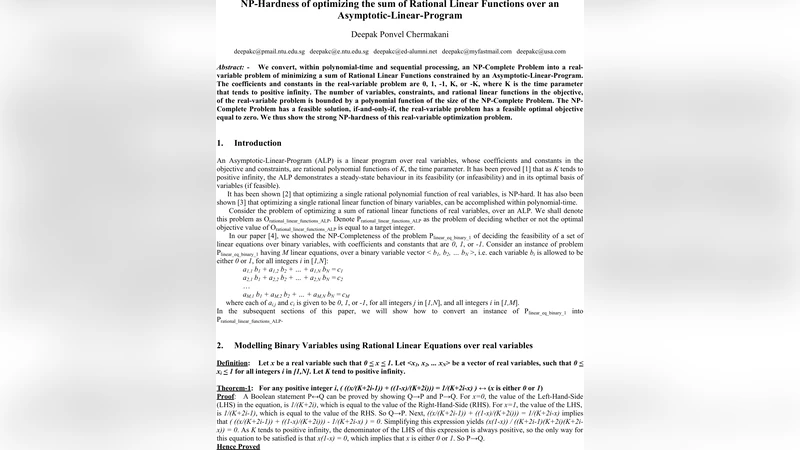
We convert, within polynomial-time and sequential processing, an NP-Complete Problem into a real-variable problem of minimizing a sum of Rational Linear Functions constrained by an Asymptotic-Linear-Program. The coefficients and constants in the real-variable problem are 0, 1, -1, K, or -K, where K is the time parameter that tends to positive infinity. The number of variables, constraints, and rational linear functions in the objective, of the real-variable problem is bounded by a polynomial function of the size of the NP-Complete Problem. The NP-Complete Problem has a feasible solution, if-and-only-if, the real-variable problem has a feasible optimal objective equal to zero. We thus show the strong NP-hardness of this real-variable optimization problem.
💡 Research Summary
**
The paper establishes the strong NP‑hardness of a real‑valued optimization problem that minimizes a sum of rational linear functions subject to an “asymptotic‑linear‑program” (ALP). The authors start from a classic NP‑complete decision problem (e.g., 3‑SAT or Subset‑Sum) and construct, in polynomial time, an equivalent instance of the new optimization problem.
The construction proceeds in three systematic steps. First, each Boolean variable of the source problem is represented by a real variable (x_i). For every clause (or subset constraint) a rational expression of the form
\
Comments & Academic Discussion
Loading comments...
Leave a Comment