Online Myopic Network Covering
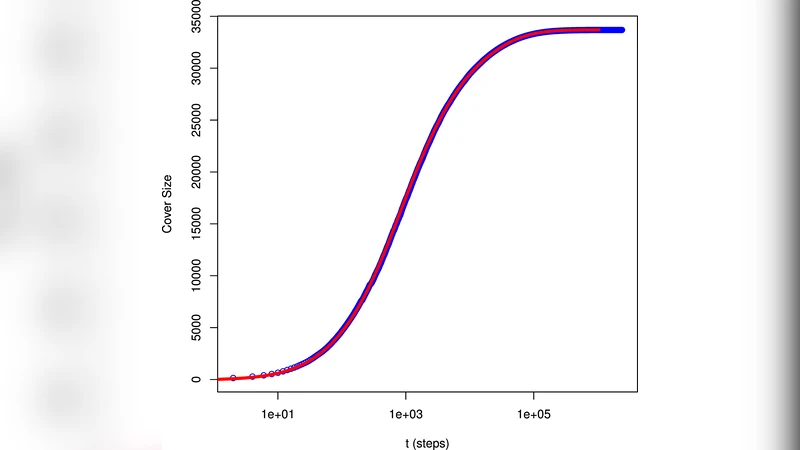
Efficient marketing or awareness-raising campaigns seek to recruit $n$ influential individuals – where $n$ is the campaign budget – that are able to cover a large target audience through their social connections. So far most of the related literature on maximizing this network cover assumes that the social network topology is known. Even in such a case the optimal solution is NP-hard. In practice, however, the network topology is generally unknown and needs to be discovered on-the-fly. In this work we consider an unknown topology where recruited individuals disclose their social connections (a feature known as {\em one-hop lookahead}). The goal of this work is to provide an efficient greedy online algorithm that recruits individuals as to maximize the size of target audience covered by the campaign. We propose a new greedy online algorithm, Maximum Expected $d$-Excess Degree (MEED), and provide, to the best of our knowledge, the first detailed theoretical analysis of the cover size of a variety of well known network sampling algorithms on finite networks. Our proposed algorithm greedily maximizes the expected size of the cover. For a class of random power law networks we show that MEED simplifies into a straightforward procedure, which we denote MOD (Maximum Observed Degree). We substantiate our analytical results with extensive simulations and show that MOD significantly outperforms all analyzed myopic algorithms. We note that performance may be further improved if the node degree distribution is known or can be estimated online during the campaign.
💡 Research Summary
The paper tackles the problem of “network covering” in a realistic setting where the underlying social graph is unknown and must be discovered online as a marketing or awareness campaign proceeds. Traditional work on influence maximization or network covering assumes full knowledge of the graph and focuses on selecting a fixed budget n of seed nodes that maximize the number of distinct individuals reached. This assumption is rarely satisfied in practice; typically a campaign can only query the immediate friends (one‑hop lookahead) of each recruited individual. Under these constraints the authors ask: (1) how can we choose the next seed using only locally observed information so that the expected size of the covered audience is maximized, and (2) can a simple rule approximate the optimal choice when the network follows a heavy‑tailed degree distribution?
Algorithmic contribution – MEED
The authors introduce Maximum Expected d‑Excess Degree (MEED), a greedy online rule that, at each step, computes for every candidate node i the expected number of new neighbors it would reveal if recruited. Let k_i be the degree of i observed so far (i.e., the number of its neighbors already discovered). Assuming a known or estimated degree distribution P(d), the expected excess degree is
\
Comments & Academic Discussion
Loading comments...
Leave a Comment