Hamiltonian Perspective on Compartmental Reaction-Diffusion Networks
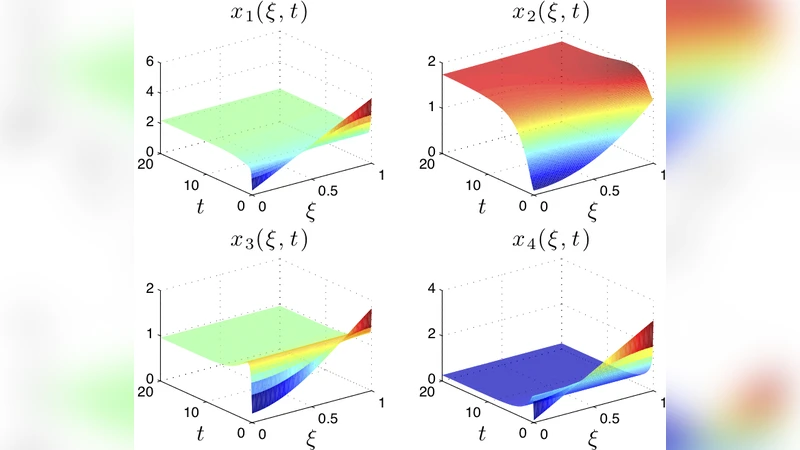
Inspired by the recent developments in modeling and analysis of reaction networks, we provide a geometric formulation of the reversible reaction networks under the influence of diffusion. Using the graph knowledge of the underlying reaction network, the obtained reaction-diffusion system is a distributed-parameter port-Hamiltonian system on a compact spatial domain. Motivated by the need for computer based design, we offer a spatially consistent discretization of the PDE system and, in a systematic manner, recover a compartmental ODE model on a simplicial triangulation of the spatial domain. Exploring the properties of a balanced weighted Laplacian matrix of the reaction network and the Laplacian of the simplicial complex, we characterize the space of equilibrium points and provide a simple stability analysis on the state space modulo the space of equilibrium points. The paper rules out the possibility of the persistence of spatial patterns for the compartmental balanced reaction-diffusion networks.
💡 Research Summary
The paper presents a unified geometric framework for reversible chemical reaction networks that are coupled with diffusion, casting the resulting reaction‑diffusion system into the language of distributed‑parameter port‑Hamiltonian systems. Starting from the graph representation of a reaction network, each species is a vertex and each reversible reaction an edge. The authors introduce a “balanced weighted Laplacian” that encodes the stoichiometry and thermodynamic equilibrium of the reactions; this matrix is generally non‑symmetric but has zero row‑sum, reflecting mass conservation. By employing differential‑geometric tools (exterior derivative, Hodge star, etc.) the continuous partial differential equations governing the spatially distributed concentrations are expressed as a port‑Hamiltonian system: the Hamiltonian is the total Gibbs free energy, the flow variables are the chemical potentials, and diffusion appears naturally through the spatial Laplacian operator.
To make the model amenable to computation, the spatial domain Ω (assumed compact) is triangulated into a simplicial complex. Using finite‑element shape functions and a discrete exterior calculus, the PDE is discretized while preserving the port‑Hamiltonian structure. Each simplex becomes a “compartment” with a single state variable representing the average concentration in that cell. The resulting ordinary differential equation system retains the form (\dot{x}= -L,\nabla H(x)), where L is the sum of the reaction Laplacian (L_r) and the geometric Laplacian (L_s) of the mesh. Crucially, the discretization is energy‑consistent: the discrete Hamiltonian is exactly the sum of the free energies of all compartments, and the inter‑compartment flows are governed by the same balanced Laplacian that appears in the continuous model.
The authors then analyze the equilibrium set. Because (L\mathbf{1}=0), the total amount of material (\mathbf{1}^\top x) is conserved, giving a one‑dimensional nullspace that corresponds to the conservation law. All equilibria satisfy (\nabla H(x)\in\ker(L)); thus the equilibrium manifold is an affine subspace defined by the conserved total mass. A Lyapunov function is constructed from the Hamiltonian, and its time derivative is (\dot V = -\nabla H^\top L \nabla H\le 0). Since all non‑zero eigenvalues of (L) are positive (the reaction Laplacian is balanced and the mesh Laplacian is symmetric positive semi‑definite), the derivative is strictly negative off the conservation direction. Consequently, trajectories converge globally to the equilibrium manifold modulo the conserved quantity, establishing asymptotic stability in the quotient space.
A significant implication of this analysis is the impossibility of Turing‑type pattern formation in “balanced” reaction‑diffusion networks. In classical pattern‑forming systems, diffusion can destabilize a homogeneous steady state because the diffusion matrix introduces eigenvalues with opposite signs to those of the reaction Jacobian. Here, however, the balanced weighted Laplacian guarantees that all non‑zero eigenvalues are positive, and the diffusion Laplacian adds further positive contributions. Hence any spatial perturbation inevitably reduces the Hamiltonian, leading to decay rather than amplification. The paper rigorously proves that no non‑trivial spatial patterns can persist in the compartmental model derived from a balanced network.
Overall, the work bridges the gap between graph‑theoretic reaction network theory and continuum diffusion models, delivering a mathematically rigorous, structure‑preserving discretization that yields compartmental ODE models suitable for simulation and control design. By characterizing the equilibrium space, providing a simple Lyapunov‑based stability proof, and ruling out pattern formation, the authors lay a solid foundation for future extensions such as non‑balanced reactions, nonlinear diffusion, and port‑Hamiltonian optimal control of spatially distributed chemical processes.
Comments & Academic Discussion
Loading comments...
Leave a Comment