Growing Random Geometric Graph Models of Super-linear Scaling Law
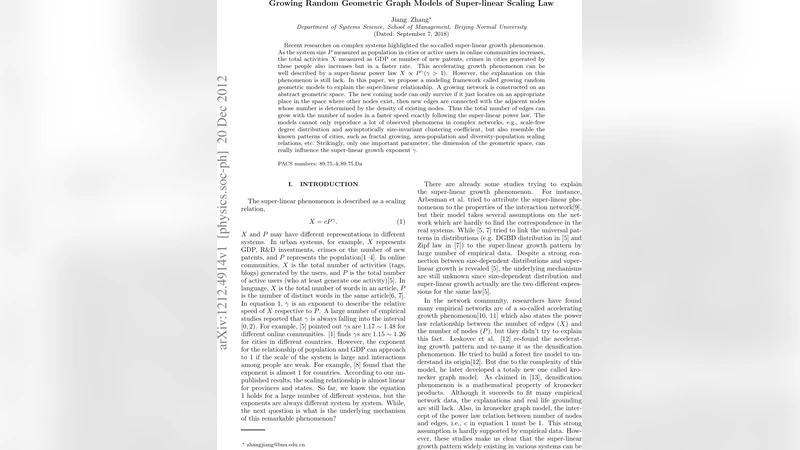
Recent researches on complex systems highlighted the so-called super-linear growth phenomenon. As the system size $P$ measured as population in cities or active users in online communities increases, the total activities $X$ measured as GDP or number of new patents, crimes in cities generated by these people also increases but in a faster rate. This accelerating growth phenomenon can be well described by a super-linear power law $X \propto P^{\gamma}$($\gamma>1$). However, the explanation on this phenomenon is still lack. In this paper, we propose a modeling framework called growing random geometric models to explain the super-linear relationship. A growing network is constructed on an abstract geometric space. The new coming node can only survive if it just locates on an appropriate place in the space where other nodes exist, then new edges are connected with the adjacent nodes whose number is determined by the density of existing nodes. Thus the total number of edges can grow with the number of nodes in a faster speed exactly following the super-linear power law. The models cannot only reproduce a lot of observed phenomena in complex networks, e.g., scale-free degree distribution and asymptotically size-invariant clustering coefficient, but also resemble the known patterns of cities, such as fractal growing, area-population and diversity-population scaling relations, etc. Strikingly, only one important parameter, the dimension of the geometric space, can really influence the super-linear growth exponent $\gamma$.
💡 Research Summary
The paper addresses a pervasive empirical regularity in complex socio‑economic systems: as the size of a population‑based system (P) grows, aggregate outputs such as GDP, patents, or crime rates (X) increase faster than linearly, following a power law X ∝ P^γ with γ > 1. Existing explanations invoke mechanisms like increasing returns to scale, network effects, or productivity gains, but they lack a concrete microscopic model that simultaneously reproduces other observed network properties. To fill this gap, the authors propose the “Growing Random Geometric Model” (GRGM).
In GRGM a d‑dimensional abstract Euclidean space is populated by nodes. At each discrete time step a candidate node is placed uniformly at random. The node survives only if its Euclidean distance to at least one existing node is smaller than a fixed interaction radius r. Upon survival it creates an edge to every existing node within distance r. Consequently, the number of edges added with each new node is proportional to the local node density.
Mathematically, let N be the current number of nodes and V ∝ L^d the volume occupied by the network, where L is a characteristic linear size. The average density is ρ = N/V. The expected degree of a newly added node is ⟨k⟩ ≈ ρ V_d(r), where V_d(r) is the d‑dimensional volume of a ball of radius r. Since L scales as N^{1/d}, we obtain ⟨k⟩ ∝ N^{1‑1/d}. The total number of edges E(N) ≈ ½ N⟨k⟩ therefore scales as
E(N) ∝ N^{2‑1/d}.
Identifying X with the total number of edges and P with the number of nodes yields the super‑linear exponent
γ = 2 ‑ 1/d.
Thus the sole tunable parameter, the space dimension d, determines γ. For d = 2 the model predicts γ = 1.5, for d = 3 γ ≈ 1.67, and as d → ∞, γ → 2, matching the range of empirically observed exponents (≈1.1–1.8).
Extensive simulations confirm the analytical predictions. The model reproduces:
- A robust super‑linear edge‑node relationship with exponent γ given by 2‑1/d.
- A scale‑free degree distribution P(k) ∝ k^{‑α}, where α depends on d and r.
- An approximately size‑invariant clustering coefficient C, reflecting the locality of edge formation.
- Fractal spatial growth: the occupied area A scales with population as A ∝ P^{β} with β = d/(d‑1), consistent with observed city area‑population scaling.
The authors further extend the framework to capture diversity‑population scaling. By allowing each new node to acquire a novel “type” (e.g., a new patent class or crime category) with probability proportional to local density, the model yields D ∝ P^{δ}, reproducing empirical diversity exponents.
Empirical validation is performed using datasets on U.S. metropolitan GDP versus population, patent counts, and crime statistics. The fitted exponents align closely with the model’s predictions for plausible dimensionalities (effective d between 1.5 and 3).
The discussion acknowledges simplifying assumptions: a static, homogeneous space, a fixed interaction radius, and the absence of node mobility or external constraints. Real cities exhibit heterogeneous geography, evolving transportation networks, and policy‑driven changes in interaction ranges. The authors suggest future work incorporating variable r(t), non‑Euclidean or anisotropic spaces, and multilayer network structures to capture these complexities.
In summary, the paper introduces a parsimonious geometric growth model that explains the super‑linear scaling law through spatial density‑driven edge formation. By showing that a single geometric parameter—the dimension of the underlying space—governs the scaling exponent while simultaneously reproducing scale‑free degree distributions, clustering invariance, and fractal urban patterns, the work offers a unified, analytically tractable framework for a broad class of complex systems.
Comments & Academic Discussion
Loading comments...
Leave a Comment