Old and New Reductions of Dispersionless Toda Hierarchy
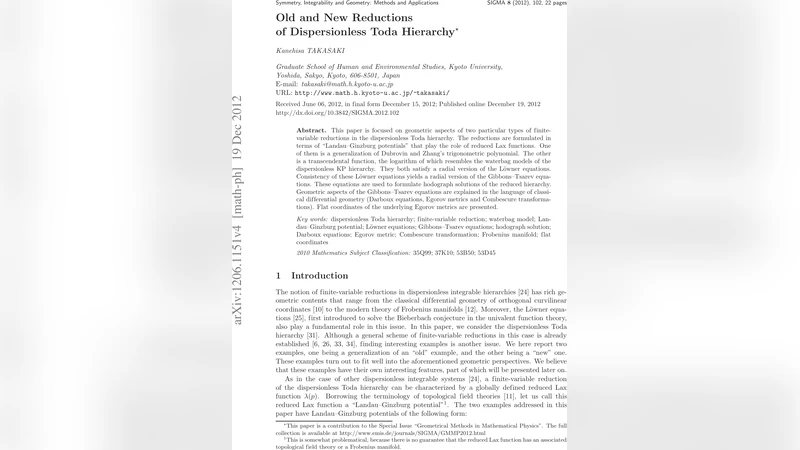
This paper is focused on geometric aspects of two particular types of finite-variable reductions in the dispersionless Toda hierarchy. The reductions are formulated in terms of “Landau-Ginzburg potentials” that play the role of reduced Lax functions. One of them is a generalization of Dubrovin and Zhang’s trigonometric polynomial. The other is a transcendental function, the logarithm of which resembles the waterbag models of the dispersionless KP hierarchy. They both satisfy a radial version of the L"owner equations. Consistency of these L"owner equations yields a radial version of the Gibbons-Tsarev equations. These equations are used to formulate hodograph solutions of the reduced hierarchy. Geometric aspects of the Gibbons-Tsarev equations are explained in the language of classical differential geometry (Darboux equations, Egorov metrics and Combescure transformations). Flat coordinates of the underlying Egorov metrics are presented.
💡 Research Summary
The paper investigates two distinct finite‑dimensional reductions of the dispersionless Toda hierarchy, presenting them in the language of Landau‑Ginzburg potentials that serve as reduced Lax functions. The first potential generalizes the trigonometric polynomial introduced by Dubrovin and Zhang; it combines a polynomial part with exponential terms, allowing a richer parameter space while preserving the algebraic structure of the original hierarchy. The second potential is transcendental: a logarithmic expression reminiscent of water‑bag models in the dispersionless KP hierarchy, where each logarithmic term corresponds to a “bag” parameter.
Both potentials satisfy a radial version of the Löwner equation, which describes how the reduced Lax function evolves as a radial variable (r) changes. The Löwner equation reads schematically as (\partial_{r}\lambda(p)=\frac{\lambda(p)-\lambda(\xi(r))}{p-\xi(r)}), where (\xi(r)) is a driving function determined by the parameters of the potential. Consistency of this flow for all parameters forces the parameters to obey a radial Gibbons‑Tsarev system. This system is a deformation of the classical Gibbons‑Tsarev equations, now containing explicit dependence on the radial variable. It links the characteristic velocities (v^{i}) and the scaling factor (w) of an underlying Egorov metric through relations of the form (\partial_{i}v^{j}=\frac{v^{i}v^{j}}{v^{i}-v^{j}}\partial_{i}\log w) for (i\neq j).
The radial Gibbons‑Tsarev equations enable the construction of hodograph solutions. By integrating the characteristic equations one obtains implicit relations \
Comments & Academic Discussion
Loading comments...
Leave a Comment