Faraday waves in binary non-miscible Bose-Einstein condensates
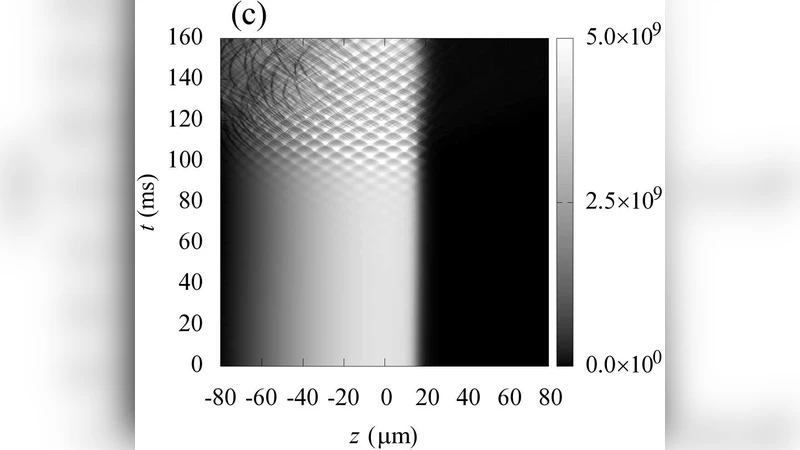
We show by extensive numerical simulations and analytical variational calculations that elongated binary non-miscible Bose-Einstein condensates subject to periodic modulations of the radial confinement exhibit a Faraday instability similar to that seen in one-component condensates. Considering the hyperfine states of $^{87}$Rb condensates, we show that there are two experimentally relevant stationary state configurations: the one in which the components form a dark-bright symbiotic pair (the ground state of the system), and the one in which the components are segregated (first excited state). For each of these two configurations, we show numerically that far from resonances the Faraday waves excited in the two components are of similar periods, emerge simultaneously, and do not impact the dynamics of the bulk of the condensate. We derive analytically the period of the Faraday waves using a variational treatment of the coupled Gross-Pitaevskii equations combined with a Mathieu-type analysis for the selection mechanism of the excited waves. Finally, we show that for a modulation frequency close to twice that of the radial trapping, the emergent surface waves fade out in favor of a forceful collective mode that turns the two condensate components miscible.
💡 Research Summary
This paper investigates the emergence of Faraday‑type surface waves in elongated, binary, non‑miscible Bose‑Einstein condensates (BECs) when the radial confinement is subjected to a periodic modulation. Using extensive three‑dimensional numerical simulations of the coupled Gross‑Pitaevskii equations (GPE) together with an analytical variational treatment, the authors demonstrate that the Faraday instability, previously observed in single‑component condensates, also manifests in two‑component systems under experimentally realistic conditions.
The physical system considered consists of the two hyper‑fine states of ^87Rb atoms, which are tuned to be immiscible by appropriate choices of the intra‑ and inter‑species s‑wave scattering lengths. Two stationary configurations are examined in detail: (i) a dark‑bright symbiotic pair, where one component forms a dense dark soliton at the trap centre while the other component occupies the surrounding region as a bright “halo”. This configuration corresponds to the ground state of the binary mixture. (ii) A spatially segregated state, in which the two components occupy opposite ends of the elongated trap; this is the first excited state of the system. Both configurations have been realized experimentally in similar setups.
The radial trap frequency is taken to be ω_r≈2π×200 Hz, and the confinement is modulated as V(r,t)=½mω_r^2