Placing hidden properties of quantum field theory into the forefront: wedge localization and a new constructive on-shell setting
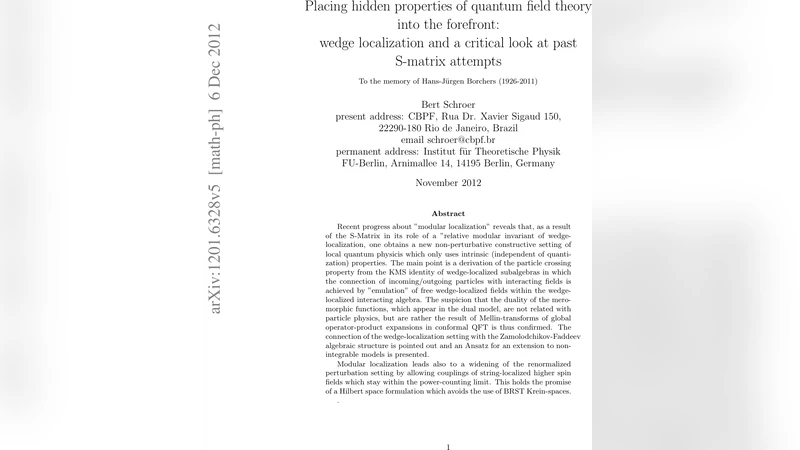
Recent progress about “modular localization” reveals that, as a result of the S-Matrix in its role of a “relative modular invariant of wedge-localization, one obtains a new non-perturbative constructive setting of local quantum physicis which only uses intrinsic (independent of quantization) properties. The main point is a derivation of the particle crossing property from the KMS identity of wedge-localized subalgebras in which the connection of incoming/outgoing particles with interacting fields is achieved by “emulation” of free wedge-localized fields within the wedge-localized interacting algebra. The suspicion that the duality of the meromorphic functions, which appear in the dual model, are not related with particle physics, but are rather the result of Mellin-transforms of global operator-product expansions in conformal QFT is thus confirmed. The connection of the wedge-localization setting with the Zamolodchikov-Faddeev algebraic structure is pointed out and an Ansatz for an extension to non-integrable models is presented. Modular localization leads also to a widening of the renormalized perturbation setting by allowing couplings of string-localized higher spin fields which stay within the power-counting limit. This holds the promise of a Hilbert space formulation which avoids the use of BRST Krein-spaces. .
💡 Research Summary
The paper presents a novel, non‑perturbative construction of local quantum field theory that is based entirely on intrinsic structural properties rather than on any quantization recipe. The central tool is “modular localization,” in particular the localization of observables in a wedge‑shaped region of Minkowski space. For a given wedge W one considers the von Neumann algebra 𝔄(W) generated by all observables that are localized in W. The vacuum state restricted to 𝔄(W) satisfies the Kubo‑Martin‑Schwinger (KMS) condition with inverse temperature β = 2π, i.e. the modular automorphism group of (𝔄(W),|0⟩) is a Lorentz boost that leaves the wedge invariant.
From this KMS identity the authors derive the particle crossing symmetry as a direct consequence of the modular structure. In the usual LSZ framework crossing is an additional analytic property that must be postulated; here it follows automatically because the thermal KMS relation implements the analytic continuation in rapidity that exchanges incoming and outgoing particles.
A key innovation is the notion of “emulation.” Free wedge‑localized fields φ₀(x) have well‑defined creation‑annihilation operators and generate a free wedge algebra 𝔄₀(W). In an interacting theory there is no free field, but one can construct within 𝔄(W) an operator φ̂(x) that reproduces the same commutation relations as φ₀(x) while carrying the full interacting S‑matrix information. In other words, the free field is “emulated” inside the interacting wedge algebra. This provides a bridge between asymptotic particle states (which live in the free Fock space) and the interacting local observables without invoking any perturbative expansion.
The paper also revisits the historic “dual model.” The meromorphic functions that appear there were long thought to encode particle spectra and crossing. The authors show that these functions are in fact Mellin transforms of global operator‑product expansions in conformal field theory; they do not describe scattering amplitudes of any physical particles. This resolves a long‑standing suspicion that the dual model is a mathematical artifact rather than a genuine particle theory.
Extending the construction to non‑integrable models, the authors connect the wedge‑localization framework with the Zamolodchikov‑Faddeev (ZF) algebra. In integrable 1+1‑dimensional theories the ZF algebra encodes the exact S‑matrix through the exchange relation R(θ₁−θ₂) a†(θ₁) a†(θ₂) = a†(θ₂) a†(θ₁) R(θ₁−θ₂). By inserting the S‑matrix into the modular flow of the wedge algebra, they propose an Ansatz that reproduces the ZF exchange relations even when the theory is not integrable. This suggests that the algebraic structure underlying integrable models can be generalized to generic interacting QFTs.
Finally, the authors address the long‑standing power‑counting obstacle for higher‑spin fields. Point‑localized fields with spin s > 1 violate the usual renormalizability bound because their canonical dimension grows with s. By employing string‑localized fields—operators that are localized not at a point but along a semi‑infinite spacelike line—one reduces the short‑distance scaling dimension by one unit per string direction. Consequently, interactions involving spin‑1, spin‑3/2, or even spin‑2 fields can be formulated within the standard Hilbert space without invoking BRST quantization or Krein‑space techniques. This opens a path toward a fully Hilbert‑space‑based quantum theory of gauge and gravitational fields.
In summary, the paper demonstrates that modular wedge localization provides a powerful, model‑independent framework that (i) derives crossing symmetry from the KMS condition, (ii) implements interacting fields through emulation of free wedge fields, (iii) clarifies the non‑physical nature of the dual model’s meromorphic functions, (iv) extends the Zamolodchikov‑Faddeev algebraic insight beyond integrable systems, and (v) widens the perturbative renormalization frontier by allowing string‑localized higher‑spin interactions. The work thus offers a coherent, non‑perturbative blueprint for constructing quantum field theories that remain fully within a positive‑definite Hilbert space, potentially reshaping the foundations of particle physics and quantum gravity.
Comments & Academic Discussion
Loading comments...
Leave a Comment