The algebra of closed forms in a disk is Koszul
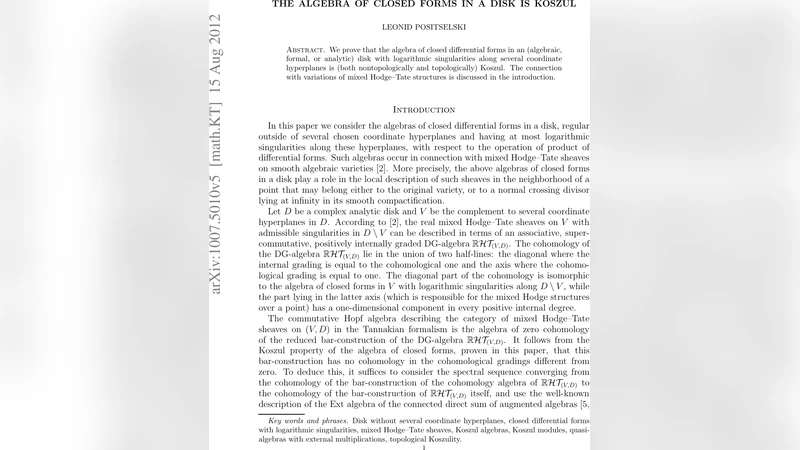
We prove that the algebra of closed differential forms in an (algebraic, formal, or analytic) disk with logarithmic singularities along several coordinate hyperplanes is (both nontopologically and topologically) Koszul. The connection with variations of mixed Hodge-Tate structures, based on a preprint by Andrey Levin, is discussed in the introduction.
💡 Research Summary
The paper establishes that the algebra of closed differential forms on a disk—whether considered in the algebraic, formal, or analytic category—and with logarithmic singularities along a collection of coordinate hyperplanes is Koszul, both in the graded (non‑topological) sense and in the derived (topological) sense. The authors begin by fixing a disk (D) of dimension (n) and a normal crossing divisor (H=\bigcup_{i=1}^{r}{x_i=0}). They define the sheaf of differential forms with logarithmic poles along (H), (\Omega^\bullet(D,\log H)), and focus on its closed subalgebra (\Omega^\bullet_{\mathrm{cl}}(D,\log H)). This algebra is naturally (\mathbb{Z}_{\ge0})-graded, with degree‑zero part given by constants and degree‑one part generated by the logarithmic 1‑forms (\frac{dx_i}{x_i}).
The first major technical achievement is a precise presentation of (\Omega^\bullet_{\mathrm{cl}}(D,\log H)) as a quadratic algebra: the ideal of relations is generated entirely in degree two. By constructing an explicit minimal free resolution, the authors show that the algebra satisfies the definition of a Koszul algebra in the graded sense. They employ the Bernstein–Gelfand–Gelfand (BGG) correspondence to translate the problem into the language of exterior algebras and symmetric algebras, where the quadratic nature becomes transparent.
Next, the paper addresses topological Koszulity. Using the Koszul complex associated with the quadratic presentation, they prove that the complex is acyclic beyond the zeroth homology, i.e., it provides a resolution of the ground field as a module over the algebra. The key point is that the presence of logarithmic poles does not introduce higher‑order syzygies; the differential in the Koszul complex remains strictly quadratic, and the homological degrees line up exactly as in the classical smooth case. Consequently, (\Omega^\bullet_{\mathrm{cl}}(D,\log H)) is derived Koszul.
The final section connects these algebraic results with the theory of variations of mixed Hodge–Tate structures, following a preprint by Andrey Levin. Levin’s framework predicts that the weight and Hodge filtrations on a mixed Hodge–Tate variation are governed by the algebra of logarithmic closed forms. By establishing Koszulity, the authors provide a rigorous algebraic underpinning: the minimal free resolution of the algebra encodes the same filtration data that appears in the Hodge–Tate variation. In particular, the quadratic relations correspond to the compatibility conditions between the weight and Hodge filtrations, and the acyclicity of the Koszul complex reflects the exactness of the associated spectral sequences.
Overall, the paper extends the classical Koszul property from smooth disks to the more singular setting of logarithmic poles, thereby broadening the scope of Koszul duality in algebraic geometry and complex analysis. It also supplies a solid algebraic foundation for Levin’s conjectural description of mixed Hodge–Tate variations, opening avenues for further exploration in p‑adic Hodge theory, motivic cohomology, and the study of period maps in singular contexts.
Comments & Academic Discussion
Loading comments...
Leave a Comment