Network-level dynamics of diffusively coupled cells
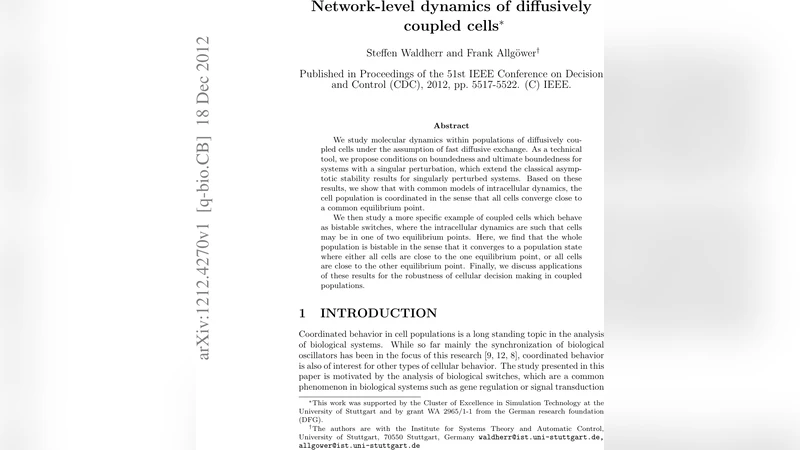
We study molecular dynamics within populations of diffusively coupled cells under the assumption of fast diffusive exchange. As a technical tool, we propose conditions on boundedness and ultimate boundedness for systems with a singular perturbation, which extend the classical asymptotic stability results for singularly perturbed systems. Based on these results, we show that with common models of intracellular dynamics, the cell population is coordinated in the sense that all cells converge close to a common equilibrium point. We then study a more specific example of coupled cells which behave as bistable switches, where the intracellular dynamics are such that cells may be in one of two equilibrium points. Here, we find that the whole population is bistable in the sense that it converges to a population state where either all cells are close to the one equilibrium point, or all cells are close to the other equilibrium point. Finally, we discuss applications of these results for the robustness of cellular decision making in coupled populations.
💡 Research Summary
The paper investigates the dynamics of populations of diffusively coupled cells under the assumption that inter‑cellular diffusion is much faster than intracellular reactions. By treating the system as a singularly perturbed one, the authors first develop new boundedness and ultimate boundedness results that extend classical asymptotic‑stability theorems for singular perturbations. Unlike traditional Tikhonov‑type results that guarantee convergence to an exact equilibrium, these theorems guarantee that the fast diffusion variables remain confined to a small neighborhood (of order ε) and that the slow intracellular states become ultimately bounded within a compact set. The proofs rely on constructing separate Lyapunov functions for the slow and fast subsystems, establishing inequalities that show the fast subsystem decays at a rate 1/ε while the slow subsystem is only weakly perturbed by the residual diffusion error.
Armed with these technical tools, the authors then examine generic intracellular models—single‑species production‑degradation kinetics, low‑dimensional feedback loops, etc.—and demonstrate that, provided the boundedness conditions hold, all cells in the population converge to a common equilibrium point up to an O(ε) error. In other words, the population becomes coordinated: the diffusion coupling forces the state vectors of all cells to collapse onto a thin manifold near a shared steady state. This result formalizes the intuitive notion that rapid exchange of signaling molecules synchronizes the behavior of otherwise heterogeneous cells.
The paper’s most striking contribution lies in the analysis of a bistable intracellular switch. Each cell’s dynamics are described by a nonlinear Hill‑type function that yields two stable equilibria (denoted A and B) separated by an unstable saddle. When cells are coupled through fast diffusion, the collective dynamics exhibit “population‑level bistability”: the entire ensemble converges either to the configuration where every cell is close to equilibrium A or to the configuration where every cell is close to equilibrium B. The authors prove that mixed states—where some cells sit near A and others near B—are exponentially unlikely when diffusion is sufficiently strong, and they quantify the size of the attraction basins using a composite Lyapunov function. Moreover, they show that the population’s bistable response is robust to stochastic perturbations and parameter variations, because the diffusion term continuously suppresses deviations from the consensus manifold.
Finally, the authors discuss several biological implications. First, in tissues where signaling molecules diffuse rapidly, the theoretical results explain how cells can make coherent decisions (e.g., differentiation, apoptosis) despite intrinsic noise. Second, in synthetic biology, engineering a network of bistable switches across many cells can exploit diffusion to achieve a reliable, population‑wide “on/off” state without requiring precise tuning of each individual circuit. Third, the analysis suggests that impairing diffusion (e.g., by altering extracellular matrix properties) could increase heterogeneity in tumor cell populations, potentially contributing to therapy resistance. The paper thus bridges rigorous singular‑perturbation theory with concrete questions in cellular decision‑making, offering a versatile framework for studying synchronization, robustness, and multistability in diffusively coupled biological networks.
Comments & Academic Discussion
Loading comments...
Leave a Comment