Algebra in superextensions of inverse semigroups
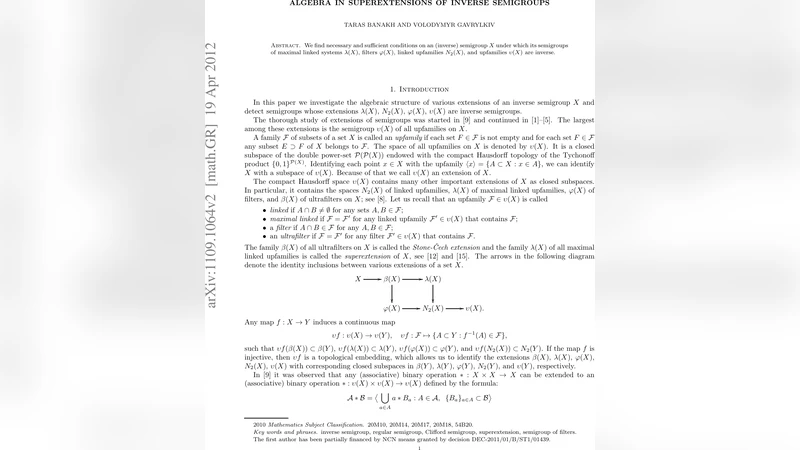
We find necessary and sufficient conditions on an (inverse) semigroup $X$ under which its semigroups of maximal linked systems $\lambda(X)$, filters $\phi(X)$, linked upfamilies $N_2(X)$, and upfamilies $\upsilon(X)$ are inverse.
💡 Research Summary
The paper investigates when various “super‑extensions” of an inverse semigroup X inherit the inverse property. The extensions considered are the semigroup of maximal linked systems λ(X) (the super‑extension), the semigroup of filters ϕ(X), the semigroup of linked up‑families N₂(X), and the semigroup of all up‑families υ(X). The authors give complete necessary and sufficient conditions for each of these extensions to be an inverse semigroup (equivalently, a regular semigroup with commuting idempotents).
The work begins by recalling the construction of the space υ(X) of all up‑families on a set X. An up‑family is a non‑empty family of subsets closed under supersets. The binary operation on υ(X) is defined by
A * B = {⋃_{a∈A} a * B_a : B_a∈B for each a∈A},
which extends any associative binary operation * on X to a right‑topological semigroup structure on υ(X). The subspaces β(X) (ultrafilters), λ(X) (maximal linked up‑families), ϕ(X) (filters), and N₂(X) (linked up‑families) are closed subsemigroups of υ(X).
A key observation is that a semigroup S is inverse iff it is regular (every element x satisfies x∈xSx) and its idempotents commute. Using this, the authors reduce the problem to checking regularity and commutativity of idempotents in each extension. Proposition 3.1 shows that an element x∈X is regular in X exactly when the principal ultrafilter hₓᵢ is regular in υ(X). Consequently, Corollary 3.2 yields that X is inverse iff it embeds into some inverse subsemigroup of υ(X).
The main results are four theorems (Theorems 1.1–1.4) that list precisely which semigroups X make the corresponding extension inverse:
-
Theorem 1.1 (λ‑extension): λ(X) is a commutative Clifford (hence inverse) semigroup iff X is a finite commutative Clifford semigroup isomorphic to one of
C₂, C₃, C₄, C₂×C₂, L₂×C₂, L₁⊔C₂, Lₙ, or C₂⊔Lₙ (n∈ℕ).
Here Cₙ denotes the cyclic group of order n and Lₙ the linear semilattice {0,…,n−1} with min as the operation. -
Theorem 1.2 (filter‑extension): ϕ(X) is inverse iff X is isomorphic to C₂, Lₙ, or Lₙ⊔C₂ for some n.
-
Theorem 1.3 (linked‑up‑family extension): N₂(X) is inverse iff X is isomorphic to C₂ or Lₙ.
-
Theorem 1.4 (full up‑family extension): υ(X) is inverse iff it is a finite semilattice, which happens exactly when X itself is a finite linear semilattice Lₙ.
The “only‑if” directions rely on a combinatorial argument (Proposition 2.1) showing that if the idempotents of β(X) commute then every cyclic subsemigroup and every linear subsemigroup of X must be finite. This eliminates infinite cyclic groups or infinite chains from consideration. The “if” directions are proved by explicit structural analysis of the extensions for the listed X. For each admissible X the authors describe λ(X), ϕ(X), N₂(X), and υ(X) as direct products or ordered unions of well‑understood inverse components, verifying regularity and commutativity of idempotents directly.
Sections 4–6 contain detailed calculations for the “exceptional” small semigroups (C₂, C₃, C₄, C₂×C₂, L₁⊔C₂, L₂×C₂). For instance, λ(C₃) is shown to be isomorphic to L₁⊔C₃, λ(C₄) to (C₂⊔L₁)×C₄, and λ(L₂×C₂) to a product of a six‑element semilattice with C₂. These concrete examples illustrate the general pattern and confirm that no other finite semigroups yield inverse extensions.
The paper also points out an open problem (Problem 1.5): characterizing those X for which the Stone–Čech compactification β(X) is an inverse semigroup. Proposition 2.1 gives a necessary condition (all cyclic and linear subsemigroups of X must be finite), but a full characterization remains unknown.
Overall, the article provides a complete classification of inverse super‑extensions of inverse semigroups, showing that only very restricted finite structures—essentially finite groups of order ≤4, finite Boolean semilattices, and their simple disjoint unions—produce inverse λ, ϕ, N₂, or υ. This contributes to the broader program of understanding how algebraic properties behave under topological compactifications and other “large” extensions.
Comments & Academic Discussion
Loading comments...
Leave a Comment