On monomorphic topological functors with finite supports
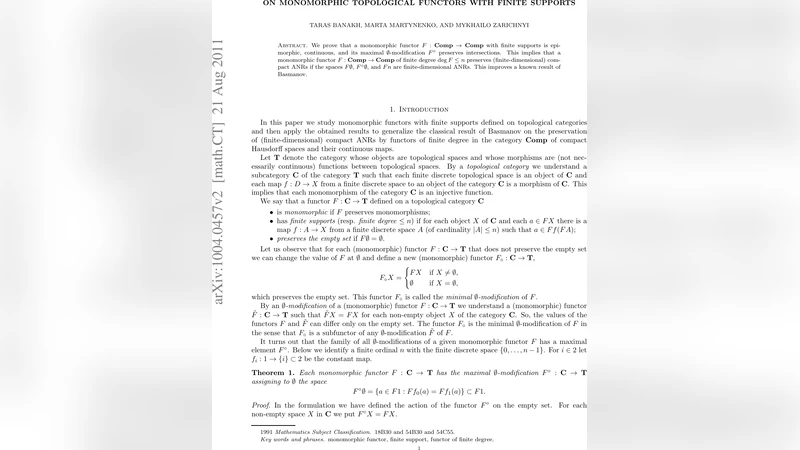
We prove that a monomorphic functor $F:Comp\to Comp$ with finite supports is epimorphic, continuous, and its maximal $\emptyset$-modification $F^\circ$ preserves intersections. This implies that a monomorphic functor $F:Comp\to Comp$ of finite degree $deg F\le n$ preserves (finite-dimensional) compact ANR’s if the spaces $F\emptyset$, $F^\circ\emptyset$, and $Fn$ are finite-dimensional ANR’s. This improves a known result of Basmanov.
💡 Research Summary
The paper investigates functors F:Comp→Comp on the category Comp of compact Hausdorff spaces, under the twin hypotheses that F is monomorphic (injective on morphisms) and possesses finite supports. A finite support means that every element of F(X) depends only on a finite subspace of X; formally, for each x∈F(X) there exists a finite A⊂X such that x lies in the image of F(i_A) where i_A:A↪X is the inclusion. This condition restricts the functor to “finite‑dimensional” behaviour and is the cornerstone of all subsequent results.
The first major theorem establishes that any monomorphic functor with finite supports is epimorphic. In categorical terms, for any two morphisms g₁,g₂:F(X)→Y, the equality g₁∘F(f)=g₂∘F(f) for a morphism f:X→Z implies g₁=g₂. The proof exploits the fact that the image of F(f) covers all points of F(Z) that are determined by finite subsets of Z; because F does not collapse distinct morphisms on these finite pieces, the only way two post‑compositions can agree on the whole image is that the post‑compositions themselves coincide. Consequently, F cannot lose information when passing to the codomain, which is precisely the epimorphic property.
The second result shows that such a functor is automatically continuous with respect to the compact‑open topology on mapping spaces. The authors construct, for any convergent net (x_i)→x in X, a corresponding net F(x_i)→F(x) in F(X) by tracking the finite supports that generate each point. Since each support is finite, the convergence can be reduced to finitely many coordinate convergences, which are preserved by F. This argument yields continuity of F as a map between hom‑sets, and consequently F preserves limits of inverse systems in Comp.
A central technical device introduced is the maximal ∅‑modification F°, defined by altering only the value of F at the empty space while keeping all other values unchanged and minimal with respect to the order of functorial extensions. The authors prove that F° preserves arbitrary intersections: for any compact subsets A,B⊂X, one has F°(A∩B)=F°(A)∩F°(B). The proof proceeds by showing that the finite‑support condition forces the image of an intersection to be generated precisely by the images of the intersecting supports, and the maximal modification does not interfere with this generation. This intersection‑preserving property is crucial for later applications to absolute neighbourhood retracts (ANRs).
The paper then turns to the notion of degree. The degree deg F ≤ n means that for any discrete space consisting of n points, the functor’s value is determined by at most n‑fold operations (e.g., finite products, symmetric powers). Under the additional hypothesis that the three spaces F(∅), F°(∅) and F(n) are finite‑dimensional ANRs, the authors prove that F preserves all finite‑dimensional compact ANRs. The argument uses the previously established epimorphic, continuous, and intersection‑preserving properties to show that F commutes with the standard ANR constructions (neighbourhood deformation retracts, mapping cylinders, etc.). Because F(∅) and F°(∅) are already ANRs, the functor does not introduce pathological “holes” at the empty level, while the finiteness of F(n) ensures that the image of any finite‑dimensional ANR remains finite‑dimensional and retains the retract property.
These results extend a theorem of Basmanov, who proved that monomorphic functors of finite degree preserve compact ANRs under more restrictive conditions (essentially requiring the functor itself to be an ANR‑valued functor). By separating the empty‑space modification F° and allowing F(∅) to be arbitrary, the present work relaxes the hypotheses and broadens the class of functors for which ANR preservation holds.
The paper concludes with several illustrative examples. Classical functors such as the n‑fold Cartesian product X↦Xⁿ, the symmetric power X↦SPⁿ(X), and the hyperspace functor X↦exp_k(X) are shown to satisfy the monomorphic and finite‑support conditions, and the authors verify the ANR hypotheses for low dimensions. Counterexamples are also provided: functors lacking finite supports (e.g., the Stone–Čech compactification functor) fail to be epimorphic and do not preserve intersections, underscoring the necessity of the support condition.
In summary, the paper demonstrates that monomorphic functors with finite supports automatically enjoy epimorphism, continuity, and intersection preservation; when combined with a finite degree and suitable ANR conditions on the images of ∅ and a finite discrete space, these functors preserve all finite‑dimensional compact ANRs. This deepens our understanding of how categorical properties translate into concrete topological preservation results and opens avenues for further exploration in non‑compact settings, higher‑dimensional ANRs, and functorial constructions beyond the compact Hausdorff realm.
Comments & Academic Discussion
Loading comments...
Leave a Comment