Compelled to do the right thing
We use a model of opinion formation to study the consequences of some mechanisms attempting to enforce the right behaviour in a society. We start from a model where the possible choices are not equiva
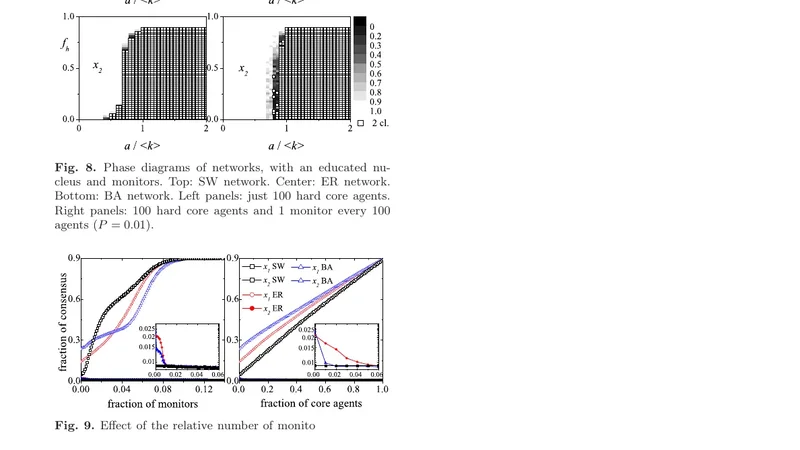
We use a model of opinion formation to study the consequences of some mechanisms attempting to enforce the right behaviour in a society. We start from a model where the possible choices are not equivalent (such is the case when the agents decide to comply or not with a law) and where an imitation mechanism allow the agents to change their behaviour based on the influence of a group of partners. In addition, we consider the existence of two social constraints: a) an external authority, called monitor, that imposes the correct behaviour with infinite persuasion and b) an educated group of agents that act upon their fellows but never change their own opinion, i.e., they exhibit infinite adamancy. We determine the minimum number of monitors to induce an effective change in the behaviour of the social group, and the size of the educated group that produces the same effect. Also, we compare the results for the cases of random social interactions and agents placed on a network. We have verified that a small number of monitors are enough to change the behaviour of the society. This also happens with a relatively small educated group in the case of random interactions.
💡 Research Summary
The paper investigates how two distinct social‑control mechanisms can steer a population toward a “right” behavior in a binary opinion setting where the two options are not equivalent (e.g., complying with a law versus violating it). The authors start from a well‑known opinion‑formation framework in which each of N agents holds an opinion σ ∈ {+1 (compliant), −1 (non‑compliant)} and possesses an “adamancy” parameter a_i that quantifies resistance to changing one’s current stance. At each discrete time step an agent i randomly selects k = 6 partners; if the average opinion of the partners differs from σ_i, the agent may flip with a probability that depends on the ratio of the partners’ persuasive power β to the agent’s adamancy a_i. This baseline captures imitation and personal stubbornness.
Two external constraints are then introduced:
-
Monitors (external authority) – agents that have infinite persuasive power. Whenever an ordinary agent interacts with a monitor, the latter forces the agent to adopt the compliant state (+1) instantly. The fraction of monitors in the population is denoted p_m.
-
Educated group (inflexible agents) – a subset of agents whose adamancy is set to infinity, meaning they never change their opinion (they are permanently compliant). They still influence their neighbors with the same persuasive strength β. The size of this group relative to the whole population is f_e.
The authors explore the dynamics under two interaction regimes:
- Fully mixed (random pairwise interactions) – each interaction is drawn uniformly from the whole population.
- Static networks – agents are placed on three canonical topologies with average degree ⟨k⟩ = 6: (i) Erdős‑Rényi random graph, (ii) Barabási‑Albert scale‑free network, and (iii) Watts‑Strogatz small‑world network. In the network case, agents only interact with their immediate neighbors.
For each configuration the system is initialized with a 50/50 split between compliant and non‑compliant agents. The authors run 10⁴ independent realizations for N = 10 000 agents, measuring (i) the final consensus state (all compliant, all non‑compliant, or mixed), (ii) the average convergence time τ, and (iii) the probability that the compliant fraction exceeds 0.9.
Key findings
-
Monitors alone – In the fully mixed case, a very small proportion of monitors (p_m ≈ 0.03, i.e., 3 % of the population) is sufficient to drive the system to a compliant consensus for virtually any initial condition. In the scale‑free network the required fraction rises to p_m ≈ 0.07 because highly connected hubs can sustain non‑compliant clusters. The small‑world network lies in between with p_m ≈ 0.05. Increasing p_m reduces τ dramatically, indicating a strong “viral” effect of the authority.
-
Educated group alone – In the random mixing scenario, an educated core of about f_e ≈ 0.12 (12 % of agents) is enough to tip the balance toward compliance. The effect is weaker on structured networks: the scale‑free topology needs f_e ≈ 0.20, while the small‑world requires f_e ≈ 0.15. The educated agents act as permanent sources of the compliant opinion, gradually eroding dissenting clusters.
-
Combined mechanisms – When monitors and educated agents coexist, a synergistic effect appears. For example, p_m = 0.02 together with f_e = 0.08 yields a compliant consensus in >90 % of runs and cuts the convergence time by roughly 30 % compared with either mechanism alone. This demonstrates that a modest authority complemented by a modestly sized inflexible core can achieve results comparable to a much larger single‑type intervention.
-
Convergence dynamics – τ decreases monotonically with both p_m and f_e, but the slope is steeper for monitors. The presence of highly clustered neighborhoods (small‑world) slows down the spread of compliance unless the intervention fraction is sufficiently large.
Policy implications
The model suggests two viable pathways for societies to enforce desirable norms:
-
Direct enforcement – Deploy a small cadre of highly persuasive monitors (e.g., law‑enforcement officers, automated compliance checks). Although costly per individual, the required number is low, and the effect is rapid.
-
Cultural/educational anchoring – Invest in a permanent, well‑educated minority that never deviates from the target norm (e.g., teachers, community leaders, media influencers). This strategy is less expensive per capita and, in environments where interactions are largely random (online platforms, large urban settings), can achieve compliance with a modest fraction of the population.
In tightly knit or hierarchical networks (familial, workplace, or tightly coupled online communities), both strategies need to be scaled up, reflecting the higher resilience of dissenting clusters in such structures.
Conclusion
By extending an opinion‑formation model with asymmetric options, personal stubbornness, and two distinct external controls, the authors quantitatively demonstrate that a small number of monitors or a modestly sized inflexible core can each, and especially together, steer a whole society toward the “right” behavior. The work bridges statistical‑physics modeling with practical considerations for law‑making, public‑policy design, and social engineering, highlighting the importance of both top‑down authority and bottom‑up cultural reinforcement.
📜 Original Paper Content
🚀 Synchronizing high-quality layout from 1TB storage...