Transition Path, Quasi-potential Energy Landscape and Stability of Genetic Switches
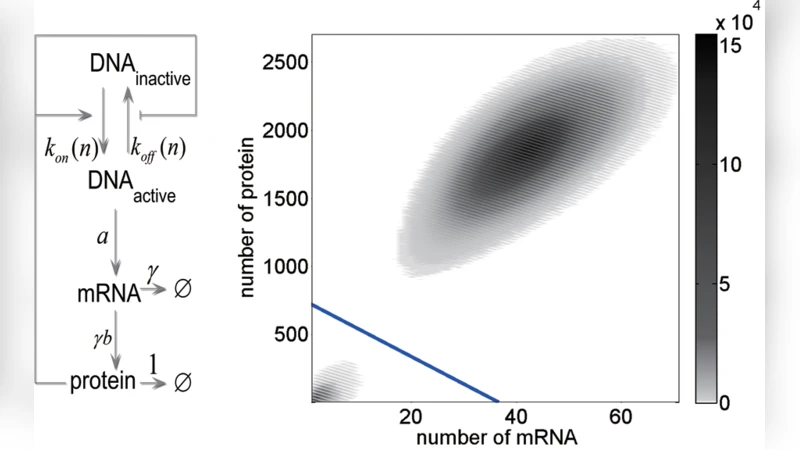
One of the fundamental cellular processes governed by genetic regulatory networks in cells is the transition among different states under the intrinsic and extrinsic noise. Based on a two-state genetic switching model with positive feedback, we develop a framework to understand the metastability in gene expressions. This framework is comprised of identifying the transition path, reconstructing the global quasi-potential energy landscape, analyzing the uphill and downhill transition paths, etc. It is successfully utilized to investigate the stability of genetic switching models and fluctuation properties in different regimes of gene expression with positive feedback. The quasi-potential energy landscape, which is the rationalized version of Waddington potential, provides a quantitative tool to understand the metastability in more general biological processes with intrinsic noise.
💡 Research Summary
This paper addresses the fundamental problem of how genetic regulatory networks drive transitions between distinct cellular states in the presence of both intrinsic and extrinsic noise. The authors focus on a minimal two‑state genetic switch model that incorporates positive feedback, a motif known to generate bistability in gene expression. Starting from the master equation that governs the stochastic dynamics of the switch, they apply a Wentzel‑Kramers‑Brillouin (WKB) approximation combined with large‑deviation theory to rewrite the probability distribution in the exponential form P(x) ≈ exp
Comments & Academic Discussion
Loading comments...
Leave a Comment