Parameterized Metatheory for Continuous Markovian Logic
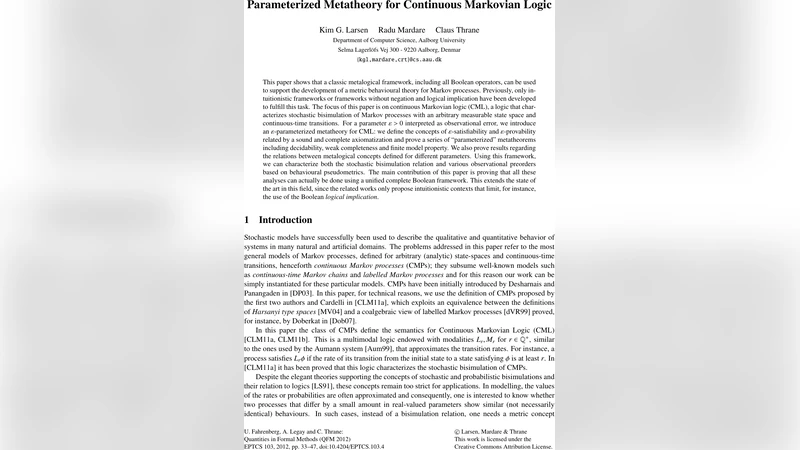
This paper shows that a classic metalogical framework, including all Boolean operators, can be used to support the development of a metric behavioural theory for Markov processes. Previously, only intuitionistic frameworks or frameworks without negation and logical implication have been developed to fulfill this task. The focus of this paper is on continuous Markovian logic (CML), a logic that characterizes stochastic bisimulation of Markov processes with an arbitrary measurable state space and continuous-time transitions. For a parameter epsilon>0 interpreted as observational error, we introduce an epsilon-parameterized metatheory for CML: we define the concepts of epsilon-satisfiability and epsilon-provability related by a sound and complete axiomatization and prove a series of “parameterized” metatheorems including decidability, weak completeness and finite model property. We also prove results regarding the relations between metalogical concepts defined for different parameters. Using this framework, we can characterize both the stochastic bisimulation relation and various observational preorders based on behavioural pseudometrics. The main contribution of this paper is proving that all these analyses can actually be done using a unified complete Boolean framework. This extends the state of the art in this field, since the related works only propose intuitionistic contexts that limit, for instance, the use of the Boolean logical implication.
💡 Research Summary
The paper presents a unified Boolean metatheory for Continuous Markovian Logic (CML) that incorporates an observational error parameter ε > 0. By treating ε as a tolerance for discrepancies between the true transition rates of a continuous‑time Markov process and the rates assumed by an observer, the authors define two new semantic notions: ε‑satisfiability (⊨ε) and ε‑provability (⊢ε). ε‑satisfiability means that a CML formula holds up to an error of ε, while ε‑provability is obtained by adapting the standard CML axioms and inference rules with ε‑adjustments, preserving all Boolean connectives (∧, ∨, ¬, →).
The central technical result is a sound and complete axiomatization linking ⊨ε and ⊢ε for every ε. This bridges the gap between syntax and semantics in a setting where quantitative imprecision is explicitly modeled, something that earlier intuitionistic or negation‑free approaches could not achieve.
Beyond completeness, the authors establish several “parameterized” metatheorems. First, they prove decidability: given a CML formula φ and a rational ε, one can algorithmically determine whether φ is ε‑satisfiable. The decision procedure reduces the problem to a finite‑state automaton construction that respects the ε‑tolerance. Second, they show weak completeness: any formula that is ε‑satisfiable can be derived in the ε‑provability system, even when the underlying Markov model is infinite. Third, they demonstrate the finite model property: for each ε, if a formula is ε‑satisfiable then there exists a finite Markov chain (with a bounded number of states depending on the size of the formula and ε) that witnesses the satisfaction. These results collectively provide a solid foundation for automated reasoning tools.
A particularly insightful contribution is the systematic analysis of the relationships between different ε‑levels. The paper proves monotonicity: if ε₁ < ε₂ then ⊨ε₂ ⊇ ⊨ε₁ and ⊢ε₂ ⊇ ⊢ε₁. This monotone hierarchy allows one to view ε as a dial that gradually weakens the observational preorder: larger ε yields coarser equivalence classes. By interpreting the distance d(s, t) between two states as the infimum ε for which s and t satisfy the same set of formulas under ⊨ε, the authors recover the standard behavioral pseudometric used in quantitative verification. In the limit ε → 0, ε‑bisimulation collapses to exact stochastic bisimulation, showing that the parameterized framework subsumes the classical qualitative theory.
Overall, the work demonstrates that a full Boolean logic, equipped with an ε‑parameter, can simultaneously capture exact stochastic bisimulation, approximate bisimulation, and a whole spectrum of observational preorders derived from behavioral pseudometrics. This unifies previously fragmented approaches—intuitionistic logics lacking negation or implication—into a single, expressive, and mathematically robust system. The metatheoretical guarantees (decidability, weak completeness, finite model property) make the framework attractive for practical applications such as model checking, controller synthesis, and quantitative analysis of stochastic systems.
Comments & Academic Discussion
Loading comments...
Leave a Comment